sutikshan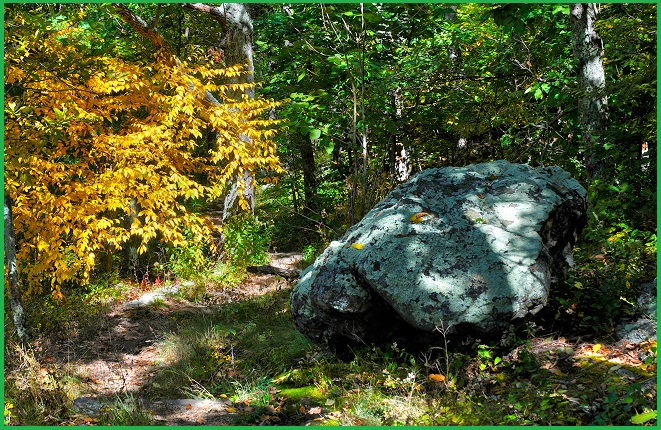
Catoctin Greenstone, Virginia
Catoctin Greenstone formation, located in the Blue Ridge Province of northern Virginia, Maryland, and southern Pennsylvania. The Formation is a thick sequence of greenstone and interbedded sedimentary rocks. The Catoctin Formation is characterized by a diverse suite of metabasalt, metarhyolite, and porphyritic rocks. Notable structural and volcanic features include columnar jointing, low-dipping primary joints, and flow breccias, alongside amygdules and sedimentary dikes. Evidence of its volcanic origins is further supported by the presence of columnar basalts and greenstone dikes.
In this region, the Catoctin Formation rests unconformably upon granitic basement rocks. The thickness of its basal sedimentary layer varies significantly, from a few inches to 150 feet, and includes pebbles derived from the underlying plutonic rocks. The pre-Catoctin erosional surface is highly irregular; in several locations, ancient hills with elevations up to 750 feet were entirely submerged by Catoctin lavas. Given the lack of a significant temporal break between the Catoctin and the overlying Cambrian sediments, the formation is likely early Cambrian in age.
Geology
Positioned between the Chilhowee Group and the ancient basement complex (1.2-1.0 Ga), the Catoctin Formation maintains a thickness of approximately 100-400 feet. It is bounded by distinct unconformities both at its contact with the underlying granitic basement and the overlying Loudoun Formation (Chilhowee Group ). Metamorphic processes have transformed the unit’s original lithology into metabasalts—often paired with amygdalar layers and minerals such as quartz, calcite, and epidote—and metarhyolites associated with breccia and purple slate. Additionally, the formation hosts folded and altered hornblende-calcite schist and greenstone. The underlying basement rock, which exhibits a significant unconformity with the Catoctin, consists of a diverse suite of granite, anorthosite, quartz monzonite, syenite, and paragneiss.
Features
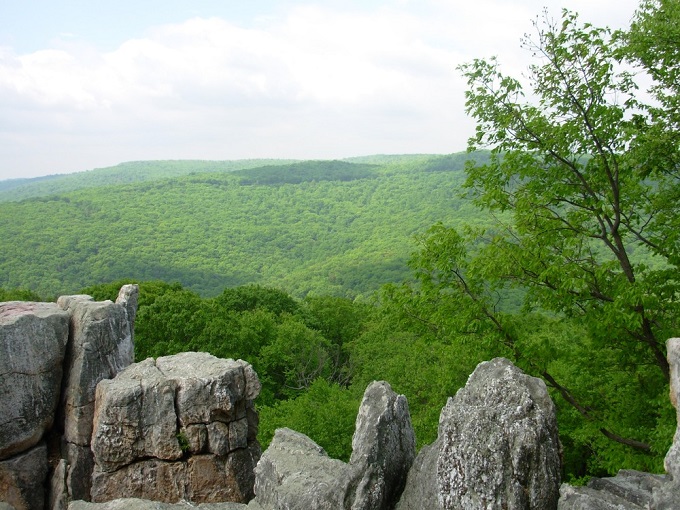
The Catoctin Formation exhibits a diverse array of geological features, most notably columnar and low-dipping jointing, flow breccias, and sedimentary dikes. Additionally, the unit is characterized by the presence of amygdaloids, greenstone dikes, and distinctive purple volcanic slate.
Also read- Discover the Rare Magic of Raiyoli Dinosaur Fossil Park in Gujarat
Volcanic features include dikes of greenstone and Purple volcanic slate. Apart from this some sedimentary structures can be seen, like flow breccias, Sedimentary dikes.
Primarily characterized by a fine-grained, massive structure, the Catoctin Formation exhibits slaty or mylonitic textures in localized areas of deformation. Quartz, feldspar, and epidote are prevalent throughout the unit, occurring as both veins and masses; however, these features are frequently obscured by chlorite in zones of intense foliation. While hydrothermal alteration is generally fine-grained, localized areas contain large feldspar clasts that dominate the rock fabric. Additionally, the formation features elliptical amygdules primarily filled with quartz, feldspar, and epidote, though accessory minerals such as hematite, chlorite, chalcopyrite, malachite, and zeolite are also present.
Also read- Geotourism And Modern Geotechniques
How to Reach Catoctin Greenstone, Virginia
The best places to view or reach the Catoctin Greenstone in Virginia are primarily within Shenandoah National Park along Skyline Drive, with prominent exposures at the Greenstone Overlook (Milepost 8.8) and near Stony Man (near Thornton Gap). Access the area via I-66 or US-211 to the park entrances, followed by hiking the Appalachian Trail or taking short, self-guided loops from overlooks.