sutikshan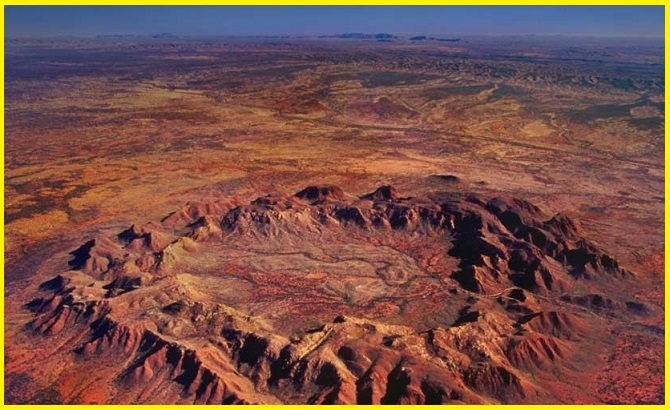
Gosse Bluff
Gosses Bluff is considered the eroded remnant of an impact crater. Located in the southern Northern Territory of Australia, it lies about 175 km west of Alice Springs. It was named in 1872 by Ernest Giles after Henry Gosse, the brother of explorer William Gosse.
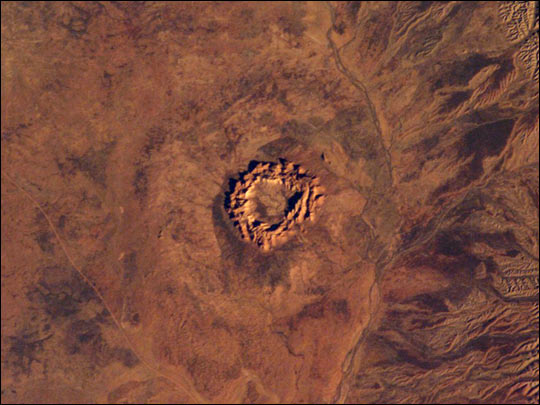
The Crater, situated between the Macdonnell Range (to the north) and the James Range (to the south), is one of the most intensively studied impact craters in the country. The feature was created about 142 million years ago by the collision of an asteroid or comet, estimated to be 1 km in diameter.
The crater’s most distinct element is an isolated, circular central ring of hills measuring about 4.5 km across. The grayish feature surrounding this inner ring likely delineates the original boundary of the outer crater rim.
Gosse Bluff Crater
Formed approximately 142.5 million years ago by the impact of an asteroid or comet, the original Gosses Bluff crater dates back to the earliest Cretaceous period, near the Jurassic–Cretaceous boundary. While the original rim was an estimated 22 km in diameter, it has since eroded. The visible, 5 km diameter, 180 m high feature is now interpreted as the eroded relic of the crater’s central uplift.
Also read- Murphy’s Haystacks: A Breathtaking Granite Inselbergs of Australia
The theory that the feature was formed by an impact was first proposed in the 1960s, primarily supported by the abundance of shatter cones. The site has also been subject to petroleum exploration, leaving behind two abandoned wells near its center.
Cultural
Known to the Western Arrernte Aboriginal people as Tnorala, the site is a sacred place and is now preserved within the Tnorala Conservation Reserve. According to a Western Arrernte Dreamtime story, its origins stem from a cosmic impact that occurred when a group of celestial women were dancing as stars in the Milky Way.
Tnorala Gosse Bluff Conservation Reserve
Tnorala (Gosses Bluff) Conservation Reserve holds great cultural significance for the Western Arrernte Aboriginal people and is also a site of international scientific interest. As a registered sacred site, the traditional owners welcome visitors to experience the magic of Tnorala, provided that guests respect the area and adhere to the restricted access signs.
Also Read- Geotourism And Modern Geotechniques
Scientific consensus suggests that approximately 142.5 million years ago, an object, likely a comet, created a crater roughly 20 kilometers across. Due to erosion and the lowering of the land surface by about 2 km, the bluff today is an eroded remnant, measuring only approximately 5 km in diameter. The remnant crater was named Gosses Range in 1872 by explorer Ernest Giles after H. Gosse, a Fellow of the Royal Society. Intriguingly, both the Aboriginal and scientific interpretations of the Bluff share a celestial origin.
How to Reach Gosse Bluff
To reach Gosse Bluff, drive west from Alice Springs along either Larapinta Drive or Namatjira Drive until you reach the turn-off for the conservation reserve. A four-wheel-drive (4WD) vehicle is recommended for the final dirt road portion, which can become impassable after heavy rain. The reserve is approximately 175 km from Alice Springs and contains a picnic area for visitors.