sutikshan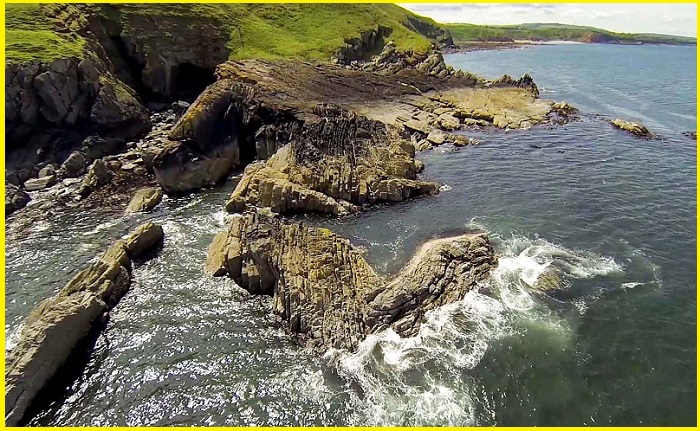
Siccar Point, Scotland
Siccar Point is a rocky headland situated in Berwickshire on the eastern coast of Scotland. It is well known in the history of geology for Hutton’s Unconformity, discovered in 1788, which James Hutton regarded as strong evidence supporting his theory of Uniformitarianism in geological development.
Loction
Siccar Point lies within the parish of Cockburnspath, Scotland. The ruins of the old parish church, St Helen’s Chapel, stand about one kilometre west of the point.
Many geological formations, such as the Old Red Sandstone and greywacke, are located near the Siccar Point. Also believed that the medieval village of Old Cambus was once located closer to Siccar Point than the present-day hamlet of the same name.
Hutton’s Unconformity
James Hutton discovered Siccar Point on a boat journey in 1788. The geologist James Hutton observed the striking angular unconformity exposed at the site. He later explained that the rock formations provided convincing evidence for the theory of Uniformitarianism, which states that the natural laws and geological processes operating today have always functioned in the same way throughout Earth’s history. A letter on the International Union of Geological Sciences included Siccar Point as one of the first 100 Global Geological Heritage Sites, a list published in October 2022.
Also Read- Earth’s Magnetic Field Reversal: The Fascinating Fact
Siccar Point Geology
At this location, nearly vertical marine sandstones of the early Silurian Period (Llandovery Epoch, about 440 million years ago) are overlain unconformably by gently inclined terrestrial sandstones of the late Devonian Period (about 375 million years ago). The gap between these rock sequences represents roughly 65 million years of geological history, spanning the tectonic closure of the Iapetus Ocean, which once separated Scotland from England, and the formation of vast mountain ranges to the northwest.
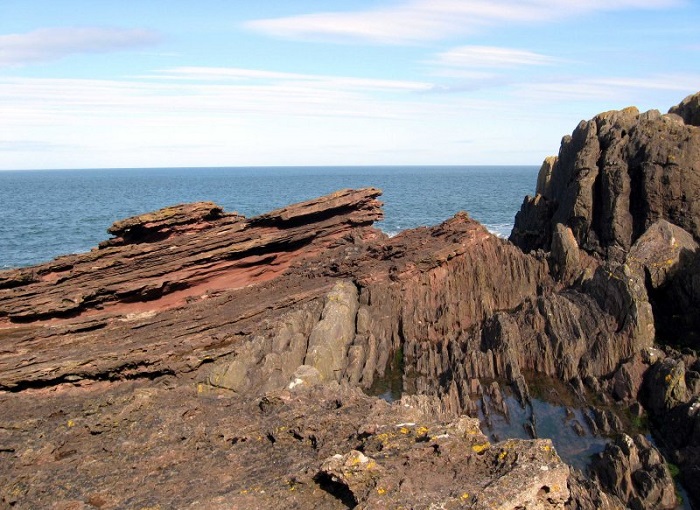
The Silurian sediments were originally deposited on the sea floor, then buried and transformed into solid rock. Later, they were folded, uplifted, and eroded to form a relatively flat surface. Eventually, this surface was covered by Devonian sediments that were transported southward from the erosion of nearby mountains. Subsequent tectonic movements gently tilted the entire sequence to its present northward inclination.
Also Read- Geotourism And Modern Geotechniques
Before the Late Devonian, prolonged erosion created an uneven land surface with significant palaeorelief due to the different weathering and erosion rates of individual Silurian beds. In this landscape, the wacke sandstones stood out more prominently than the surrounding layers. Resting on this sharp angular unconformity are Upper Devonian deposits of reddish-brown breccia and conglomerate belonging to the Redheugh Mudstone Formation of the Stratheden Group. Unlike the steeply inclined Silurian rocks below, these younger Devonian strata dip only gently, reflecting the later and comparatively weaker effects of the Variscan Orogeny.
How to reach Siccar point
Siccar Point lies near the village of Cockburnspath, overlooking the North Sea. Drive along small rural roads toward Siccar Point and then walk about 20–30 minutes across farmland to reach the cliff viewpoint. The nearest major airport is Edinburgh Airport. Dunbar Train Head is Berwick-upon-Tweed Railway Station.