sutikshan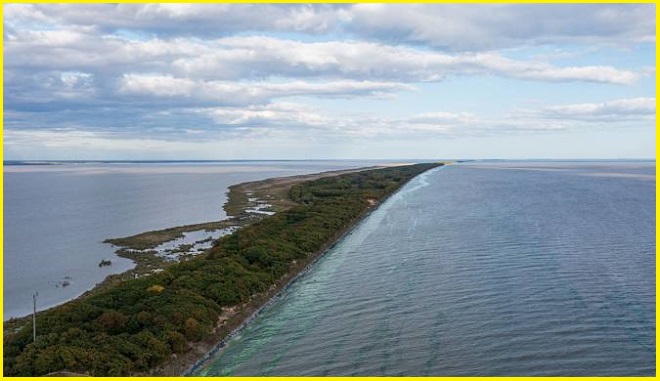
Lake Khanka
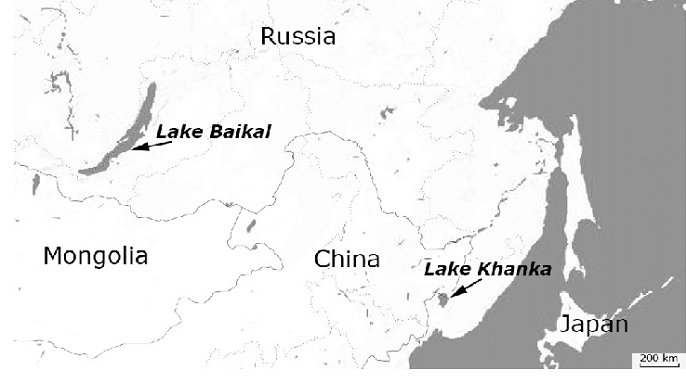
Lake Khanka or Lake Xingkai is a freshwater lake located on the border of Primorsky Krai in Russia and Heilongjiang Province in Northeast China (45°0′N 132°25′E). Lake Khanka, the largest lake in Primorsky Krai, lies at the center of the Khankan Lowland, straddling the border with China’s Heilongjiang Province. Its northern section falls within Chinese territory. The lake has a pear-shaped form with an extension toward the north, and its surface area fluctuates significantly with climate conditions, ranging from a maximum of 5,010 km² to a minimum of 3,940 km². It stretches about 90 km in length and reaches a maximum width of 67 km. A total of 24 rivers flow into the lake, while only one river, the Songacha, carries water out, linking Lake Khanka to the Ussuri River and ultimately to the Amur River system.
Lake Khanka is relatively shallow, with an average depth of 4.5 meters and a typical range of 1–3 meters; its maximum depth reaches 10.6 meters. The lake holds an average volume of 18.3 km³, which can increase to as much as 22.6 km³. The water is often cloudy due to frequent winds that cause strong mixing. Each year, the lake receives an inflow of about 1.94 km³ of water, while its outflow through the Songacha River averages around 1.85 km³.
Lake Khanka Map
This lake, located in southern East Siberia, is the largest and deepest freshwater lake in the world, holding about 20% of the planet’s unfrozen freshwater reserves.
Ramsar sites
Lake Khanka, is one of the largest freshwater lakes in Far Eastern Russia and China and plays a vital role in regional biodiversity. It serves as a critical freshwater source for birds, especially waterfowl, and supports some of the highest levels of avian diversity in Eurasia. The lake also harbors a rich variety of freshwater fish and aquatic species, including a significant population of the rare Chinese soft-shelled turtle.
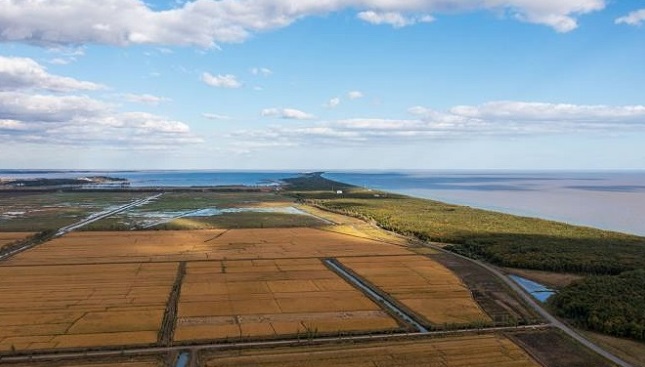
The surrounding landscape consists of open lowlands, wetlands, grassy meadows, and swamps, which provide habitats for numerous rare and endangered plants. Recognized for its ecological importance, Lake Khanka has been designated a Ramsar Wetland of International Importance and is also part of UNESCO’s World Network of Biosphere Reserves, underscoring its global significance for conservation and sustainable use.
Lake Khanka Frozen Waterfall
There is no specific landmark called the “Lake Khanka Frozen Waterfall.” Instead, frozen waterfalls are natural ice formations that can occur in various regions, including areas near Lake Khanka’s basin in Russia and China. More renowned examples include the Drung Waterfall in India and the Vilyuchinsky Waterfall in Russia. Such formations occur when waterfalls freeze in cold weather, though water often continues to flow beneath the ice.
Also read- The Painted Hills-Where Volcanoes Painted the Land
Near Lake Khanka Basin (Russia–China): Although Lake Khanka itself is a freshwater lake, the surrounding region is renowned for its natural beauty. In winter, some of the local waterfalls may freeze due to the area’s extremely low temperatures.
Drung Waterfall (Kashmir, India): A popular tourist attraction, this waterfall is famous for freezing completely during the winter months, creating a striking natural ice formation.
Vilyuchinsky Waterfall (Kamchatka, Russia): Standing about 40 meters tall, this scenic waterfall is another well-known site that can freeze in winter, forming an impressive icy spectacle.
How to Reach Lake Khanka
To reach Lake Khanka, fly to Jixi Xingkaihu Airport (JXA) and continue by ground transport—such as a hired car or taxi—to the lake. You can compare fares to JXA and book tickets through online travel agencies to find the best rates.