sutikshan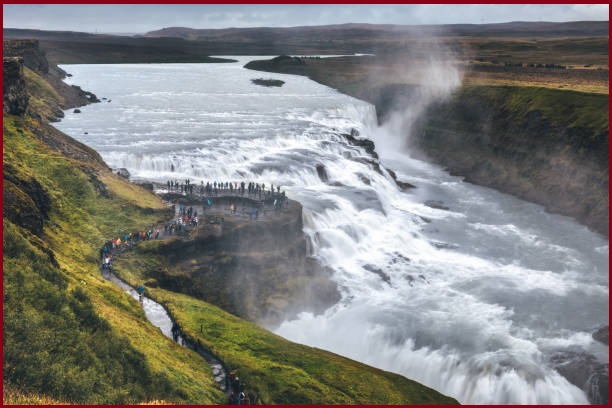
Gullfoss
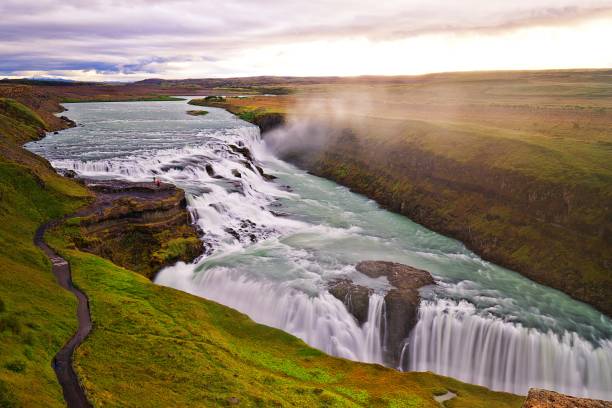
Gullfoss, meaning ‘Golden Falls’ in Icelandic, stands as one of Iceland’s most iconic and cherished waterfalls, nestled within the Hvítá River canyon in Southwest Iceland. The Hvítá River flows southward until about a kilometer above Gullfoss, where it sharply turns westward. Here, it cascades down a wide, curved three-step “staircase” before plunging abruptly in two stages—first 11 meters, then 21 meters into a deep crevice measuring 32 meters in depth. The crevice, approximately 20 meters wide and 2.5 kilometers long, runs perpendicular to the river’s flow. In summer, the waterfall carries an average of 141 cubic meters of water per second, reducing to 80 cubic meters per second in winter. The highest recorded flood reached 2,000 cubic meters per second.
How These Waterfall Forms and Geology
It is thought that, Over time, the Hvítá River has carved its way through the landscape, with the canyon gradually forming since the melting of glaciers at the end of the ice age. The geological layers the waterfall falls over were all formed during the warm period of the ice age. In the waterfall’s ridges are dolerite layers, and between them is a sediment layer almost 10 m thick made from conglomerate rock, mudstone, and gravel on the top. All the sediment layers, except the gravel layer, are well bonded. The visible thickness of the gravel layer in the Golden Waterfall is 8 m, but it is 40 m at the front of the canyon. The gravel layer has loose gravel lenses in many places, which the water easily washes out of the rock, Ongoing water erosion continues to extend it by 25 cm annually.
During the early to late 20th century, there was significant interest in harnessing Gullfoss for hydroelectric power. The Golden Waterfall was temporarily leased to foreign investors by its owners, Tómas Tómasson and Halldór Halldórsson, though these attempts ultimately failed due to financial constraints. Eventually, Gullfoss was sold to the Icelandic state and is now under protection. Sigríður Tómasdóttir, daughter of Tómas Tómasson, played a pivotal role in advocating for the preservation of Gullfoss. Nevertheless, a stone memorial above the falls commemorates Sigríður’s efforts.
Winter Wonder
During winter, the Golden Waterfall transforms into a spectacular sight as it freezes into undulating waves of glistening ice. On sunny days, thousands of rainbows appear naturally, formed by the interaction of sunlight with the clouds of spray from the cascading falls. During winter, Gullfoss is a favored spot for photographers seeking to capture the enchanting Northern Lights dancing across the sky. The waterfall has also served as a filming location for several movies and notably appeared in the music video for the song “Heaven” by the American band Live.
Also Read- “Akureyri Adventures- Discovering Iceland’s Hidden Jewel”
In 1979, Gullfoss was designated as a nature reserve to ensure permanent protection of the Golden Waterfall and enable visitors to experience this stunning area. Gullfoss was recognized as one of the world’s top ten waterfalls by world-of-waterfalls.com.
Today, Gullfoss is among Iceland’s most visited tourist attractions, forming a key part of the Golden Circle route along with Þingvellir and the geysers of Haukadalur. Its breathtaking beauty and historical significance continue to captivate visitors and locals alike, solidifying its place in Icelandic culture and tourism.
How to Reach Gullfoss
Gullfoss Waterfall is an integral stop on Iceland’s renowned Golden Circle Route. Located in the Haukadalur Valley along the Hvita River (White River), it shares the valley with Geysir. The popularity of Gullfoss ensures the route is well-signposted. From Reykjavik, travel east on the Ring Road for approximately 54 km, then turn onto Road 35. Follow this route until you reach the spacious parking lot near Gullfoss, adjacent to a visitor center.