sutikshan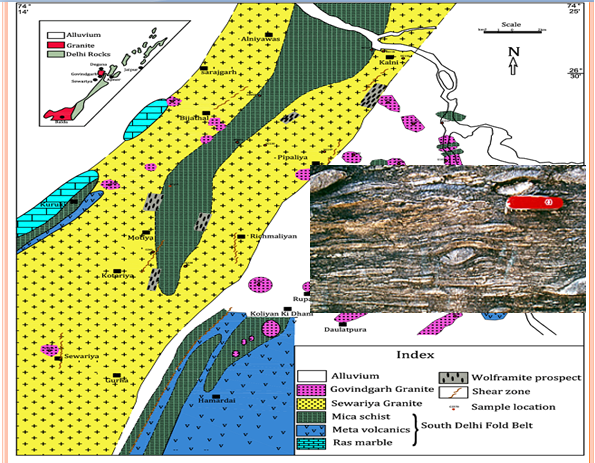
The pebbles are stretched to an extraordinary extent, about 20 to 30 times their original dimension. This is Unique and shows an uncommon geological phenomenon, that is the reason GSI declared it as a National Geological monument.
Stratigraphy
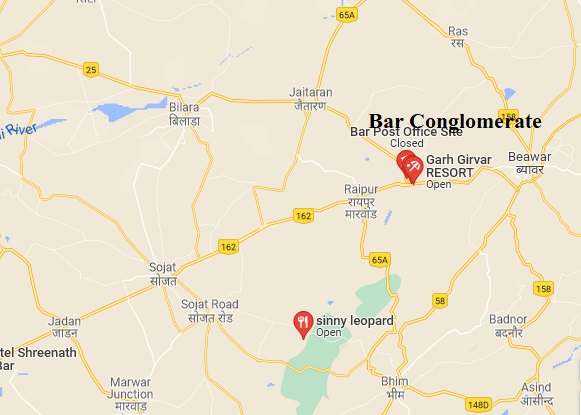
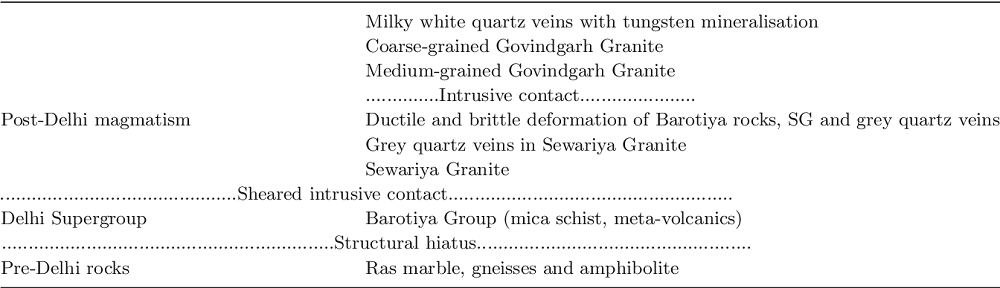
The Barr Conglomerate occurs along the western margin of the Meso- to Neoproterozoic South Delhi Fold Belt (SDFB) in Rajasthan, western India. It is the basal unit of the Barotiya Group (within the Delhi Supergroup), which overlies the basement of Banded Gneissic Complex (BGC) exposed to its west. This contact has been referred to as a strong deformation/shear zone.
Conglomerates
Conglomerates are the clastic sedimentary rock that contains mostly pebble-size rounded clasts. The spaces between the clasts are generally filled with smaller particles and/or chemical cement that then binds and formed the rock matrices together.
Deformation pattern
The basal Delhi conglomerates at the village Bar are reputed for the intense deformation seen in them. The pebbles in the conglomerate are mostly made up of quartzites. They vary in size from small pebbles to large cobbles. The percentage deformation in the long axes of the pebbles is around 175, and in some extreme cases about 700.
The pebbles lie on the cleavage/bedding surface with their long axes almost parallel to each other. The long axes are coincident with the true dip of the cleavage surface. The overall matrix of the conglomerate is psammo-pelitic and consists of sharply alternating psammite and pelite layers. A strong cleavage is seen in the matrix which is parallel to the bedding.
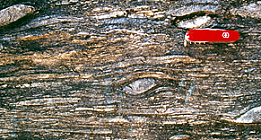
The pebbles are flattened and elongated. A two-stage deformation model in which an early phase of flattening followed by flow is suggested for the pebbles in the conglomerate. The conglomerate is a solid rock formed in the cementation and lithification of clasts with an angular shape.
A structural study in the rocks of the Barotiya Group indicates the presence of three deformational phases. The first deformation episode (D1) produced long-limbed isoclinal folds with axial planar schistosity or gneissosity which became asymmetrically folded with dextral vergence (Z-shaped folds) during the second deformation phase (D2).
The structural geometry in the Barr conglomerate and the neighboring rocks in the western flank of the Meso- to Neoproterozoic South Delhi Fold Belt indicate superposed deformation, with structures developed by horizontal dextral simple shear deformation superimposed on earlier structures formed during approximately ESE-WNW compression and subvertical maximum elongation.
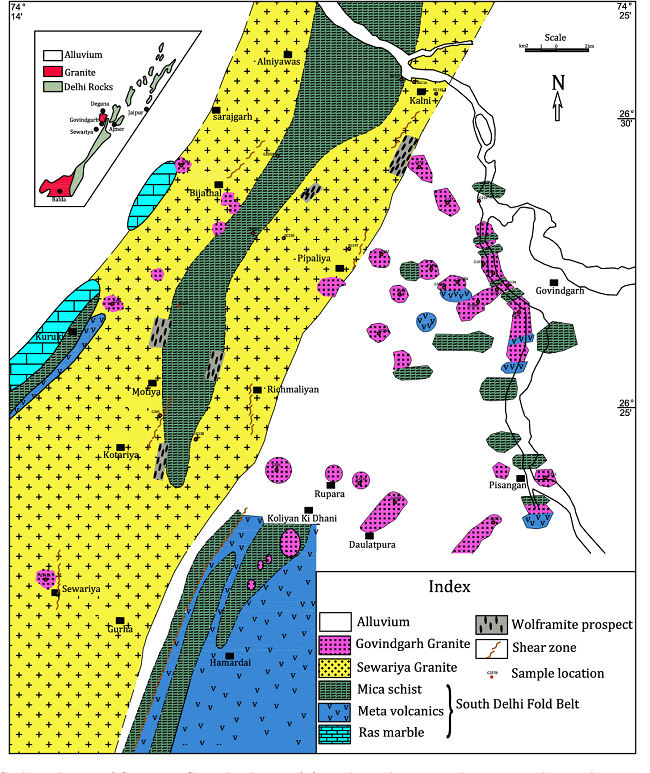
Thin streaks of quartzo-feldspathic material parallel to schistosity in the conglomerate probably represent disrupted primary layers, adding in the associated calc-gneiss and the major lithological contacts are parallel to the D1 schistosity (S1) due to the isoclinal nature of the folds. The last phase D3 is weak and has produced broad warps of schistosity and bedding on transverse east-west axial planes.
Pebble shapes in deformed conglomerates have long been used to estimate finite strain in rocks. If the pebbles were all initially spherical and had the same viscosity as the matrix, they would behave as passive markers, and the pebble shape after deformation would represent the strain ellipsoid.
Also read- Colca Canyon Trek: The Ultimate natural wonder in Peru-Geo-tourism
The basic principle of strain measurement from initial non-spherical markers was first discussed by Ramsay (1967). This led to a method, known as the Rf-4 method, that was later elaborated by several workers. Graphical and algebraic methods have been devised to compute the shape of finite strain ellipse from the measurement of shapes of deformed pebbles that were initially elliptical.