sutikshan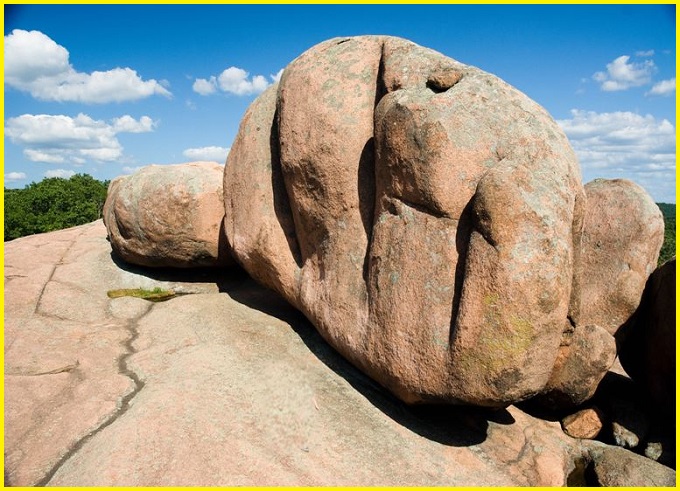
Elephant Rocks, Missouri
The granite elephant-shaped boulders in Elephant Rocks National Park are a unique formation that formed nearly 1.5 billion years ago. These massive rocks are arranged end-to-end, resembling a parade of circus elephants. Their striking formations captivate geologists, attract history enthusiasts curious about the area’s quarrying past, and delight children who enjoy climbing over and between the boulders.
One of the easiest ways to explore the Granite Boulder is via the Braille Trail, thoughtfully designed for visitors. This trail winds through the central rock formations, with a spur leading to the remains of an old railroad engine house, a relic of the region’s quarrying and railroad heritage.
The site was established as a state park in 1967 after geologist Dr. John Stafford Brown donated the land. Today, it serves as a popular spot for picnicking, rock climbing, and trail exploration, and is overseen by the Missouri Department of Natural Resources.
Geology
The Elephant Rocks, Missouri, are a group of residual boulders produced by the weathering of Graniteville Granite. This rock is a medium- to coarse-grained, muscovite-biotite alkali granite, typically composed of about 55% alkali feldspar, 40% quartz, and less than 5% mafic minerals. The Graniteville Granite formed 1.4 billion years ago during the Proterozoic, when magma intruded into nearby volcanic rocks and country rock associated with a collapsed caldera and slowly cooled to create a pluton.
Also read- Mystery of the Menan Buttes: World’s Largest Freshwater Tuff Cones
During cooling, the granite developed near-vertical fractures, which were later intensified by uplift. Over time, erosion removed the overlying rock layers, revealing the granite mass. Before exposure, groundwater weathered the rock along its fractures, producing solid corestones surrounded by soft, decomposed saprolite. Later, surface runoff washed away the saprolite, leaving behind the prominent, isolated boulders now recognized as the “elephant rocks.”
Braille-signage trail
Elephant Rocks, Missouri State Park features a paved Braille-signage trail that loops around the 7.5-acre geologic natural area. Elephant Rocks formations can be explored via the one-mile paved Braille Trail—the first of its kind in Missouri state parks. The asphalt path, Carpet markers, and hand ropes guide visitors along the route and indicate changes in the trail. Much of the trail is shaded, with rest areas available along the way.

A short spur trail leads to a viewpoint overlooking an old quarry site. Just beyond the park lies Missouri’s oldest documented commercial granite quarry, established in 1869. This quarry supplied stone for bridge piers along the Mississippi River, and between 1880 and 1900, it produced millions of paving blocks used in the St. Louis levee and downtown streets. Nearby quarries also contributed granite for many prominent buildings in St. Louis.
Also read- Geotourism And Modern Geotechniques
How to reach Elephant Rocks, Missouri
Elephant Rocks, Missouri, is situated at 7396 Highway 21 in Belleview, Missouri (63623), about 100 miles (roughly a 1.5-hour drive) southwest of St. Louis. The park can be easily reached via MO-21 and offers free entry, along with convenient visitor parking. The one-mile connects its primary attractions, the paved Braille Trail, an accessible loop designed for all visitors.