sutikshan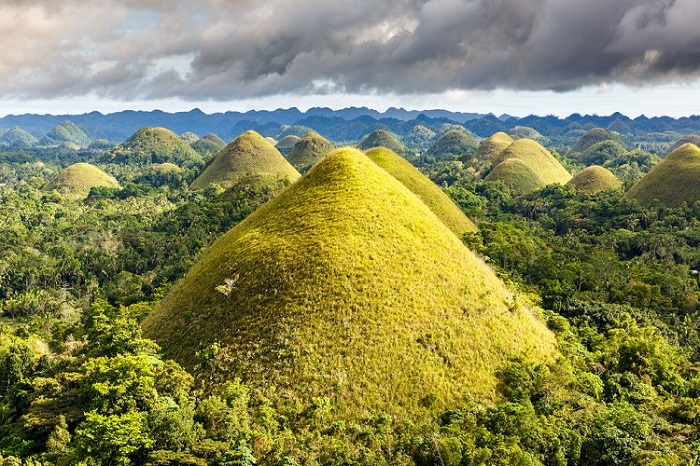
Chocolate Hills

How the Chocolate Hills Philippines Formed
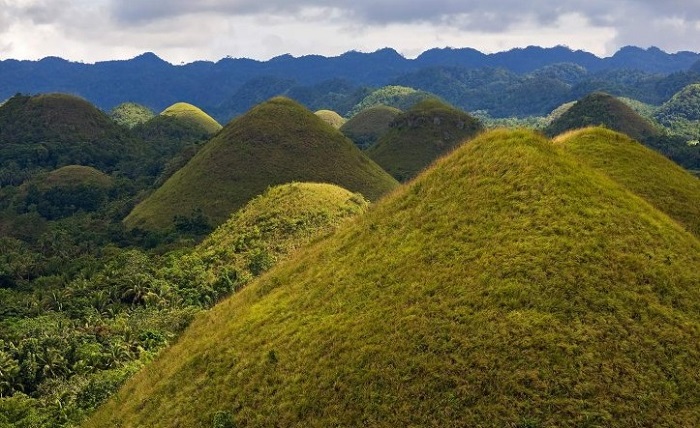
Geologists believe that the limestone rocks of the area eroded in a uniform direction and formed the hills; the Kart’s topography is responsible for leaving this landscape in the area. These are conical karst comprised of Late Pliocene to Early Pleistocene age. The thin to medium-bedded, sandy to rubbly Marine limestone is rich in fossils of shallow marine organisms like foraminifera, coral, mollusks, and algae.
Another theory is that the hills were formed by the upliftment of coral deposits as they erupted from the sea in a massive geologic action, and the rainwater and erosion over the past thousand years gave the finishing touches to these mounds.
Also Read- A Magical Coralline Island- Siquijor, Philippines
Nearly symmetrical, these unique, dome-shaped hills are composed of grass-covered limestone and range in height from 30 to 50 meters, with the largest reaching 120 meters. They are scattered by the hundreds across the towns of Carmen, Batuan, and Sagbayan.
Chocolate Hills Resort
The name “Chocolate Hills Resort” is used for several different establishments, notably a controversial one situated inside the protected Chocolate Hills area in Bohol, Philippines. It also refers to two legitimate businesses, White Chocolate Hills Resort (Zamboanguita, Negros Oriental) and Panglao Chocolate Hills Hostel and Resort (Panglao, Bohol), both offering standard amenities and attractions.