sutikshan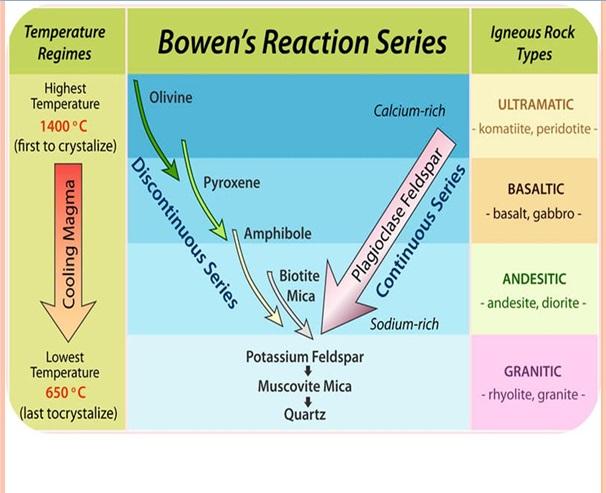
Bowen’s Reaction Series
NL Bowen has given the order of crystallization of the common silicate minerals from magma. The theory given by him is widely accepted as the general model for the evolution of magmas during the cooling process. He determined that specific minerals form at specific temperatures as magma cools. Bowen’s reaction series is able to explain why certain types of minerals tend to be found together while others are never associated with one another. The Bowen reaction series is separated into two branches. The continuous series describes the evolution of the plagioclase feldspars as they evolve from being calcium-rich to sodium-rich. The discontinuous Series describes the formation of the mafic minerals olivine, pyroxene, amphibole, and biotite mica.
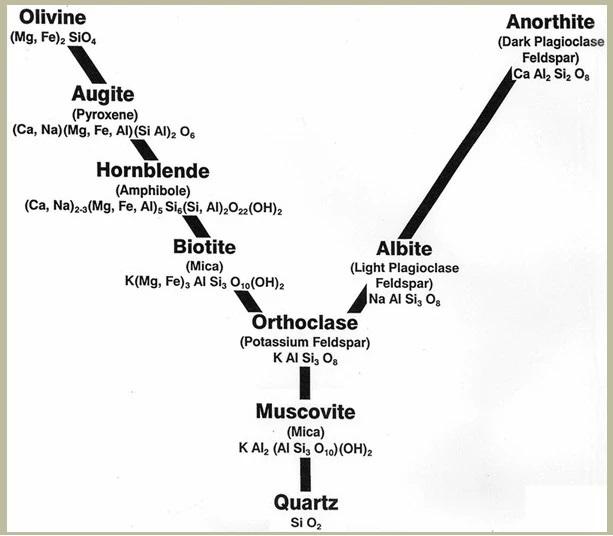
The Surprising thing that Bowen found concerned the discontinuous branch is that, at a certain temperature, magma might produce olivine, but if that same magma was allowed to cool further, the olivine would “react” with the residual magma, and change to the next mineral on the series.
The Principles of Bowen reaction series-
- Principles of Bowen reaction series state that as a melt cools, minerals crystallize that are in thermodynamic equilibrium with the melt.
- As the melt keeps cooling and minerals keep crystallizing, the melt will change its composition.
- The earlier formed crystals will not be in equilibrium with this melt anymore and will be dissolved again to form new minerals. In other words, these crystals react with the melt to form new crystals; therefore, the name reaction series.
- This reaction series implies that from a single “parental magma,” all the various kinds of igneous rocks can be derived by Magmatic Differentiation.
- The common minerals of igneous rocks can be arranged into two series: a continuous reaction series of the feldspars and a discontinuous reaction series of the ferromagnesian minerals (olivine, pyroxene, hornblende, biotite).
Continuous and Discontinuous series
In Bowen’s reaction series, the Discontinuous series starts with olivine, then pyroxene, amphibole, and biotite. In this “reaction sequence,” each mineral in the series is replaced by the next one as the molten material cools. As Bowen put it, “The disappearance of minerals in the order they appear is the essence of the reaction series.” Olivine forms crystals, which then react with the rest of the magma as pyroxene forms. At a certain point, all olivine is absorbed and found only in pyroxene. The pyroxene then reacts with the liquid and the amphibole crystals replace it, and then replace the biotite amphibole.
A continuous series of Bowen’s reaction series is a plagioclase feldspar. At high temperatures, the high-calcium variety of anorthite mineral forms. Then, as temperatures fall, it is replaced by sodium-rich varieties, namely Bytownite, Labradorite, Andesine, Oligoclase, and Albite. As the temperature continues to fall, these two series merge, and more minerals crystallize in this order: Alkali feldspar, muscovite, and quartz.
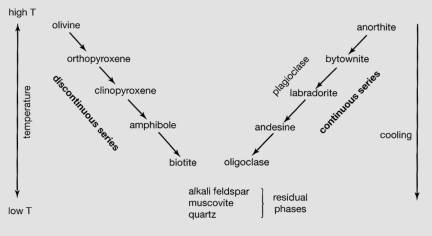
The reason for this evolution of minerals is the dropping temperature of the magma that allows silica to form more complex structures. You can see that Olivine, with its isolated silica tetrahedra, forms at the highest temperatures, and as temperatures drop, silica tetrahedra first manage to join together in chains (pyroxenes), then in ribbon structures (amphiboles), and then in micas, a sheet Structure. Finally, in the Reaction series at the lowest temperature, the two branches merge and minerals form that are common to Felsic rocks – muscovite mica, orthoclase feldspar, and quartz.
The entire series is not found in nature, but many magmatic rocks show parts of the sequence. The main limitations are the state of the liquid, the rate of cooling, and the tendency of mineral crystals to settle under gravity.
Also Read- Igneous Pluton-Emplacement and Type
Bowen’s reaction series and Igneous rocks
Bowen’s reaction series is based on observations and experiments of natural rocks; the crystallization sequence of typical basaltic magma changes as it cools. Bowen’s Reaction Series describes temperatures at which different common silicate minerals change from liquid to solid phase (or solid to liquid). This reaction series implies that from a single “parental magma,” all the various kinds of igneous rocks can be derived by Magmatic Differentiation.
Generally speaking, higher temperature minerals have a higher proportion of iron and magnesium and are therefore considered mafic. Low-temperature minerals are associated with the opposite end of the composite spectrum (higher in silicon and oxygen) and are considered to be felsic. Some minerals are clearly mafic, some are clearly felsic, and some fall between these two extremes.
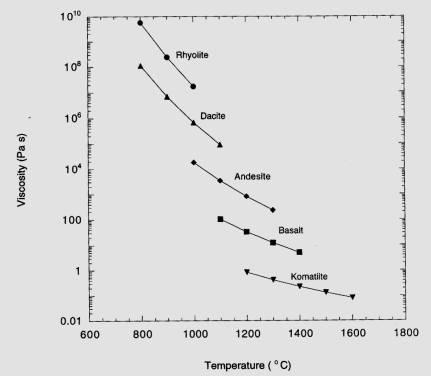
Common mafic minerals include olivine, pyroxene, amphibole, biotite mica, and plagioclase feldspar. Common felsic minerals include quartz, muscovite mica, and orthoclase feldspar. Different magma compositions clearly result in different magmatic rocks. Another factor contributing to the differences in igneous rocks is related to the time taken for the crystallization of magma. In general, the faster the cooling rate (if extrusion is common for volcanic rocks), the smaller the mineral grains obtained. A slower cooling history (often intrusive) results in a coarse-grained rock. Magmas of intermediate compounds cause crystallization of intermediate minerals (in fact, a mixture of medium-range minerals: amphibole and both feldspar species), common magmatic rocks, andesite (extrusion), and diorite (intrusive).
Magmatic Differentiation
Magmatic differentiation is the process of separating the magma several times. (Recrystallization of Magma) as it evolves and migrates upwards in the Earth’s crust. first separated olivine and pyroxene (crystal mush), and then created a peridotite, more mafic than basalt. The remaining melt would crystallize pyroxene, hornblende, and plagioclase with intermediate Ca content (andesine), and might erupt from a volcano and form andesite.
Also Read- Geotourism And Modern Geotechniques
The second condition is that if the Magma remained buried, the crystal reaction would form a diorite from which, in turn, a granitic melt would rise. The parental magma that Bowen envisioned was a “primitive” basalt with high Fe and Mg contents and fairly low SiO2 contents. This gradual change in mineral composition during differentiation is accompanied by a change in color also (Mafic rocks are dark, felsic rocks light), and density of the respective rocks, and is the basis for most of the accepted classification schemes of igneous rocks.
The original composition of the magma, of course, determines the variety of igneous rocks. An originally dioritic/andesitic magma, for example, could never give rise to basalt but may give rise to granite. Magma may be modified by mixing with another magma that is further or less evolved, and then rocks of unusual mineral composition may form. Another way in which magma can be modified is by assimilation of wall rock during its rise through the crust.