sutikshan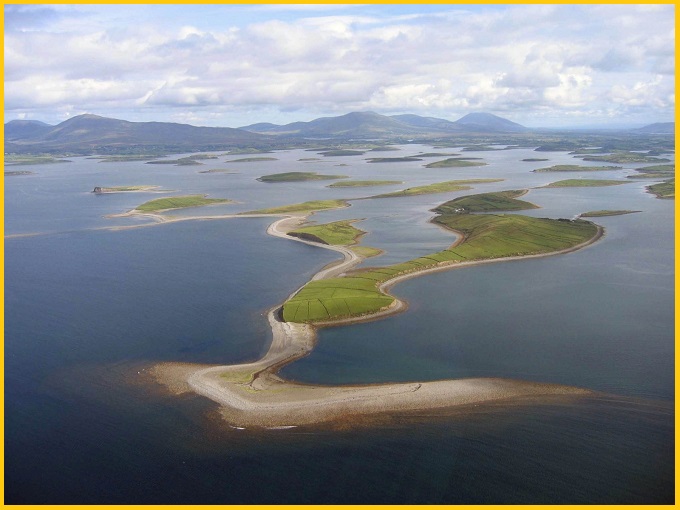
Drumlins of Clew Bay
The drumlins of Clew Bay form a striking submerged landscape of 365 elongated, teardrop-shaped hills, shaped by glaciers during the last Ice Age and often called “one for every day of the year.” These islands are part of a “drowned” drumlin field created around 18,000–16,000 years ago, when ice sheets moved westward toward the Atlantic, leaving behind glacier-sculpted hills that now rise above the sea.
Geology
The drumlins are Quaternary in age, formed beneath an ice sheet that advanced from northeast to southwest during the peak of the last Ice Age. The bedrock surrounding Clew Bay consists of three main types: Carboniferous sandstones to the north, Carboniferous limestones in the central inner bay, and Silurian meta-sedimentary and meta-igneous rocks to the south. Notably, glacial landforms occur almost entirely in the Carboniferous limestone areas. Features such as Lough Furnace moraines and the Castlebar–Westport region are integral parts of this extensive drumlin field.
The classic “drowned” drumlin landscape illustrates how the sea has eroded a drumlin swarm formed during the second advance of ice in the last Ice Age. Nowhere else in Ireland matches its scale or the diversity of drumlin features.
Also read- Geotourism And Modern Geotechniques
Drumlin Islands
Clew Bay is characterized by numerous elongated drumlin islands and peninsulas aligned east–west along the inner coastline between Newport and Westport. Its eastern shore is bordered by a low-lying landscape underlain by Lower Carboniferous limestone.
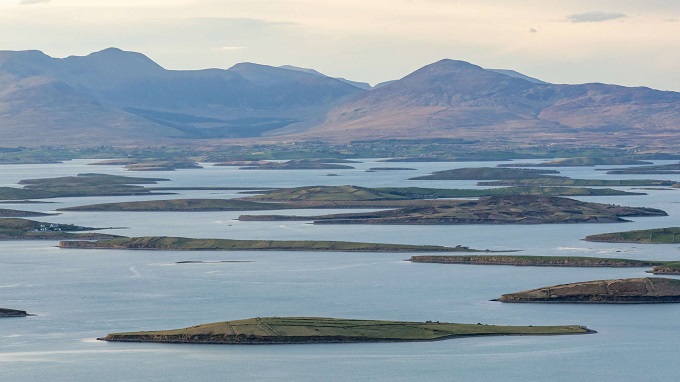
To reach the drumlins of Clew Bay in County Mayo, Ireland, travel to Westport or Louisburgh for scenic coastal views, or take a boat tour from Westport Quay (seasonal) for close-up views of the 365+ island archipelago. The best viewpoints are on the south side of the bay along the R335 road.