sutikshan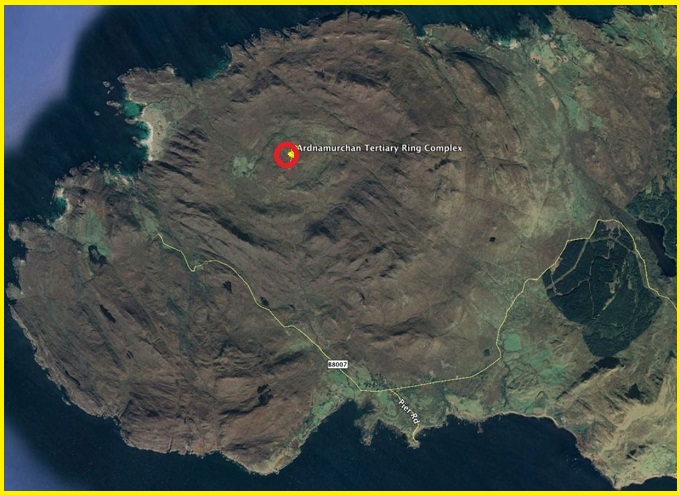
Ardnamurchan Ring Complex
The Ardnamurchan Ring Complex is one of the most remarkable geological features in Scotland, located on the remote Ardnamurchan Peninsula. It represents the deeply eroded roots of an ancient volcano that was active around 60 million years ago during the early Paleogene Period.
The Ardnamurchan Ring Complex is a classic example of a central igneous complex, formed by repeated volcanic intrusions. Instead of a single eruption, magma intruded multiple times into the crust, creating a series of concentric (ring-shaped) structures.
The west coast of Scotland hosts several volcanic complexes formed during the early Tertiary Period, when Europe and North America began to drift apart, and the Atlantic Ocean started to open. These complexes offer remarkable insights into the internal processes of volcanoes. Among them, the Ardnamurchan Ring Complex stands out for its key role in shaping scientific understanding of how magma is emplaced within the upper continental crust.
Among the Tertiary Period complexes of northwest Britain, the Ardnamurchan Ring Complex displays the most well-developed ring intrusions. Of these, the gabbroic “Great Eucrite” is the most outstanding and is widely regarded as a classic example of a ring dyke.
Also read- Geotourism And Modern Geotechniques
Geology
The northwestern part of the Ardnamurchan Peninsula is composed of a lopolith—once thought to be a ring dyke—that is now exposed at the surface. Evidence for this structure comes from rock exposures in the area, where phenocrysts show plagioclase crystals aligned toward the center of the complex, a pattern produced by magmatic flow within a lopolith.
In some locations near the inner margins of the complex, small remnants of lava flows that once erupted onto the surface can still be found. The sub-concentric rings of this geological structure are clearly visible in satellite imagery and topographic maps, although they are less distinct when viewed on the ground.
At least seven other comparable complexes formed during the same tectonic episode occur along the west coast of Britain.
Atraction
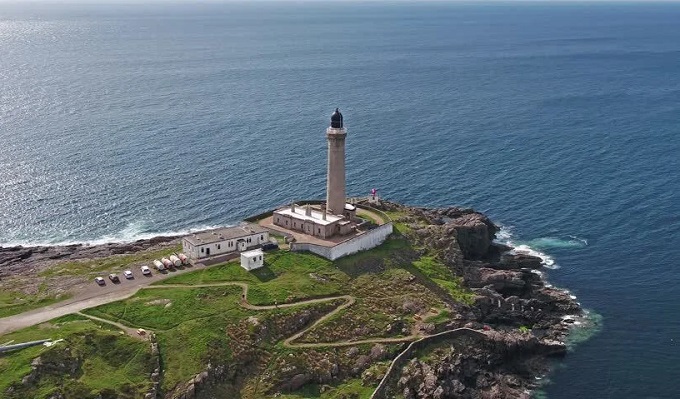
Ardnamurchan Peninsula remains a wild and largely untouched landscape. Ardnamurchan Point, near the most westerly point of mainland Britain, features a lighthouse perched above dramatic cliffs, offering sweeping views across the Atlantic Ocean.
Also read- Amazing Elephant Rocks, Missouri: 1.5 Billion-Year-Old Granite Wonders
The northern part of Ardnamurchan lies within the Morar, Moidart and Ardnamurchan National Scenic Area, one of 40 designated scenic areas in Scotland. These areas are recognized for their outstanding natural beauty and are protected through restrictions on certain types of development.
How to Reach Ardnamurchan Peninsula
Reaching the remote Ardnamurchan Peninsula involves driving through the Scottish Highlands via scenic, single-track roads or taking local ferries. The primary routes are the Corran Ferry south of Fort William (faster, year-round, non-booked) or driving around via Lochailort. A scenic alternative is the Tobermory to Kilchoan ferry from the Isle of Mull.