sutikshan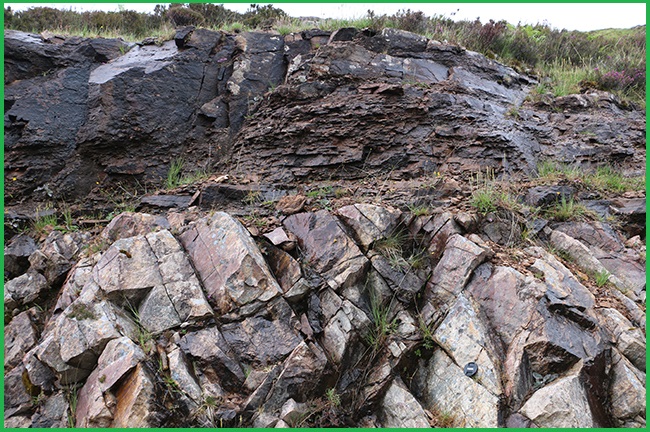
The Sub-Torridonian unconformity
The Sub-Torridonian unconformity along the Assynt Road (A837), near Loch Assynt in northwest Scotland, is a world-famous geological site and is widely regarded as one of the finest in Britain. Here, Proterozoic Torridonian sandstones (about 1,000 million years old) lie directly above much older Archean Lewisian gneiss (around 3,000 million years old), revealing an extraordinary gap of nearly 2 billion years in the geological record.
The Lewisian gneiss basement exhibits distinct foliations and banded structures that are abruptly cut off by the overlying sandstone, which belongs to the Precambrian Torridon Group. The unconformity commonly appears as a gently east-dipping surface, where red to purple, coarse-grained sandstones rest upon a pale grey, uneven, and weathered surface of metamorphic gneiss.
Geology
The landscape of western Assynt is shaped by two major geological units: the Lewisian gneiss, which forms the ancient crustal foundation of northwest Scotland, and the sandstones of the Torridonian Group.
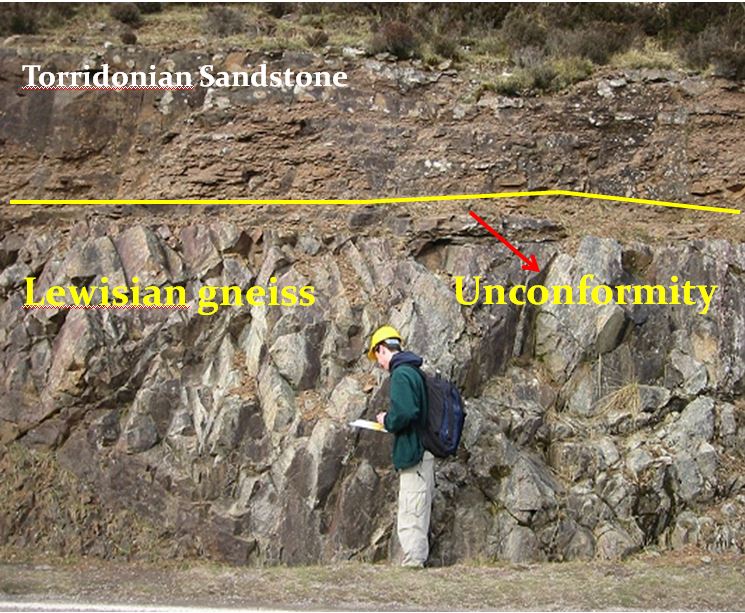
The Lewisian gneiss creates a low-lying, uneven terrain dotted with small hills and lochans, while the Torridonian sandstones rise dramatically to form mountains such as Quinag, Suilven, and Canisp. Remarkably, the Torridonian layers remain largely flat-lying and appear mostly undisturbed, despite the extensive tectonic activity that has affected much of the Scottish Highlands over geological time.
A striking and easily accessible example of the contact between the Lewisian and Torridonian rocks can be seen in road cuttings near the shore of Loch Assynt. This boundary is an unconformity representing a vast gap in geological history—nearly 1.5 billion years.
Also read- Conewago Potholes: The Amazing Natural Rock Pits in Pennsylvania
In the eastern section, the contact surface gently undulates, preserving part of the ancient landscape on which the Torridonian sediments were deposited. Further west, the lower road cuttings reveal a weathered layer of Lewisian gneiss beneath the unconformity, offering valuable evidence of chemical weathering processes that occurred more than a billion years ago.
These outcrops are among the most significant geological sites in Britain, helping students and visitors appreciate the immense scale of geological time. Located within the Northwest Highlands Geopark, they attract hundreds of visitors each year. Unfortunately, during 2013–14, some of the finest exposures were damaged when research scientists carried out indiscriminate rock coring, resulting in vandalism of the site.
Also read- Geotourism And Modern Geotechniques