sutikshan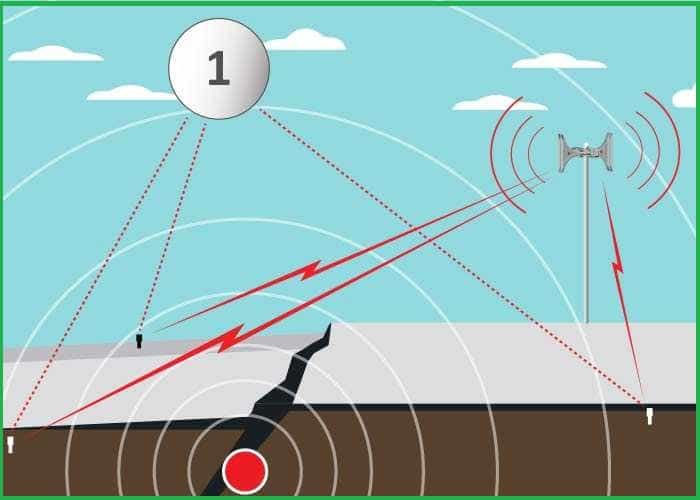
To date, neither the USGS nor any other scientific organization has successfully predicted a major earthquake. The methods for doing so remain unknown, and it is unlikely that we will have this capability in the foreseeable future. Currently, USGS scientists can only estimate the probability that a significant earthquake will occur in a given area over a specified period.
What is Earthquake Early Warning Systems (EEWS)
Every year, extreme weather and geological events affect millions of people worldwide, often escalating into disasters that claim lives and cause extensive damage to infrastructure, further intensifying hardship for the most vulnerable communities.
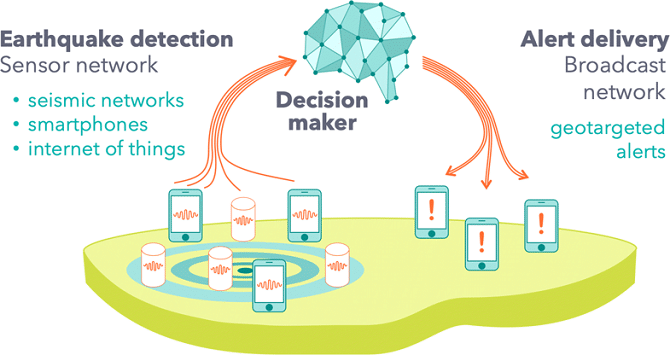
Earthquake Early Warning Systems (EEWS) detect the initial, faster P-waves of an earthquake to provide seconds to tens of seconds of warning before the slower, more destructive S-waves arrive, allowing for automatic shutdowns (trains, utilities) or personal protective actions like “Drop, Cover, Hold On”. These systems use seismic sensors, rapid communication, and algorithms to estimate an earthquake’s size and potential impact, sending alerts via apps, sirens, and media to protect lives and infrastructure, even if perfect prediction isn’t possible.
Earthquake Probabilities
Scientists use probability-based methods to estimate the likelihood that an earthquake of a certain magnitude will occur in a specific region over a defined time period. Several approaches are used to calculate these probabilities, most commonly by analyzing the average rate of past earthquakes. By assuming that earthquakes occur at a relatively constant rate over time, researchers can estimate the chances of a similar event happening within a future time window.
Probabilistic Seismic Hazard Analysis (PSHA) advances this approach by accounting for all possible earthquakes that may occur in an area, and the intensity of ground shaking each could produce. By integrating earthquake occurrence rates with expected shaking levels, PSHA estimates the probability that ground motion will exceed a specified threshold within a given period. This analysis is crucial for engineers and planners, as it underpins earthquake-resistant building design, seismic codes, and long-term risk mitigation strategies.
Also Read- Natural Coal Fires: Identificaion and Prevention Coal seams fire
Earthquake Prediction
The term earthquake prediction generally implies the ability to determine when, where, and how strong a future earthquake will be. However, the reality is that no scientifically reliable method currently exists to achieve this. There has always been a strong interest in predicting earthquakes, as unexpected events can be devastating, and advanced knowledge could clearly help save lives and protect property by allowing timely precautions.
Long-term earthquake probabilities and medium-term forecasts, such as those for aftershocks, are comparable to how scientists interpret long-term climate trends or intermediate phenomena like El Niño. However, unlike short-term weather forecasts, seismologists are still unable to accurately specify the exact time, location, and magnitude of individual earthquakes.
Artificial intelligence (AI) and the Internet of Things (IoT)
Despite this limitation, earthquake prediction remains a popular topic among psychics and pseudo-scientists, many of whom claim remarkable predictive success. These assertions are not supported by empirical evidence or by a sound understanding of the physical processes that cause earthquakes. Earthquakes are unrelated to factors such as cloud formations, human aches and pains, or the behavior of slugs. Similarly, tidal forces and unusual animal behavior have proven ineffective as reliable earthquake predictors.
There has been growing interest in earthquake prediction and in developing a deeper understanding of the processes that generate earthquakes; however, earthquakes remain among the least predictable natural hazards. A wide range of tools—including satellite observations, Global Positioning System (GPS) measurements, interferometric synthetic aperture radar (InSAR), and various seismometers such as microelectromechanical system (MEMS) sensors, ocean-bottom seismometers, and distributed acoustic sensing (DAS) systems—have been employed to improve earthquake monitoring and forecasting efforts. Despite major advances in seismic data recording, storage, and analysis, accurately predicting the exact time, location, and magnitude of earthquakes continues to be extremely challenging. Nevertheless, emerging technologies such as artificial intelligence (AI) and the Internet of Things (IoT) show considerable promise in providing new insights and enhancing future earthquake forecasting capabilities.
The role of AI in the prediction of earthquakes
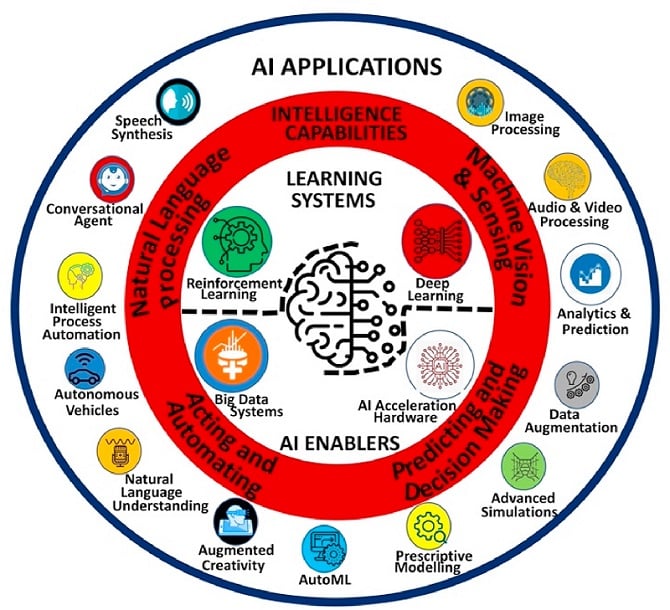
Artificial intelligence (AI) is a subfield of computer science that enables computers to emulate human cognitive functions such as memory, learning, decision-making, and problem-solving. The concept of AI was introduced by, and since then, the field has experienced substantial advancements and widespread application across diverse disciplines. Although the terms artificial intelligence and machine learning (ML) are often used interchangeably, ML is a subset of AI in which algorithms learn from data, autonomously improve their performance, identify patterns, and generate predictions
Machine learning algorithms are founded on mathematical frameworks such as linear algebra, calculus, and probability theory, which enable the transformation of input data into predictive models. ML techniques are broadly categorized into supervised learning, unsupervised learning, and reinforcement learning, the latter relying on trial-and-error interactions guided by reward mechanisms.
Supervised learning algorithms use labeled datasets to minimize the difference between predicted and actual outputs and are commonly applied to regression and classification problems, including linear, nonlinear, multiple, and logistic regression. In contrast, unsupervised learning algorithms, such as k-means clustering and principal component analysis, aim to identify hidden structures and patterns within unlabeled data. While unsupervised learning offers advantages such as the ability to process real-time data, ease of implementation, and lower costs, it also presents challenges, including unpredictable outcomes and difficulties in ev
1. Xiong et al. (2021) proposed a groundbreaking framework for earthquake forecasting by introducing the Inverse Boosting Pruning Trees (IBPT) model. This novel approach integrates satellite-derived data from ten parameters, including infrared observations, hyperspectral imagery, and gas-sensing signals, compiled from global earthquakes that occurred between 2006 and 2013. Inspired by principles of convolutional neural networks, the IBPT model employs a four-layer architecture and is trained on a comprehensive global dataset comprising 1,234 earthquakes with magnitudes between 6 and 7 and 137 events with magnitudes greater than 7. To evaluate its performance, the IBPT model was benchmarked against eight state-of-the-art machine learning techniques. Although the model achieved a coefficient of determination (R > 0.6), its practical applicability is limited by high computational complexity, primarily due to the large number of iterations required during the pruning process.
2. Turarbek et al. (2023) presented a novel end-to-end approach to improve earthquake detection accuracy by optimizing each stage of the detection pipeline. Their study proposed a Conv2D-based convolutional neural network (CNN) architecture for processing seismic waveforms, which outperformed several traditional machine-learning techniques and existing state-of-the-art methods. The model was evaluated using 97 years of seismic records from Kazakhstan (1906–2022) and achieved performance metrics of 63% accuracy, 82.4% precision, 62.7% recall, and an 83% F-score.
Read- Geotourism And Modern Geotechniques
These results demonstrate the effectiveness of the proposed Conv2D model in detecting real-world earthquakes within seismic zones and underscore its potential for seismic event forecasting. However, despite its promising performance, the model exhibited instability attributed to limited training data. The study further hypothesized that earthquake occurrences may follow cyclical patterns, suggesting that the use of historical predictors such as magnitude and depth could contribute to forecasting future destructive earthquakes.
3. Bhatia et al. (2023) presented a study on artificial intelligence–based real-time earthquake prediction, proposing an IoT–Edge–centric smart monitoring and prediction framework that integrates cloud and edge computing technologies. In this collaborative architecture, IoT sensors collect real-time seismic data, which are processed at the edge layer using a Bayesian belief model for feature classification. The cloud layer then applies an Adaptive Neuro-Fuzzy Inference System (ANFIS) to forecast earthquake magnitudes.
Experimental results demonstrate that the proposed framework achieves high classification performance (precision 92.52%, sensitivity 91.72%, and specificity 91.01%), along with reduced computational latency (23.06 s) and enhanced reliability (95.26%) and stability (92.16%). Overall, the model highlights the potential of intelligent, real-time earthquake prediction systems with improved accuracy and operational efficiency.
Internet of Things (IoT) and its role in earthquake prediction
The term Internet of Things (IoT) was first introduced in 1999 within the Radio Frequency Identification (RFID) research community. It was coined to describe the integration of technologies such as artificial intelligence (AI), information and communication technology (ICT), and data analytics, forming a platform that interconnects a wide range of physical objects, including devices and sensors. These objects are capable of collecting and exchanging data over the Internet without direct human involvement. Although the concept was proposed more than two decades ago, significant interest from researchers and investors has emerged primarily over the past decade (Wortmann and Flüchter, 2015; Al-Turjman and Alturjman, 2018).
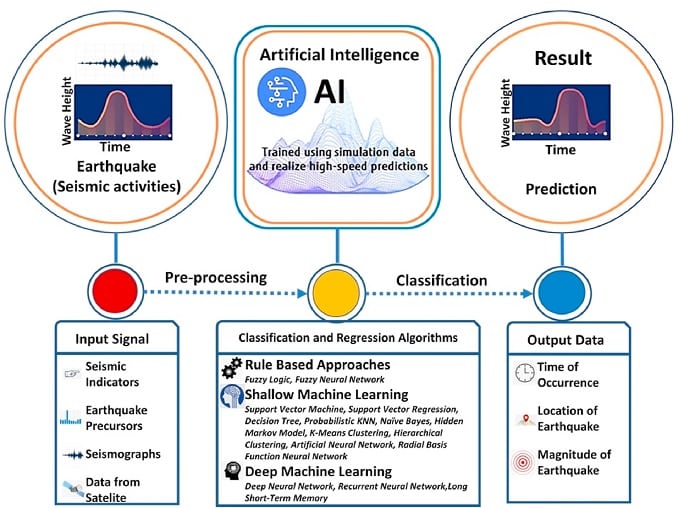
IoT emphasizes sensor-enabled connectivity in devices such as mobile phones, monitoring systems, and computers, and its rapid growth has enabled a broad range of applications in environmental sciences, architecture, smart homes, healthcare, and industrial systems. IoT devices are typically assigned unique identifiers, allowing them to communicate and exchange information autonomously without human intervention. An IoT system is fundamentally built around connectivity, communication, and data exchange governed by predefined protocols to enable real-time monitoring, intelligent decision-making, tracking, positioning, safety, and process control.
Types of IoT nodes
IoT node types differ in their underlying technologies, operational lifespans, and power requirements, and these nodes function as critical components of earthquake monitoring systems.