sutikshan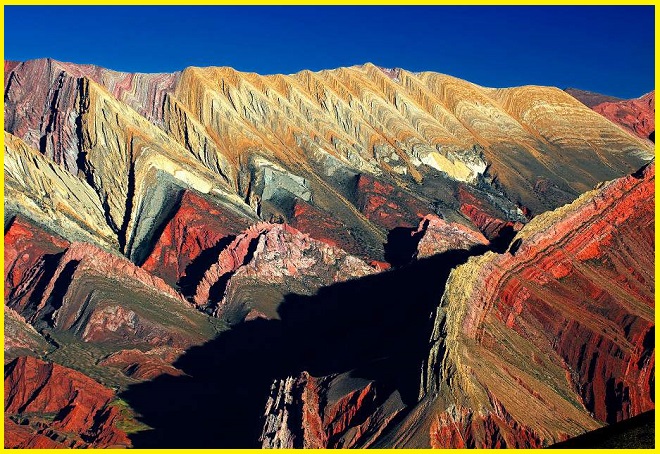
14 Colors Mountain
Declared a UNESCO World Heritage Site, the Mountain of 14 Colors is one of the most stunning natural wonders in Argentina and all of South America. Rising to 4,761 meters above sea level—with the lookout point at a lower elevation—these mountains rival Peru’s famous Rainbow Mountain.
Known by many names, including Serranías de Hornocal, Cerro Hornocal, Cerro de los 14 Colores, Quebrada de Humahuaca, and Argentina’s Rainbow Mountain, this colorful range owes its beauty to layers of limestone called Yacoraite. Over 600 million years of erosion have exposed its mineral-rich layers, creating the vibrant stripes that dazzle visitors today. While similar formations can be seen across Salta and Jujuy, none compare to the grandeur of the 14 Colors Mountain. For travelers exploring Northern Argentina, this breathtaking destination is a must-see, and it’s surprisingly easy to visit.
Also read- Lake Khanka: A Ramsar and UNESCO Biosphere Treasure
Geology
Serranía de Hornocal, or 14 Colors mountain, is located in northwestern Argentina, within the Quebrada de Humahuaca (Humahuaca Gorge). The “14 Colors Mountain,” or Serranía de Hornocal in Argentina, showcases geology shaped by mineral-rich sedimentary layers deposited underwater more than 600 million years ago. Among these is the Yacoraite formation, later uplifted and exposed through erosion. The mountain’s vivid palette comes from the minerals within these layers—hematite creating reds, goethite producing yellows and browns, and carbon contributing grays—together forming the striking multicolored slopes visible today.
Spectacular array of colors
The mountain is renowned for its striking multicolored slopes, formed by mineral-rich sedimentary rock. These layers create a dazzling display of red, green, blue, and yellow hues that shift in intensity with the changing light of day and the sun’s position.
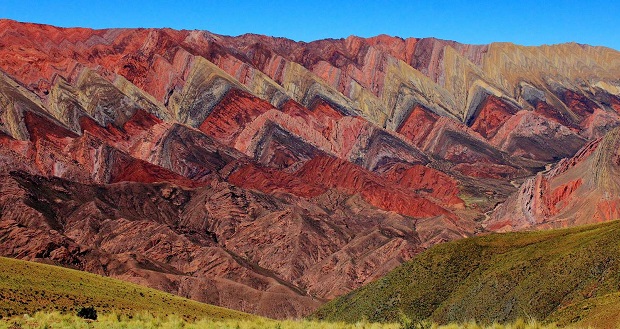
The 14 Colors mountain showcases a breathtaking palette of reds, greens, blues, and yellows. Its appearance transforms with the changing light, offering visitors a dynamic and ever-shifting view throughout the day. The main viewpoint sits at an impressive altitude of about 4,350 meters, adding to the sense of awe and grandeur.
The best time to view the 14 Colors mountain in its full vibrancy is in the afternoon, ideally between 3:00 and 6:00 pm, when the sun illuminates the formations directly.
How to Reach 14 Colors Mountain
To visit the Mountain of 14 Colors (Serranía de Hornocal), travelers first head to the town of Humahuaca in Jujuy Province, Argentina. From there, the viewpoint can be reached via the steep, unpaved RP 73 road. Visitors can either drive themselves or hire a local driver with a 4×4 vehicle. The journey from Humahuaca to the viewpoint typically takes about 40–45 minutes.