 sutikshan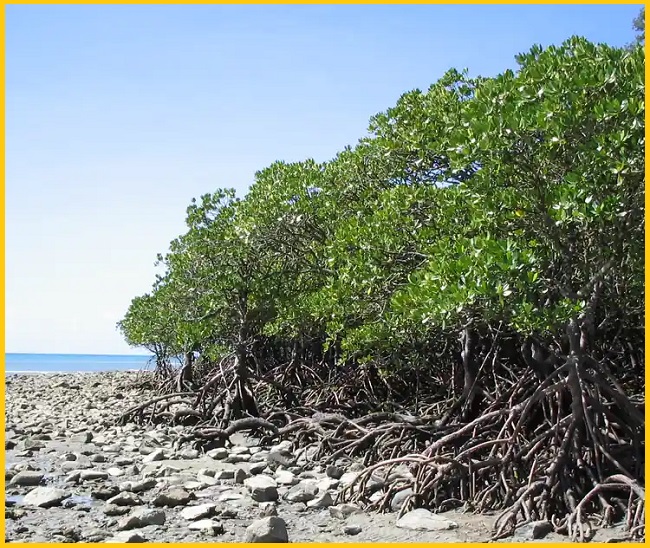
Wet Tropics of Queensland- World Heritage site
It also provides an extraordinary record of the ecological and evolutionary processes that shaped Australia’s flora and fauna, preserving remnants of the ancient Gondwanan forests that once spanned Australia and parts of Antarctica 50 to 100 million years ago. All of Australia’s distinctive marsupials and most of its other animal species originated in rainforest ecosystems, with their closest surviving relatives found today in the Wet Tropics. The Wet Tropics of Queensland meets all four natural heritage criteria for designation as a World Heritage Site. The Wet Tropics were inscribed as a World Heritage Site in 1988 and were later added to the Australian National Heritage List on 21 May 2007.
Climate
The region supports tropical rainforests at their latitudinal and climatic limits. Unlike most seasonal tropical evergreen equatorial forests, it experiences a pronounced dry season and frequent cyclones. Many unique characteristics of the Wet Tropics stem from its high but seasonal rainfall, varied terrain, and steep environmental gradients. Beyond its ecological complexity, the Wet Tropics is renowned for its outstanding natural beauty, dramatic landscapes, and scenic vistas.
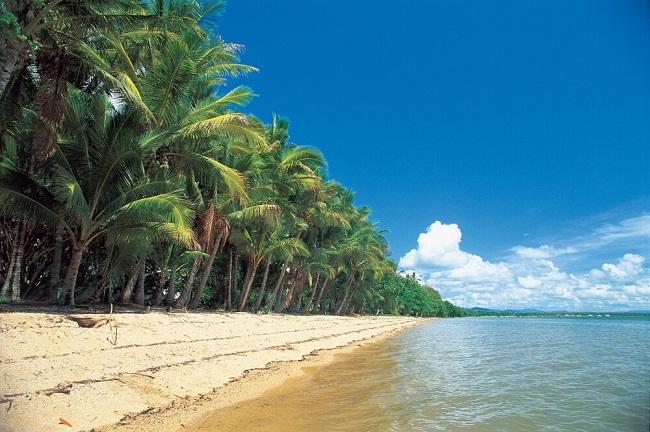
The Wet Tropics display extraordinary natural beauty, featuring breathtaking landscapes that include vast forest vistas, wild rivers, cascading waterfalls, rugged gorges, and striking coastal scenery. This is especially evident between the Daintree River and Cedar Bay, where dramatic coastal vistas blend tropical rainforest with white sandy beaches and fringing coral reefs. The meandering channels of the Hinchinbrook Channel support the region’s most extensive mangrove systems, creating a rich visual mosaic of rainforest and mangroves and forming a continuous terrestrial link with the Great Barrier Reef.
Also read- Lower Awash Valley: A UNESCO World Heritage Site of Human Evolution
Geography
The Wet Tropics of Queensland extends from Townsville to Cooktown, running roughly parallel to the Great Barrier Reef, itself a World Heritage Site. The terrain is rugged, dominated by the Great Dividing Range along with numerous smaller coastal ranges, highlands, tablelands, foothills, and escarpments. The heritage area encompasses the northern section of Queensland’s tropical rainforests, including the renowned Daintree Rainforest, and contains 16 distinct structural types of rainforest. The World Heritage site also features Australia’s highest waterfall, Wallaman Falls, and spans 13 major river systems, including the Annan, Bloomfield, Daintree, Barron, Mulgrave, Russell, Johnstone, Tully, Herbert, Burdekin, Mitchell, Normanby, and Palmer Rivers. Significant dams within the area include Copperlode Falls, Koombooloomba, and Paluma Dams.
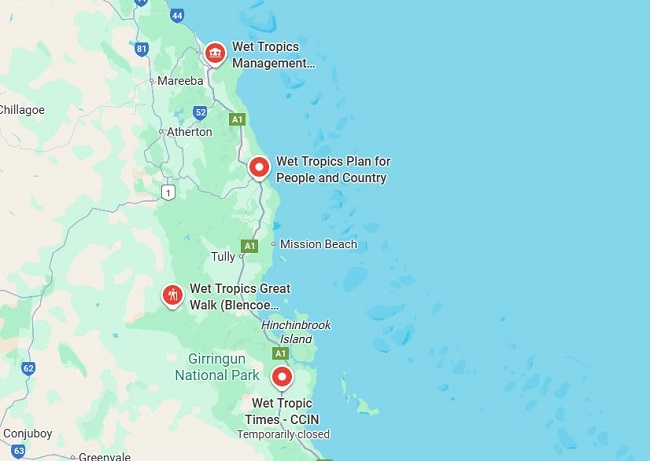
Wet Tropics of Queensland Map
The Wet Tropics of Queensland World Heritage Site encompasses tropical forests along the north-eastern section of the Great Dividing Range.
Wet Tropics of Queensland Plants
The Wet Tropics preserves one of the most complete and diverse living records of the major stages in the evolution of land plants, from the earliest pteridophytes over 200 million years ago to the emergence of seed-producing plants, including cone-bearing cycads and southern conifers (gymnosperms), and later the flowering plants (angiosperms).
The Wet Tropics supports an exceptionally high level of biodiversity, encompassing over 3,000 vascular plant species across 224 families. Of these, 576 species and 44 genera are endemic, including two plant families found nowhere else. As the largest part of the Australasian region where rainforests have persisted continuously since Gondwanan times, its flora—containing the highest concentration of primitive, archaic, and relict taxa known—represents the closest modern equivalent of ancient Gondwanan forests.
Animals
Vertebrate diversity and endemism are also remarkable: the region hosts 107 mammal species, including 11 endemic species and two monotypic endemic genera. Birdlife is equally rich, with 368 species, 11 of which are endemic. Reptilian diversity includes 113 species, 24 of them endemic, including three monotypic endemic genera. Amphibians are represented by 51 species, 22 of which are endemic. All of Australia’s unique marsupials and most of its other animal species originated in rainforest ecosystems, with the Wet Tropics still hosting many of their closest surviving relatives. This makes the region one of the most significant living records of both marsupial and songbird evolutionary history.
Although the Wet Tropics covers less than 0.2% of Australia, it harbors an extraordinary proportion of the country’s biodiversity: 30% of marsupial species, 60% of bats, 25% of rodents, 40% of birds, 30% of frogs, 20% of reptiles, 60% of butterflies, 65% of ferns, 21% of cycads, 37% of conifers, 30% of orchids, and 18% of vascular plants. This remarkable concentration of species makes the region of immense scientific significance and a cornerstone for conservation efforts in Australia.
How to Reach Tropics of Queensland
To visit the Wet Tropics of Queensland, the primary gateway is Cairns Airport (CNS), which handles both domestic and international flights. From Cairns, travelers can hire a car or four-wheel-drive vehicle to explore nearby attractions such as the Daintree Rainforest. Alternatively, the Spirit of Queensland train from Brisbane provides access to the region, while regional buses and organized tours offer additional travel options.