 sutikshan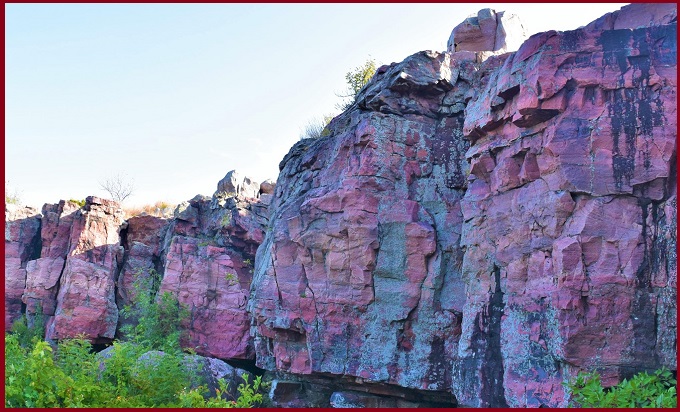
Sioux Quartzite, Minnesota
Sioux Quartzite is a Proterozoic-era rock located near the meeting point of Minnesota, South Dakota, and Iowa. The Quartzite Formed from deposits left by braided rivers, these rocks—and their related units—may represent a large sedimentary wedge that once spread across the passive margin along the southern edge of the ancient North American craton.
History
The Quartzite formation has a vast historical background. The Rock provided catlinite, or pipestone, which Plains Indians used to create ceremonial pipes. Following European settlement, Sioux Quartzite was widely quarried for its strength and durability, becoming a key material in prominent buildings in Sioux Falls, South Dakota, and other Midwestern locations. Quarrying still takes place in Jasper, Minnesota, at the Jasper Stone Company and Quarry, which was listed on the National Register of Historic Places on January 5, 1978. Jasper is also home to many early quartzite structures, including schools, churches, and other buildings, many of which are now abandoned.
Geology
Sioux Quartzite is a red to pink, Proterozoic-era quartzite that forms a thick and extensive stratigraphic unit. The thickness reaches up to about 3,000 meters. It is exposed across southwestern Minnesota, southeastern and south-central South Dakota, northwestern Iowa, and a small part of northeastern Nebraska. This formation is also correlated with similar sandstone and quartzite units in Wisconsin, as well as in southeastern Iowa, southern Nebraska, north-central New Mexico, and southeastern Arizona.
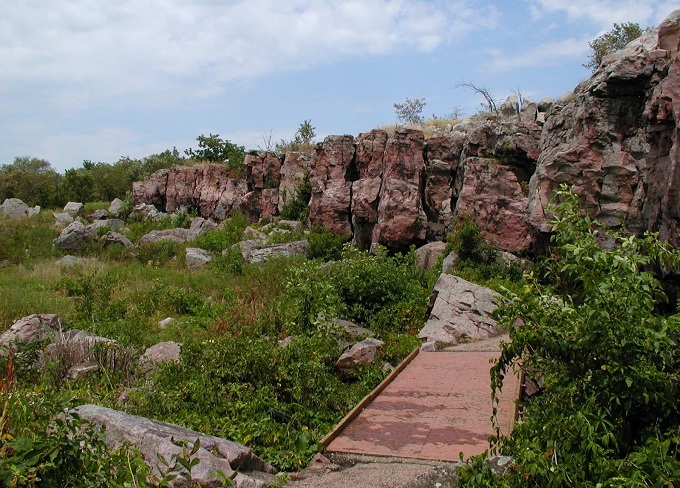
Its age has been determined using various geological dating techniques. It is younger than approximately 2,280 ± 110 million years, based on uranium-lead dating of underlying rhyolite in northwestern Iowa, and older than about 1,120 million years, based on potassium-argon dating of deformation in Pipestone, Minnesota. Recent age dating estimates, with the correlations of related formations, place its age between roughly 1,760 ± 10 million and 1,640 ± 40 million years. This period, known as the Baraboo interval, was characterized by high sea levels that covered much of North America, enabling widespread sediment deposition.
Quartzite formation
Sioux Quartzite was primarily formed from braided river deposits that consist of quartz arenite, with about 95% of the rock consisting of rounded, fine- to medium-grained quartz sand. These ancient rivers are believed to have flowed southeast across a gently sloping landscape. The basal conglomerate likely represents deposits laid down closer to the sediment source in braided stream environments. Evidence also suggests a possible marine influence in the upper portion of the formation, supported by the presence of marine sediments—such as shales and banded iron formations—found above related units in Baraboo, Wisconsin.
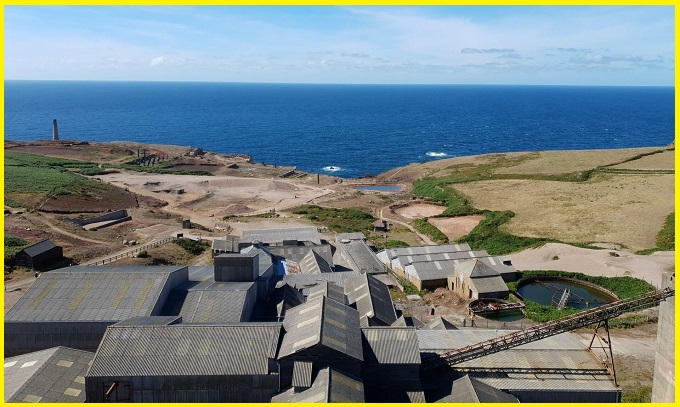
Also Read- Ultimate Geevor Tin Mine: Discover Cornwall’s Epic Hidden Mining Treasure
The formation also contains claystone layers approximately one meter thick, known as catlinite or pipestone. Overall, Sioux Quartzite and its related formations are thought to be remnants of a once extensive sedimentary wedge that spread across the southern passive margin of the ancient North American craton.
Sioux Quartzite is highly resistant to erosion and makes a topographic high for much of the Phanerozoic era. Although it was periodically submerged by rising seas during times of maximum sea levels, later erosion removed most of the overlying sedimentary layers. As a result, the only rock units that still overlie the Sioux Quartzite are of Cretaceous age, deposited when much of North America was covered by the Western Interior Seaway.
Many of the quartzite outcrops visible today were exposed by glacial erosion during the Quaternary period. Some of these surfaces have been dated using cosmogenic radionuclides such as beryllium-10 and aluminium-26, helping scientists determine when the Laurentide Ice Sheet retreated from the Upper Midwest. These findings indicate that southwestern Minnesota was last covered by glacial ice at least 500,000 years ago.
Also read- Geotourism And Modern Geotechniques
How to Reach Sioux Quartzite, Minnesota
To reach Sioux Quartzite locations in southwestern Minnesota, focus on areas around Pipestone, Luverne, and Jasper, easily accessible via I-90 and US-75. Key sites include Blue Mounds State Park and the Pipestone National Monument, featuring historic pink quartzite outcrops, hiking trails, and ancient petroglyphs.