Kynance Cove
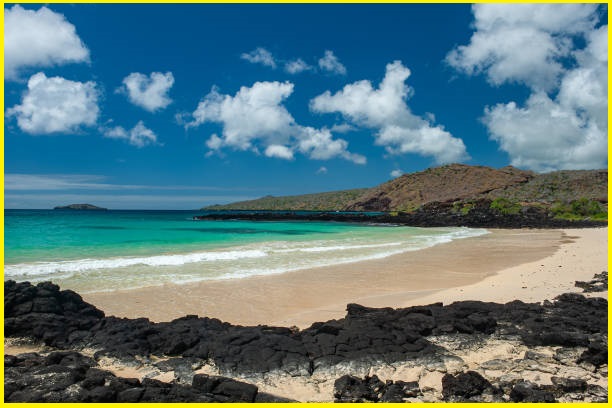
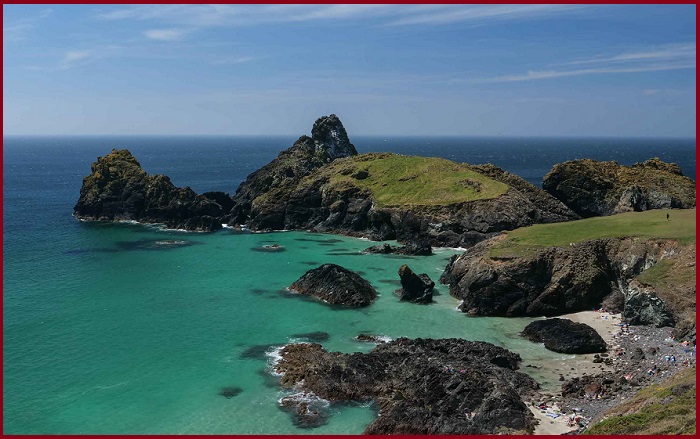
Kynance Cove lies about two miles along the South West Coast Path from Lizard Point. The cove is well known for its remarkable rock formations Specially Serpentinite, which creates dramatic and visually striking coastal cliffs.
The Rocks are mainly serpentinite, found alongside dark grey igneous rocks such as gabbro and banded metamorphic rocks known as amphibolite along the coast of the Lizard Peninsula, extending from Mullion to Porthallow. Together, these distinctive formations are referred to as the Lizard Complex, a geological assemblage that has fascinated scientists for centuries and provides important evidence of an ancient oceanic environment.
In most parts of Cornwall, the geology is dominated by dark, folded slates and light-grey granites. The cliffs at Kynance Cove, however, are quite unusual. They are composed of distinctive dark-green and reddish rocks that have been smoothed and polished by thousands of years of powerful wave action, giving them a glossy surface that resembles snakeskin.
Ancient oceans to the surface: ophiolites and obduction
The rocks of Lizard Complex were originally located several kilometres beneath the Earth’s surface under an ancient ocean. More than 300 million years ago, however, they were pushed upward and emplaced onto the land when two continental plates collided—a geological process known as Obduction.
What is Plate-Tectonic and associated Obduction
The Earth is composed of three main layers: a central core, a surrounding mantle, and an outer crust. This outer crust is divided into several large plates, and the movement of these plates is explained by the theory of Plate Tectonics. In some regions, plates move apart—such as along the Mid-Atlantic Ridge—while in other areas they collide, as occurs near Indonesia.
Where plates diverge beneath the oceans, new oceanic crust forms to fill the gap. This crust develops in layers: the upper part consists of ocean-floor sediments and lava flows, whereas the deeper levels are made up of intrusions of magma that cool and solidify to form gabbro. Beneath this crust lies serpentinite (derived from peridotite), which represents material from the upper mantle. Together, this sequence of oceanic crust and mantle rocks forms what geologists call an Ophiolite, a structure clearly exposed in the rocks of the Lizard Complex.
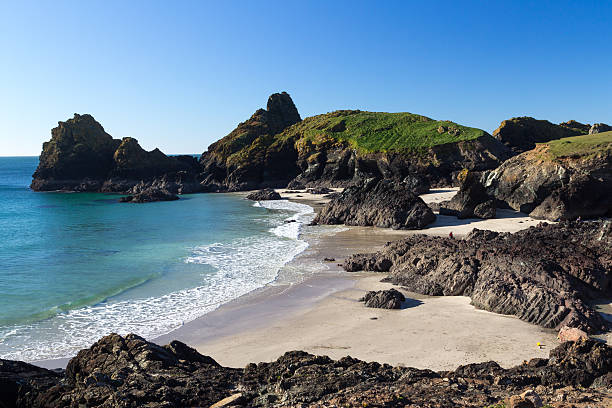
One can walk across the Moho At here
At Coverack, about 11 miles from Kynance Cove, the transition from grey gabbro to red serpentinite can be clearly observed along the beach during low tide.
This boundary between the Earth’s crust and mantle is called the Mohorovičić Discontinuity (Moho), which normally occurs around 7 km beneath the ocean floor. However, Coverack is one of the rare locations in the world where this boundary can be seen directly at the Earth’s surface.
Also read- Siccar Point Scotland: A Revolutionized Iconic Unconformity
Kynance Geotourism
The geomorphology of Kynance Cove is remarkably scenic. At low tide, waves break on both sides of a narrow sand spit that connects the main headland to several sea stacks. This distinctive landscape has developed due to the underlying geology, as the different rock types of the Lizard Complex have eroded at varying rates over time.
A short walk along the cliffs from the Lizard Point Lighthouse to Kynance Cove is highly recommended when visiting Cornwall. The route follows a well-maintained and easily accessible path, and along the way visitors can observe good exposures of serpentinite near the stiles, where frequent foot traffic has polished the rocks smooth.
Kynance Cove and the surrounding coastline are owned and managed by the National Trust. The area forms part of the West Lizard Site of Special Scientific Interest and lies within the Cornwall Area of Outstanding Natural Beauty.
Geology
Around 375 million years ago, molten rock that would eventually form the peninsula lay nearly 10 km beneath the Earth’s surface. When two plates collide, and one plate gets subducted, it is subjected to intense heat and pressure. One of these rocks, peridotite, which is rich in magnesium and iron, was transformed into serpentinite as it rose upward from the Mohorovičić Discontinuity (Moho)—the boundary between the Earth’s crust and mantle.
Eventually, this rock reached the Earth’s crust at a location about 30° south of the equator, forming part of a mid-ocean ridge within the Rheic Ocean. Over the following 80 million years, the Rheic Ocean gradually closed, and the rock mass slowly moved northward. It crossed the equator roughly 250 million years ago, passed the Tropic of Cancer less than 100 million years ago, and finally arrived at about 50° north latitude around the beginning of the last Ice Age.
At Kynance Cove, there are two main varieties of serpentine rock: bastite and tremolite. The rocks found around the car park, the southern cliffs, and the path leading to the cove consist mainly of bastite serpentine, the most common type on the Lizard. This rock is coarse-grained and contains large, shiny bastite crystals that give it a distinctive speckled appearance. In contrast, the small islands, rock stacks within the cove, and the valley are composed of tremolite serpentine, which is finer-grained and shows clear banding. Tremolite differs from bastite because it forms under higher pressures within the Earth’s crust.
Also read- Geotourism And Modern Geotechniques
Kynance Cove is considered an important geological site because it exposes these two types of ophiolitic serpentinite, along with pods of granite and gneiss embedded within the serpentine rocks. Owing to its geological significance, the area has been designated as a **Geological Conservation Review site.
How To Reach Kynance Cove
Kynance Cove on the Lizard Peninsula is most easily reached by car via the A3083 road. Follow the signs toward Lizard and then Kynance Cove until you reach the National Trust car park near the cliffs. From there, visitors must take a steep footpath that descends to the beach, which typically takes about 10–15 minutes. The car park often fills up quickly during summer, so arriving before 10 AM is recommended.
Post Views: 264

 sutikshan