 sutikshan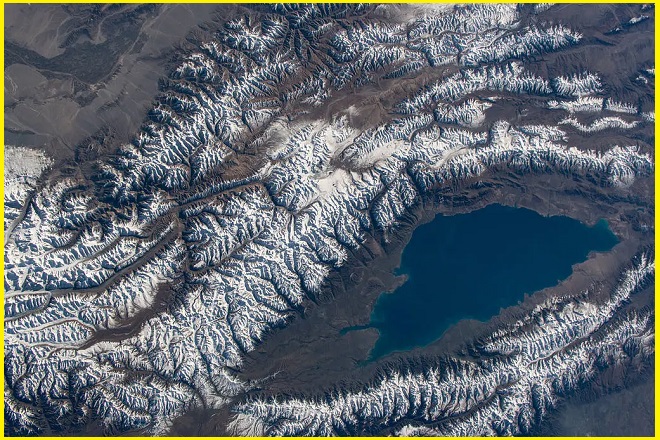
Issyk Kul
Issyk-Kul or Ysyk-Köl, meaning Warm Lake, is a large endorheic saline lake nestled in the western Tianshan Mountains of eastern Kyrgyzstan, just south of the range that separates the country from Kazakhstan. It is the world’s eighth-deepest lake, the eleventh-largest by volume. Despite its high elevation of 1,607 meters and the harsh winters of the region, Issyk-Kul rarely freezes due to its elevated salinity, hence its Kyrgyz name, “warm lake.” Today, the lake is recognized as a Ramsar site for its globally significant biodiversity and is protected as part of the Issyk-Kul Biosphere Reserve.
Geography
Issyk-Kul Lake stretches 182 kilometers in length, up to 60 kilometers in width, and covers a surface area of 6,236 square kilometers. It is the world’s second-largest mountain lake, surpassed only by Lake Titicaca in South America. Situated at an elevation of 1,607 meters, the lake reaches a maximum depth of 668 meters.
Around 118 rivers and streams flow into Issyk-Kul, the largest being the Jyrgalang and Tüp. It is primarily fed by springs, including numerous hot springs, as well as seasonal snowmelt. While the lake has no visible outlet, some hydrologists suggest its waters may seep deep underground and eventually emerge in the Chu River. Notably, the lakebed contains deposits of monohydrocalcite, making it one of the few known lacustrine sites where this mineral is found.
Ramsar Site
The Issyk-Kul State Reserve, Kyrgyzstan’s first nature reserve, was established in 1948 to protect the lake’s unique landscapes and diverse waterfowl. In 1975, Issyk-Kul gained further recognition as a Ramsar site of international importance. Later, in 2000, UNESCO designated the Issyk-Kul Biosphere Reserve as part of its World Network of Biosphere Reserves, covering the entire Issyk-Kul Region to safeguard its rich biodiversity and ecological value.
Also read- Qinghai Lake: China’s Largest Inland Salt Lake
Issyk Kul Resort
Karven Four Seasons
Recreation Center Solemar
Meridian Resort
Guest House Fairy Tale
Issyk-Kul Lake Tourism
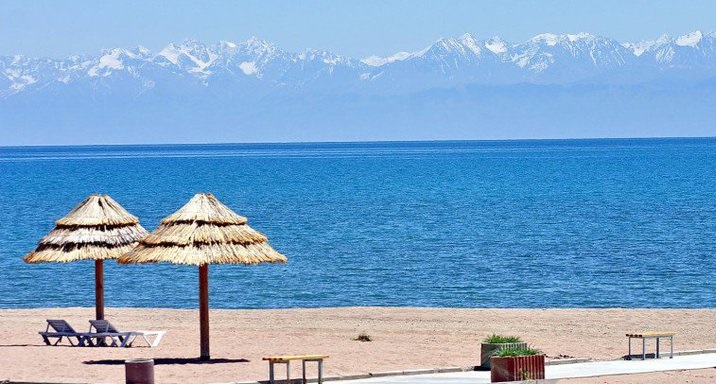
Issyk-Kul Lake is surrounded by mountains and beautiful landscapes. It stretches 182 kilometers in length and about 60 kilometers in width. The lake never freezes despite being surrounded by snow-capped peaks. To the north lies the Kungoi Ala-Too range, whose name means “sunny slopes,” while to the south rises the Terskei Ala-Too range, or “shady slopes.” These mountains help create a mild microclimate around the lake throughout the year.
Roughly 118 rivers and streams flow into Issyk-Kul, including the Jyrgalang, Tüp, and numerous mineral hot springs, yet no river flows out. This closed hydrology contributes to its slight salinity of about 0.6% and to the belief in its healing waters. Several towns and villages are located along its shores, including Karakol, Cholpon-Ata, Balykchy, Bosteri, Kyzyl-Suu, and Bokonbaevo, each serving as gateways for exploring the lake’s cultural and natural beauty.
What to do near Issyk-Kul Lake
Around Issyk-Kul Lake, most of the larger towns and villages offer plenty of dining options. Visitors can enjoy local cafes, restaurants, and even family-run home cafés that serve traditional Kyrgyz dishes. Fresh fruits and vegetables are widely available in local markets, and many guesthouses and homestays provide kitchens where travelers can cook their own meals.
Attraction
Issyk-Kul is surrounded by a wealth of cultural and natural attractions. Nearly every major town and village has an ethnographic museum, with highlights including the Cholpon-Ata Historical Museum, the Przhevalsky Memorial Museum in Karakol, and the Stone Museum in Bokonbaevo.
For nature lovers, scenic gorges lead into the Ala-Too mountain ranges—popular spots include Grigorievsky, Semenovskiy, Jety-Oguz, and Barskoon. The region is also famous for its natural hot mineral springs, found in many villages around the lake such as Tamchy, Chok-Tal, Oruktu, Jyrgalan, Ak-Suu, Jety-Oguz, Saruu, and Bar-Bulak. These springs are not only relaxing but also cherished for their therapeutic qualities.
How to reach Issyk-Kul Lake
The most common way to reach Issyk-Kul Lake is from Bishkek, Kyrgyzstan’s capital. From the city, travelers can take a bus or shared taxi along the main highway, a journey that takes about 4–5 hours. Those flying into Manas International Airport near Bishkek can easily transfer to a taxi or minibus bound for the lake.
Another option is to fly directly into Issyk-Kul International Airport, located closer to the region. For visitors coming from Kazakhstan, Issyk-Kul is also accessible by road, with a scenic drive from Almaty leading directly to the lake’s shores.