 sutikshan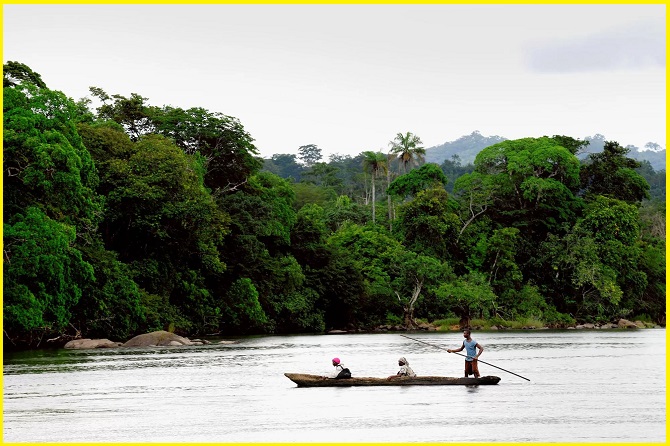
Gola Tiwai Complex
The Gola Rainforest National Park (GRNP) is Sierra Leone’s largest and most diverse tropical rainforest, renowned for its rich flora and fauna. The Tiwai Island Wildlife Sanctuary, situated on the Moa River, covers about 12 sq. km and is home to 11 species of primates, including the endangered western chimpanzee and king colobus monkey. It also supports a wide range of birdlife, reptiles, and freshwater species. Tiwai serves as both a biodiversity research center and a successful model for community-based conservation, demonstrating the harmony between environmental protection and local livelihoods.
Gola Rainforest National Park and the Tiwai Island Wildlife Sanctuary, both integral parts of the Greater Gola Landscape located within the Upper Guinean Forest, a renowned biodiversity hotspot. The region supports over 1,000 plant species, 55 mammal species (19 globally threatened), and iconic wildlife such as the African Forest Elephant and the Pygmy Hippopotamus. It also shelters about 448 bird species, including the endangered White-necked Rockfowl. Abundant in freshwater fish, butterflies, and dragonflies, the site offers vital habitats and ecosystem services, highlighting its outstanding ecological integrity and global conservation importance.
Gola Tiwai complex, Sierra Leone, UNESCO
Sierra Leone’s Gola-Tiwai complex—comprising the Gola Rainforest National Park (GRNP) and the Tiwai Island Wildlife Sanctuary—has been inscribed as the nation’s first UNESCO World Heritage Site, in recognition of decades of sustained conservation efforts spearheaded by the non-governmental organization Environmental Foundation for Africa (EFA).
Also read- Etosha National Park, An Unforgettable African Safari
Tiwai Island
Tiwai Island, situated on the Moa River, covers just 12 sq. km yet supports 11 primate species, including the endangered western chimpanzee and king colobus monkey. Today, it stands as a leading center for biodiversity research and a model of community-based conservation in West Africa.
Tiwai Island lies in Sierra Leone’s Southern Province, about 15 km from the town of Potoru, along the Moa River, and roughly 60 km inland from the Atlantic Ocean. Covering an area of 1,200 hectares, the island rises between 80 and 100 meters above sea level. It experiences a tropical climate with a rainy season from May to October and a dry season from December to March. The average annual temperature is around 27 °C, and the island receives approximately 3,000 mm of rainfall each year.
Rare and Notable Species in Gola Rainforest National Park
Mammals
Pygmy Hippopotamus – elusive and endangered, unique to West African forests. African Forest Elephant – smaller than savanna elephants, vital for forest ecology. Primates: Western Chimpanzee, Diana Monkey, Western Red Colobus, and other rare monkeys.
Birds
White-necked Rockfowl (Picathartes gymnocephalus) – critically endangered and a highlight for birdwatchers.
Over 400 bird species, including several globally threatened and endemic species.
Plants
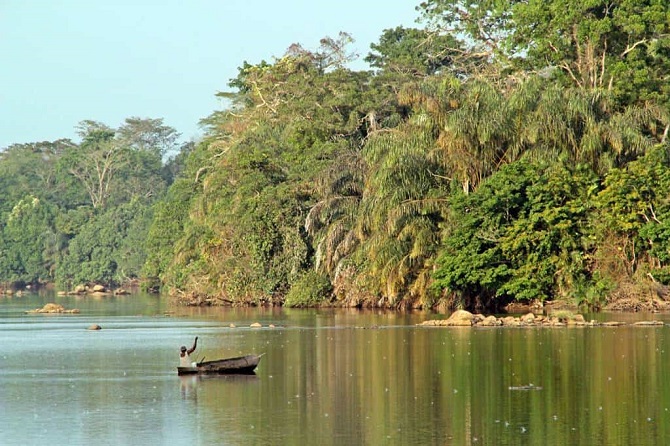
More than 1,000 plant species, with over 100 endemics, forming a crucial genetic reservoir. Rich populations of reptiles, amphibians, butterflies, dragonflies, and freshwater fish.
How to Reach Gola Tiwai Complex
To reach the Gola-Tiwai Complex, travelers must first arrive in Sierra Leone, located on the west coast of Africa. The complex lies within the Upper Guinean Forest in the southeastern part of the country, encompassing both the Gola Rainforest National Park and the Tiwai Island Wildlife Sanctuary. There are no direct public transportation routes to the sites, so access is typically arranged through private or guided travel from nearby towns such as Kenema or Potoru.