 sutikshan
Ramgarh Crater
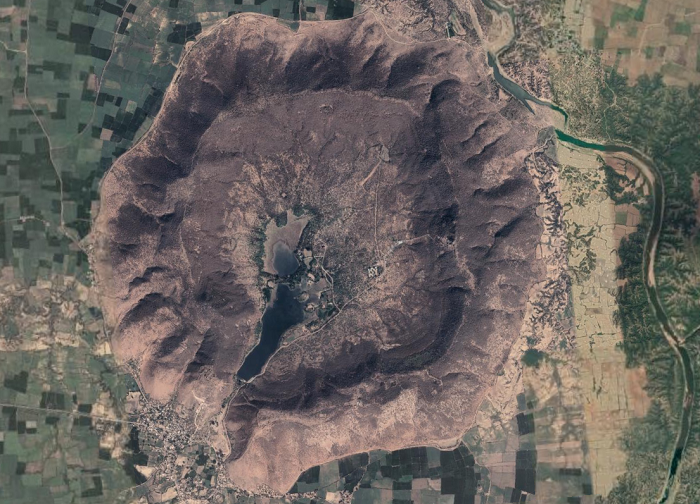
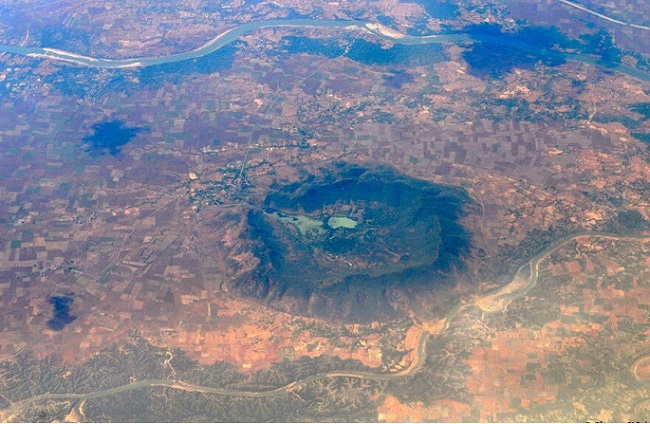
Ramgarh crater, also known as Ramgarh structure and Ramgarh Dome, is a meteor impact crater of 3 kilometres in diameter in the Kota plateau of the Vindhya range located adjacent to Ramgarh village in Mangrol Tehsil of Baran district in Rajasthan, India. Due to the impact of the meteorite, a lake 1 km long and 250 meters wide was formed, which remains today.
Ramgarh crater was first discovered by the Geological Survey of India in 1869. Since then, several geoscientists have conducted studies to determine the origin of the crater. Ramgarh crater has copy-book patterns of a meteorite impact. It is the third crater in India; two already confirmed craters in India are – Dhala in Madhya Pradesh with a 14 km diameter and Lonar in Buldhana district of Maharashtra with a 1.8 km diameter. Ramgarh crater is designated as a National Geological Monument.
Topography and Geology Ramgarh Crater
The Ramgarh Crater is a rectangular-shaped feature with a prominent, more or less continuous, raised rim all along its periphery that rises 250 m above the surrounding and dips outward with angles between 20-40 degrees from the rim crest. The N-S extension of the crater’s rim is 1.4 times its E-W extension. Ramgarh Crater is in a more degraded state compared to Arizona and Lonar Crater. The structure is formed in consolidated sediments that include flat-lying sandstone, shale, along with minor limestone of the Neoproterozoic Vindhyan Super-
group.
In 1869, the crater was first visited by geologist Frederick Richard Mallet of the Geological Survey of India (GSI). A rootless mass of sheared sandstone found near Bandewara temple in the crater indicates a fallback material. After discovering shatter cone and colluvium in the middle of the Ramgarh crater, Crawford, first to suggest that this was an impact crater.
The crater impact evidence is in the form of shatter cones in sandstones, planar deformation features (PDFs), and planar fractures (parallel sets of multiple planar cracks) in quartz grains. Shatter cones are rare geological features and are only known to form in the bedrock beneath meteorite impact craters or underground nuclear explosions. PDFs are also formed by extreme shock compressions on the scale of meteor impacts.
This regional geological structure has invited the interest of various geologists throughout the world since its discovery, and the past five decades have witnessed a number of theories on the origin of this structure.
Shatter has collected near the centrally uplifted region of the Ramgarh structure, which is an ideal location as per the well-established and internationally accepted criteria for their presence. Shatter cones have been found in the sandstones, displaying curved surfaces, with sharp striations, and exhibit horse-tail-like markings.”
Also, read- Global Giant: Olympic Dam Mine, A Massive Known Single Uranium Deposit
Glass resembling rock samples was collected from the impacted site. These spherules contain a very high percentage of iron, along with very high ratios of nickel and cobalt. These high ratios suggest a meteorite strike or extraterrestrial rocks.
Ramgarh rivulet flows in the southwest direction of the crater, and it becomes a tributary of the Parvati river 4 km west. There are several other gullies and rills formed with radial (flowing out ofthe crater) and centripetal (flowing into the crater) drainage. Radial streams flow into the Parbati River, a tributary of the Chambal River. A lake is formed due to the meteorite impact at the center of the Crater.
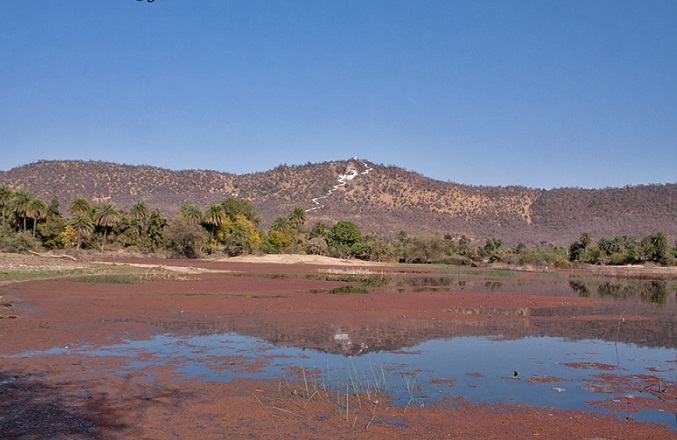
The Bhand Deva Temple, a 10th-century Shiva temple in the style of the Khajuraho Group of Monuments, is located near the center of the crater. Kuno National Park is 60 km away from the crater. Ramgarh Crater lies 110 km from Kota and 250 from Jaipur.
Read- Geotourism And Modern Geotechniques
How To Reach Ramgarh crater
To reach the Ramgarh Crater in Rajasthan, India, travel to Baran district, ideally by flying into a nearby major airport like Kota or Gwalior (though Gwalior is further), then take a taxi or hire a vehicle for the final 40 km journey from Baran to Ramgarh village, as the final stretch is remote and requires your own transport for the best experience.