 sutikshan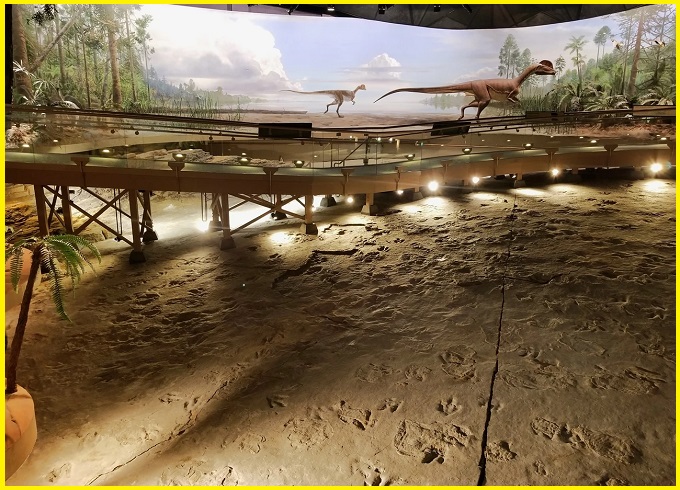
Dinosaur Trackway, Connecticut
The Connecticut River Valley Dinosaur trackways consist of fossilized footprints of various Early Jurassic dinosaurs preserved in the sandstone layers of Massachusetts and Connecticut. This discovery is notable for being among the earliest recorded evidence of dinosaur remains in North America. The initial find turned out to be part of a much larger site containing around 1,500 footprints. Additional tracks were later uncovered nearby, including about 700 more in a smaller area to the west of the original discovery.
Dinosaur State Park was established, and in April 1968, its fossil site was designated a National Natural Landmark. Today, the Dinosaur State Park and Arboretum is managed by the Connecticut Department of Energy and Environmental Protection and attracts tens of thousands of visitors each year.
Footprints and Species
Several types of fossil footprints have been identified at Dinosaur Trackway. The most common are three-toed tracks classified as Eubrontes, made by a large theropod likely similar to Dilophosaurus. These footprints typically measure about 30 to 45 centimeters in length, with a stride ranging from roughly 1.1 to 1.4 meters. Eubrontes was designated Connecticut’s state fossil in 1991, largely due to its prominence at Dinosaur State Park.
Other footprints include those identified as Anchisauripus, attributed to medium-sized theropods (despite the name, not herbivores like Anchisaurus). Additionally, rarer tracks, such as Batrachopus—probably made by a small crocodile-like reptile—and Grallator —created by a small theropod —have also been discovered.
Geology and Stratigraphy
The fossil-bearing track layers belong to a rock unit known as the East Berlin Formation. These fossil-rich beds consist of gray sandstones, siltstones, and mudstones that were deposited near the end of a lake cycle within an ancient rift valley. As a result, some features indicate exposure to air—such as mud cracks and raindrop impressions—while others, including ripple marks and cross-bedding, reflect deposition by water. This setting suggests that dinosaurs and other animals once roamed around the edges of a shallow lake.
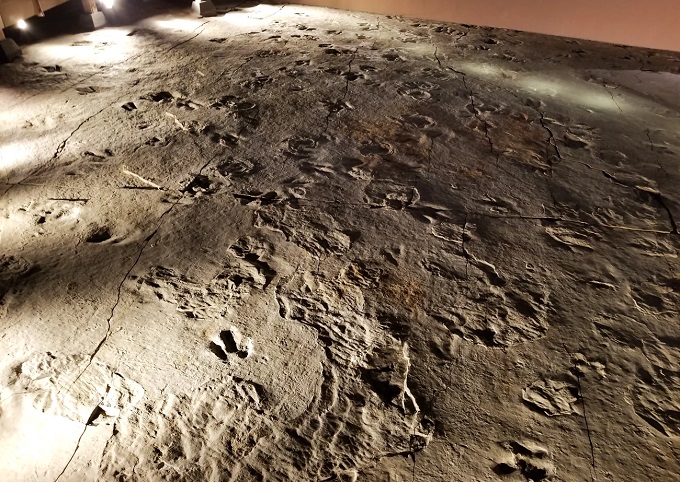
By correlating these layers with similar strata found elsewhere, scientists have determined that basalt beds from ancient lava flows occur about 42 meters above the track-bearing layers, indicating that the tracks are roughly 200 million years old, dating to the early Jurassic period. Today, the rock layers slope southward due to rifting processes active during and after their formation.
Also Read- The Night the Canyon Moved: Terrifying Madison Slide, Montana
How Connecticut Dinosaurs’ Imprints
The Connecticut River Valley is one of several regions in eastern North America where long, narrow, and deep rift valleys developed between about 230 and 190 million years ago, from the Late Triassic to the Early Jurassic, as the supercontinent Pangaea began to break apart. During that time, New England lay much farther south in tropical latitudes, making its climate significantly warmer than it is today. As North America gradually drifted away from Africa and other landmasses, a series of rift valleys formed parallel to what would later become the Atlantic Ocean.
Over time, these basins were intermittently filled with lava flows, lakes, rivers, and floodplains, preserving evidence of ancient life from periods when conditions were suitable. Although body fossils of land-dwelling vertebrates such as dinosaurs are rare, thousands of fossilized footprints have been discovered. These tracks reveal the presence of bipedal carnivorous dinosaurs (theropods) similar to Coelophysis and the larger crested Dilophosaurus, along with early relatives of sauropods like Anchisaurus and small, beaked herbivorous dinosaurs.
Also read- Geotourism And Modern Geotechniques
Because most of these dinosaurs are known only from their footprints, scientists have assigned special names to the track types. For instance, the numerous small theropod tracks are called Grallator, while the more common large theropod tracks are known as Eubrontes. The dinosaurs that created these tracks likely lived and hunted along the margins of lakes and streams, possibly feeding on fish and other aquatic life.
How to Reach Dinosaur Trackway, Connecticut
Dinosaur State Park, which preserves an extensive 200-million-year-old fossil trackway, is located at 400 West Street in Rocky Hill, Connecticut (06067). The park is conveniently accessible via I-91 (Exit 23) and is open daily from 9 AM until 30 minutes before sunset. Admission to the grounds, arboretum, and indoor exhibit center is free of charge.