 sutikshan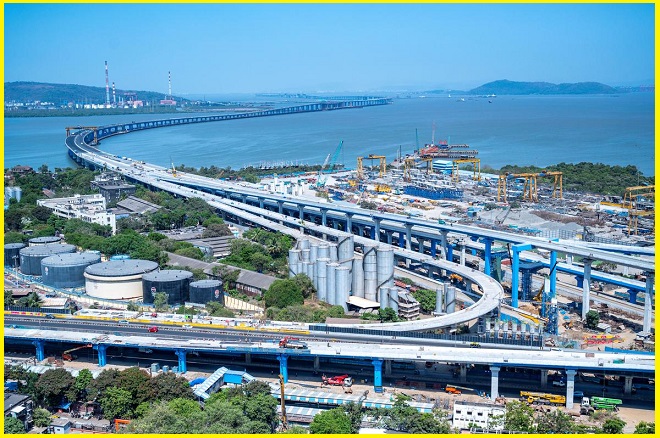
Atal Setu Bridge
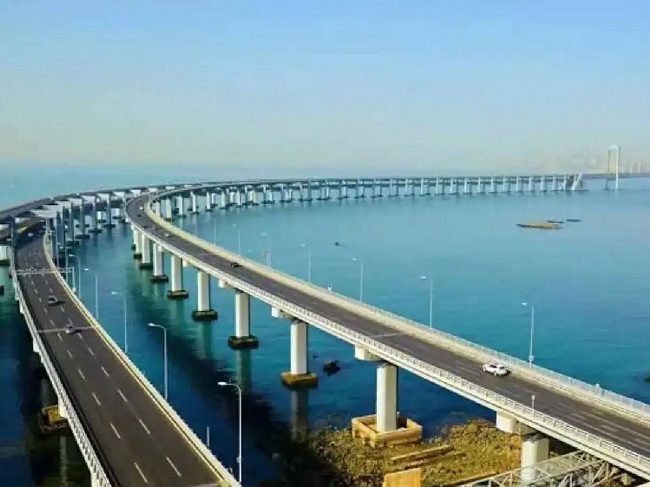
The Mumbai Trans Harbour Link, officially named Atal Bihari Vajpayee Sewri–Nhava Sheva or Atal Setu Bridge, is a 21.8 km long, six-lane, grade-separated expressway bridge connecting Mumbai with its satellite city, Navi Mumbai. It is India’s longest sea bridge and the 12th longest in the world. Starting from Sewri in South Mumbai, the bridge crosses Thane Creek north of Elephanta Island and ends at Chirle near Nhava Sheva in Uran taluka, Navi Mumbai. It links the Mumbai–Pune Expressway in the east with the upcoming Coastal Road in the west. The highway is 27 meters wide, featuring six lanes, two emergency exit lanes, edge strips, parallel crash barriers, and noise barriers on both sides. Built at a cost of ₹17,843 crore, the bridge can handle up to 70,000 vehicles daily. Construction began in April 2018, and Prime Minister Narendra Modi inaugurated the bridge on 12 January 2024.
The Mumbai Trans Harbour Link comprises a 16.5 km sea bridge and 5.5 km of land viaducts at both ends. Built in three sections, its construction required around 165,000 tonnes of reinforcement steel, 96,250 tonnes of structural steel, and 830,000 cubic metres of concrete. Notably, the bridge features India’s first use of orthotropic steel decks, which allow longer spans than conventional girders. A total of 70 such decks were installed, using about 96,250 tonnes of steel. These steel spans, weighing up to 2,600 tonnes, cover 4.7 km of the bridge, while the remaining sections consist of 60-metre-long concrete spans, each weighing up to 130 tonnes. The 4.7 km steel deck section forms the highest point of the bridge and includes a 180-metre span, the longest steel span in India, along with smaller spans, the shortest of which is 110 metres. The Mumbai Metropolitan Region Development Authority (MMRDA) opted for steel spans in these sections to avoid constructing supporting pillars in the channel, ensuring unhindered passage for ships.
Project Description
Atal Setu Bridge is a highly complex marine and foundation engineering project, as it stretches across a vast body of water with varying depths and challenging geological conditions. Marine construction presents unique difficulties, including corrosive saltwater, strong tidal forces, and potential seismic activity. The diverse seabed — comprising multiple soil types, rock formations, and debris — required the use of specialized equipment and advanced techniques to guarantee the bridge’s structural integrity and long-term durability.
Depending on the ground strata, the foundations for the intertidal and marine sections of the bridge were built using piles or columns, while open foundations were adopted for the land and interchange sections. The pile foundations were installed through reverse circulation drilling — a percussion drilling method that uses compressed air to flush cuttings from the drill hole, ensuring stability, efficiency, and safety. An additional advantage of this technique was the significant reduction in construction noise. The excavated material was collected on designated disposal barges and transported to approved sites, ensuring zero water pollution and minimal disturbance to marine life.
Atal Setu Future Role
One of the most transformative roles of the Atal Setu (MTHL) goes far beyond cutting travel time—it’s how it unlocks the future potential of Navi Mumbai, particularly with the upcoming Navi Mumbai International Airport (NMIA). Once NMIA becomes fully operational, thousands of travellers, business professionals, and logistics operators will require seamless, direct access from Mumbai and across the MMR (Mumbai Metropolitan Region). That’s where the Atal Setu proves invaluable. By linking Sewri in South Mumbai to Chirle in Navi Mumbai—just minutes away from the NMIA site—it ensures fast and convenient connectivity.
What was once a two-hour slog through central Mumbai’s traffic will now take only 30–40 minutes, making airport commutes smoother, quicker, and far less stressful while easing congestion on the city’s internal roads.]
Also read- Landmannalaugar Iceland: Trails, Springs, and Scenic Wonders
Bird watching spot
A 5.6 km temporary access bridge was built to transport equipment and workers during the construction of the MTHL. In November 2021, the MMRDA announced that instead of demolishing the structure, it would be repurposed as a bird-watching platform, offering views of flamingos and other migratory birds. The decision not only promotes eco-tourism but also saves the cost of demolition.
Location of the Mumbai Trans Harbour Link
The Atal Setu bridge will start from Sewri in South Mumbai, span across Thane Creek to the north of Elephanta Island, and end at Chirle village near Nhava Sheva.