sutikshan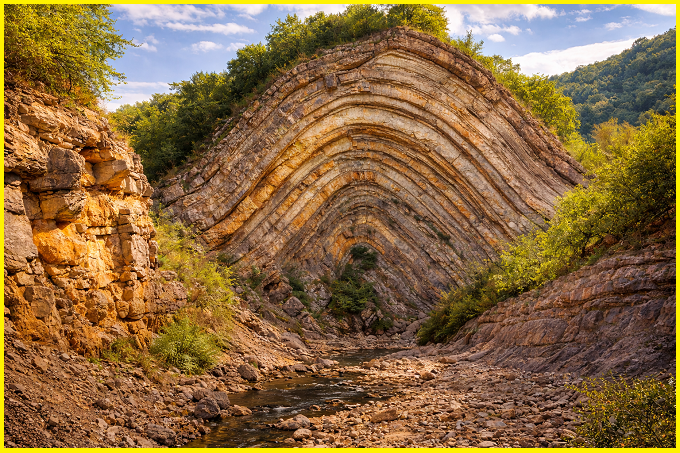
Valmeyer Anticline, Illinois
The Valmeyer Anticline, located southwest of the Waterloo–Dupo Anticline, trends northwest and exhibits a pronounced asymmetrical structure. The crest of the fold exposes the Kimmswick Limestone (Middle Ordovician), while Mississippian strata are present along both flanks. The southwest limb dips steeply at angles of 15° to 25°, whereas the northeast limb has a much gentler inclination. Excellent outcrops are located along Illinois Route 156 in Dennis Hollow and in the bluff face at the Columbia Quarry Plant No. 3.
Location
Strata of the Valmeyer Anticline are well exposed in road and stream cuts along Illinois 156, which runs through Dennis Hollow from the eastern edge of Valmeyer to about 2.4 km east of the town in Monroe County. Additional exposures occur along the bluff face at Columbia Quarry Plant No. 3, located approximately 1.5 km north of Valmeyer.
The outcrops along Illinois 156 are easily accessible, requiring no more than a 100 m walk from the highway. Parking is limited to a few grassy pullouts along the south side of the road and near private driveways. As the land north of Illinois 156 is privately owned by multiple individuals, visitors should obtain permission from nearby residents before accessing specific outcrops.
Oil Production
Unlike the similar Waterloo-Dupo Anticline, the Valmeyer Anticline does not produce oil. Because the Kimmswick (Trenton) Formation—an important producing horizon in the Waterloo and Dupo fields—has been eroded at the crest of the Valmeyer Anticline.
Also read- Discover the Powerful Thomson Dikes: A Rare Diabase Intrusion System
SALT LICK POINT
At Valmeyer, an ancient structural uplift known as the Valmeyer Anticline has formed prominent, high bluffs that project into the valley. This feature, called Salt Lick Point due to its saline deposits, offers a vantage point and has long attracted human activity. In addition to the salt licks-likely drawing deer and other wildlife—prehistoric communities visited the area to obtain chert exposed within the bluffs. Recent archaeological studies indicate that several of these chert varieties were widely used for chipped-stone tools throughout the prehistoric period. Historical records also show that early American settlers established a saltworks at this site. While it is likely that prehistoric groups also utilized the saline deposits, this has not yet been conclusively proven.
Also Read- Geotourism And Modern Geotechniques