sutikshan
Rare Earth Minerals and Green Technologies
Rare Earth Minerals (REMs) are crucial for green tech (EVs, wind turbines, solar) but pose supply chain & environmental challenges, with China dominating processing; the future involves diversifying supply, investing in domestic refining, recycling, and developing substitutes like high-entropy alloys to meet soaring demand, balancing the need for a sustainable energy transition with resource security and ecological impact.
Rare earth elements such as neodymium and dysprosium are extensively used in motors for electric vehicles, robots, and drones because they enable the production of powerful, lightweight, and highly efficient magnets.
These magnets have allowed companies like Tesla to develop EV motors that deliver high torque with minimal energy consumption, enhancing overall efficiency, and they are equally essential in high-performance robotics, where compact and powerful motors are required for precise operations.
Global demand for rare earth elements is increasing rapidly. The International Energy Agency (IEA) estimates that rare earth production will need to expand multifold by 2040 to meet the requirements of the clean energy sector. Although supply chains of REEs remain highly concentrated, with China responsible for over 60% of global rare earth mining and nearly 90% of refining capacity.
As a result, expanding and diversifying the global rare earth supply chain has become an urgent priority. Many countries are taking active steps to reduce these risks by developing alternative sources.
Green Technology
Green technology refers to the design and application of technologies that reduce the environmental and societal impacts of human activities. It includes a broad spectrum of products, services, and practices aimed at promoting sustainability and a more environmentally responsible future.
Green technology solutions are intended to be sustainable, addressing present needs without undermining the ability of future generations to meet theirs. They aim to minimize environmental impacts through approaches such as the use of renewable energy sources and an emphasis on energy efficiency.
Also Read- Volcanic Lightning and Fire Clouds: Earth’s Dazzling Phenomenon
Green technology strategies also adopt a life-cycle perspective, considering impacts from raw material extraction through production, use, and end-of-life disposal. Within a circular economy framework, advocates seek to assess the full environmental footprint of technologies while also accounting for their effects on local communities, workers, and consumers, ultimately striving to develop innovative solutions that deliver broad societal benefits.
4 Pillars of green technology
1. Energy efficiency: Green technology emphasizes lowering energy consumption and improving efficiency across operations, systems, and processes. This includes advancements such as energy-efficient appliances, smart grids, LED lighting, and enhanced insulation methods that reduce energy losses and emissions.
2. Renewable energy: Transitioning from fossil fuels to clean, renewable energy sources is a fundamental principle of green technology. Harnessing solar, wind, hydroelectric, geothermal, and biomass energy enables sustainable energy production while reducing greenhouse gas emissions and dependence on finite resources.
3. Waste reduction and management: This pillar focuses on minimizing waste through recycling, reuse, and circular economy approaches. Technologies that transform waste into useful resources—such as waste-to-energy systems—along with innovations in sustainable packaging, help decrease landfill use and environmental impacts.
4. Sustainable design and innovation: Green technology promotes the development of products, infrastructure, and systems that limit environmental harm. This includes the use of eco-friendly materials, biodegradable products, and nature-integrated technologies. Sustainable design prioritizes durability, efficient resource use, and a reduced environmental footprint.
Key Application Area
Electric Vehicles (EVs): Neodymium (Nd), Praseodymium (Pr), Dysprosium (Dy), and Terbium (Tb) are vital for powerful permanent magnets in EV motors.
Wind Turbines: Neodymium and Dysprosium create efficient, compact generators.
Solar Panels & LEDs: Cerium (Ce), Lanthanum (La), and Europium (Eu) are used in solar cells and brighter LED lighting.
Hydrogen Tech: Platinum Group Metals (PGMs) are key for fuel cells.
What are Rare Earth Elements (REEs)
Rare Earth Elements (REEs), also known as Rare Earth Minerals (REMs), comprise 17 chemically similar elements—the 15 lanthanides along with scandium and yttrium—that are vital to modern technology because of their distinctive magnetic, optical, and catalytic properties. They are used in a wide range of applications, from smartphones and electric vehicles to lasers and wind turbines, and although termed “rare,” they are relatively abundant in the Earth’s crust but difficult to concentrate economically.
Geology
The application of rare earth elements (REEs) in geology is fundamental to understanding the petrological processes involved in the formation of igneous, sedimentary, and metamorphic rocks. In geochemistry, REEs are particularly valuable for interpreting the processes that have influenced a rock because subtle differences in their atomic sizes lead to preferential fractionation of certain elements relative to others, depending on the petrological mechanisms at play.
Sources of REEs
Carbonatites (e.g., Mountain Pass, USA)
Alkaline igneous rocks
Ion-adsorption clays (common in southern China)
Monazite & Bastnäsite minerals
Marine placers & deep-sea nodules
India and REEs
India’s rare earth (RE) resources are reported to be the fifth largest in the world. However, these resources are relatively low in grade and are commonly associated with radioactivity, making extraction a prolonged, complex, and costly process. In addition, India’s deposits are dominated by light rare earth elements (LREEs), while heavy rare earth elements (HREEs) are not available in economically extractable quantities.
The rare earth sector requires a long and complex value-chain ecosystem to progress from reserves to finished products, involving numerous stages and processing facilities. These stages include obtaining statutory clearances, mining, mineral beneficiation, RE extraction, separation, oxide refining, metal production, and alloy manufacturing. For rare earth magnets specifically, alloys must be converted into magnets, which are then incorporated into final applications such as motors for energy-efficient appliances. Notably, rare earths are used only in very small quantities in finished products.
While India has established capabilities in mining, separation, oxide refining, and has also developed metal extraction facilities, industrial-scale infrastructure beyond this stage—such as alloy and magnet manufacturing—remains largely absent. In these alloys, rare earths constitute only a minor component, and several other materials are required alongside REEs. Although activities from the metal extraction stage onward fall under the free category, intermediate industries have not developed due to the lack of access to appropriate technologies.
Indian Deposit
India possesses an estimated 13.07 million tonnes of in-situ monazite resources, containing approximately 55–60% total rare earth element (REE) oxides. These resources occur mainly in coastal beach placer sands across parts of Kerala, Tamil Nadu, Odisha, Andhra Pradesh, Maharashtra, and Gujarat, as well as in inland placer deposits in Jharkhand, West Bengal, and Tamil Nadu. In value terms, more than 80% of rare earth usage is attributed to permanent magnets, which rely on magnetic REEs such as neodymium, praseodymium, dysprosium, and terbium—elements that are especially critical for energy transition technologies. Among these, dysprosium and terbium are high-value REEs but are not present in extractable quantities in Indian reserves currently under exploitation.
Indian deposits primarily yield neodymium and praseodymium, which are being extracted at purity levels of up to 99.9%. However, their concentrations in beach sand mineral (BSM) ores are low, ranging from 0.0011% to 0.012%. The mineabilty of REEs is further limited by Coastal Regulation Zone (CRZ) restrictions, as well as the presence of mangroves, forested areas, and human habitation.
India currently can exploit its light rare earth resources up to the stage of metal extraction. In terms of international collaboration, Toyotsu Rare Earths India Limited, Visakhapatnam—a subsidiary of Toyota Tsusho Corporation, Japan—is engaged in rare earth refining, sourcing rare earth concentrates from Indian Rare Earths Limited (IREL).
Rare Earth Extraction
Rare earth extraction relies on complex chemical processes to separate individual rare earth elements (REEs) from ores, largely because of their closely similar properties. Hydrometallurgical techniques—particularly solvent extraction—are the most widely used, alongside methods such as acid leaching and ion exchange. In addition, emerging approaches, including bioleaching and electrochemical techniques, are being developed to recover REEs from both primary ores and recycled materials, to lower environmental impacts and reduce costs.
Efforts to Explore REEs
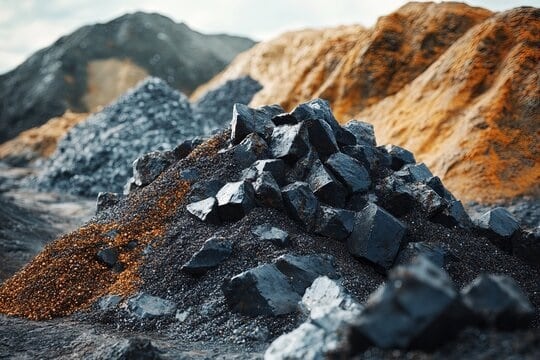
As efforts are made to diversify the global rare earth supply chain, many companies are actively exploring new deposits. Countries such as Australia, the United States, and Brazil host some of the largest rare earth reserves outside Asia, and mining companies in these regions are increasingly beginning to develop this potential.
Partnerships between governments and private industry are essential for advancing innovative extraction and refining technologies, enabling these regions to reduce global reliance on a single supplier while simultaneously supporting strong environmental, social, and governance (ESG) objectives.
Read- Geotourism And Modern Geotechniques
Concusion
Rare earth minerals are the invisible backbone of modern technology and a cornerstone of the global transition toward a sustainable, low-carbon future. From renewable energy systems and electric vehicles to advanced electronics, defense technologies, and medical devices, these critical minerals enable innovations that shape contemporary life. As demand for clean energy and high-performance technologies continues to rise, the strategic importance of rare earth minerals will only intensify.
However, their extraction and processing pose significant environmental, economic, and geopolitical challenges. Sustainable mining practices, efficient recycling, technological innovation, and responsible supply-chain management are essential to reduce ecological impacts and ensure long-term availability. In this context, rare earth minerals are not merely resources but strategic assets whose careful management will play a decisive role in balancing technological progress with environmental stewardship and global sustainability.