sutikshan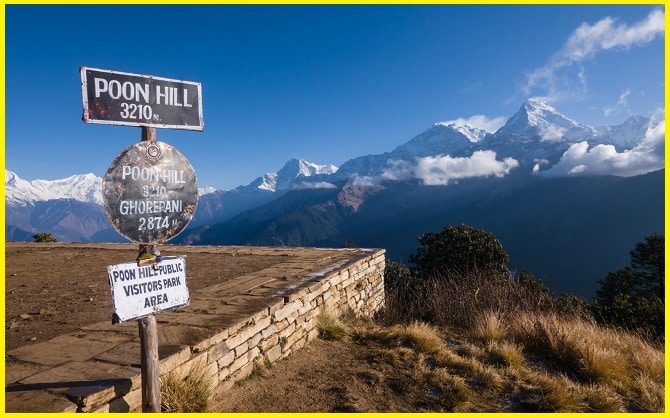
Poon Hill Nepal
Poon Hill or Pun Hill is a famous hill station and the key viewpoint on the Ghorepani Poon Hill trek in Nepal’s Gandaki Province. Located on the border of Myagdi and Kaski Districts, it offers stunning panoramic views of the Annapurna Massif and Dhaulagiri mountain ranges. Visitors can see towering peaks, including Annapurna (8,091m), Dhaulagiri (8,127m), Annapurna South (7,219m), and Machhapuchhare (6,993m). The viewpoint is situated within the Annapurna Conservation Area.
Ghorepani Poon Hill Trek
The Ghorepani Poon Hill Trek in Nepal is a highly sought-after, short Himalayan journey that offers immense rewards. This famous viewpoint, nestled in the Myagdi district, provides an unforgettable vista, including direct views of the mighty Mt. Dhaulagiri 8,167m and the surrounding Annapurna and Dhaulagiri mountain ranges. The Poon Hill Trek is a gentle, circular, lower-elevation route perfect for all trekkers, especially families and beginners, offering a 360-degree Himalayan panorama with great food and lodging. The best time to go is April, when the rhododendrons are blooming, but it can be done any time of year.
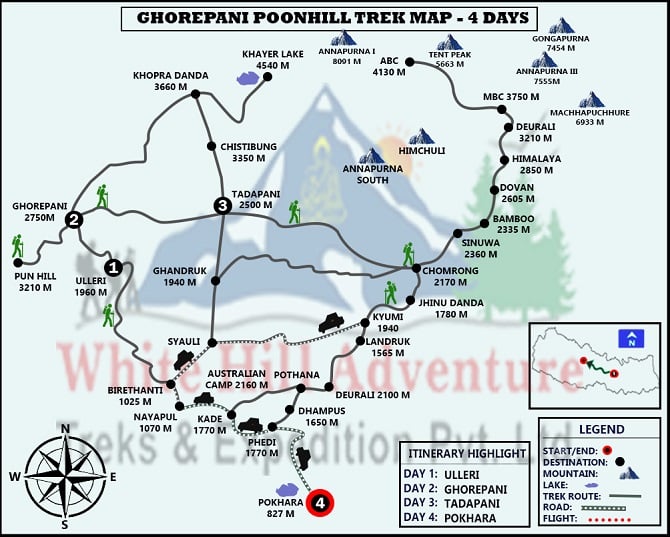
Poon Hill Trek Map
Poon Hill is located 270 km west of Kathmandu, the capital of Nepal. The hike to Poon Hill from Pokhara takes 2–3 days. The Poon Hill trek begins at Nayapul, which is a $1.5$-hour drive from Pokhara. Along the route, trekkers pass through the beautiful villages of Ulleri, Ghorepani, and Ghandruk.
Poon Hill Trek Itinerary
The Poon Hill trek is a popular, easy-to-moderate 3-5 day circuit in Nepal’s Annapurna region, typically starting and ending near Pokhara. A 4-day itinerary is highly recommended for a balanced cultural and scenic experience. This itinerary is highly popular and forms a loop, returning via Ghandruk to ensure trekkers do not repeat the same section of the trail.
| Day | Summary | Key Activities & Elevation |
| Day 1 | Pokhara to Ulleri | Morning: Drive from Pokhara to Nayapul (1.5-2 hrs). Trek: Begin the trek, passing Tikhedhunga, and climbing the steep stone steps to Ulleri 2,050m. (Total Trek: 5-6 hours) |
| Day 2 | Ulleri to Ghorepani | Trek: A gradual ascent through dense rhododendron and oak forests, passing villages like Banthanti. Arrive at Ghorepani 2,860m. A ridge village known for its excellent views. (Total Trek: 4-5 hours) |
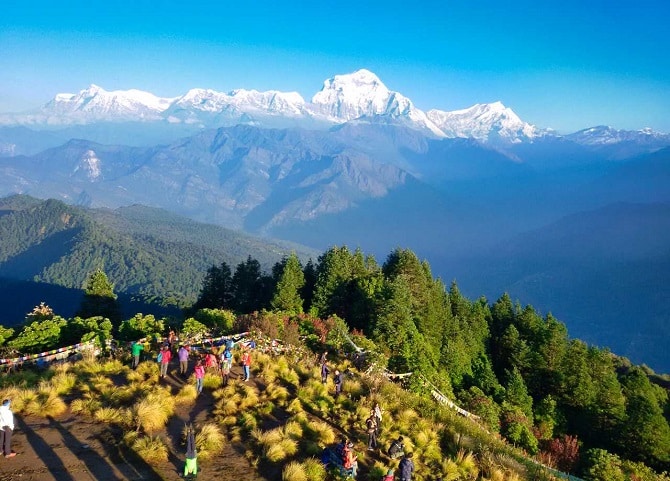
| Day 3 | Poon Hill & Tadapani | Early Morning: Hike (1 hour) to the Poon Hill viewpoint, 3,210m. for a breathtaking sunrise panorama over the Dhaulagiri and Annapurna ranges. Trek: Descend for breakfast, then trek through forests to Tadapani 2,630m. offering great views of Annapurna South. (Total Trek: 4-6 hours) |
| Day 4 | Ghandruk to Pokhara | Trek: Descend through lush forest to the large, traditional Gurung village of Ghandruk, 1,940m. Explore the village and museum. Afternoon: Drive by jeep/bus from Ghandruk/Kimche back to Pokhara (approx. 3-4 hours drive). (Total Trek: 3 hours) |
Shorter 2 or 3-day itineraries are available, primarily designed for those with limited time. These condensed versions use jeep transfers to strategic points (like Ulleri or Hile) to bypass initial sections, enabling trekkers to cover the necessary ground more quickly.
Also Read- Pokhara Itinerary, Exploring Nepal’s Natural Gem
| Feature | Description |
| Difficulty | Easy to Moderate |
| Highest Point | Poon Hill Summit 3,210m. |
| Accommodation | Teahouses (basic mountain lodges) |
| Required Permits | TIMS Card and ACAP (Annapurna Conservation Area Project) Permit |
| Best Seasons | Autumn (September–November) for clear mountain views, and Spring (March–May) for rhododendron blooms. |
Annapurna Base Camp Trek via Poon Hill
The Annapurna Base Camp (ABC) Trek via Poon Hill is a popular moderate-to-challenging journey in Nepal, typically completed in 10-14 days. Starting near Pokhara, the route traverses diverse landscapes and includes the essential early morning detour to Poon Hill for sunrise views of the Annapurna Massif. Trekkers stay in teahouses and require both the ACAP and TIMS permits. The best times to go are during the clear skies of spring and autumn.
Read- Geotourism And Modern Geotechniques
| Feature | Details |
| Duration | 10-14 days (depending on the route) |
| Difficulty | Moderate to Challenging |
| Highest Point | Annapurna Base Camp 4,130m. |
| Accommodation | Teahouses and lodges are available along the route. |
| Mandatory Permits | TIMS Card and ACAP (Annapurna Conservation Area Permit). |
| Best Seasons | Spring (March–May) and Autumn (September–November). |
| Key Highlights | Sunrise from Poon Hill, panoramic views of the entire Annapurna range, traversing rhododendron forests, and experiencing traditional Gurung/Magar villages. |