sutikshan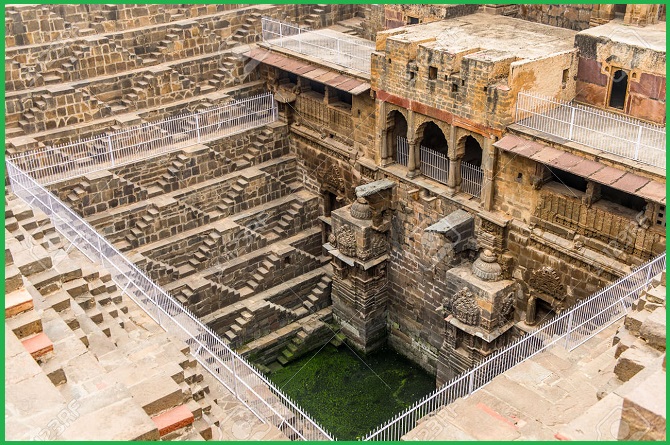
Chand Baori
Chand Baori, situated in the village of Abhaneri, is one of Rajasthan’s oldest and most remarkable stepwells. Though located in a remote corner of Rajasthan, Chand Baori remains one of India’s most captivating yet lesser-known monuments.
The village celebrated for its breathtaking architecture—3,500 precisely aligned steps, forming an intricate geometric pattern that seems to descend endlessly into the earth.
Commissioned in the 9th century by King Chanda of the Nikumbha dynasty, it ranks among the largest stepwells in the world, ingeniously designed to collect and store water while offering refuge from the region’s relentless heat. The Step well is 30 meters deep in the earth.
The dramatic play of light and shadow along its narrowing tiers highlights its engineering brilliance. Three sides of the well descend in double flights of steps leading to the water, while the fourth side is crowned by a three-storey pavilion adorned with carved jharokhas, galleries, and balconies once reserved for royal use.
Standing beside the stepwell is the Harshat Mata Temple, dating from the 9th–10th century and dedicated to the village’s presiding goddess of joy and happiness, who is believed to bless the surrounding land and waters.
Chand Baori Stepwell
Chand Baori is regarded as one of India’s oldest surviving stepwells. Three of its sides are lined with 3,500 tightly arranged steps that descend 13 levels into a deep central tank, while the fourth side features multiple tiers of pillared corridors. The precision of its geometric, diamond-patterned steps—combined with the sculpted image of Sheshashayi Vishnu reclining on the serpent Ananta—makes the structure architecturally striking. Designed in an inverted pyramid form, the stepwell corresponds to the Vijay Vapi style described in classical Indian architectural texts such as the Aparajitapriccha and Vishvakarma’s Vastushastra.
Each of the three stepped sides contains double flights of stairs across ten landings. On the north side, the pillared wall includes two offset shrines—one dedicated to Ganesha and the other to Mahishasuramardini. The Ganesha shrine is topped with a chaitya arch adorned with carvings of a female dancer and attendants, along with numerous other sculpted figures. Higher up on the structure are reliefs of Uma-Maheshwara and Durga as Simhavahini, reflecting later modifications and repairs made during the medieval period, when the well was still in active use.
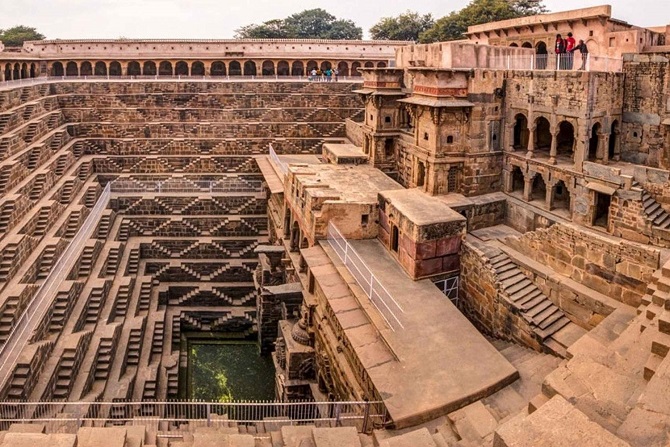
Over time, the stepwell underwent several additions for both aesthetic and practical purposes, including a pillared veranda surrounding all four sides and a small chamber known as Anderi Ujala, once used for drawing water with a pulley system. Local legend even claims that a secret tunnel once connected Abhaneri to the nearby town of Dausa.
Also read- 5 Unique Destinations for weekend getaways from Delhi
Chand Baori History
Chand Baori is believed to have been named after Raja Chanda of the Nikumbh dynasty, although no inscriptions confirm the patron or the exact date of its construction. Its architectural style and carvings closely resemble those of the terraced temples at Paranagar and Mandore, placing its origin in the 8th–9th century—likely predating the nearby Harshat Mata Temple. As noted by Morna Livingston in Steps to Water: The Ancient Stepwells of India, Chand Baori is unusual in that it reflects “two classical periods of water building in a single setting.”
The earliest sections of the stepwell date back to the 8th century, while a later palace structure—identified by its arched galleries—was added during the Chauhan dynasty’s rule. Beside the stepwell once stood the richly sculpted Harshat Mata Temple, built in the 7th–8th century but later damaged during the raids of Mahmud of Ghazni. Many of its pillars, statues, and decorative fragments now lie scattered around the site, with some preserved by the Archaeological Survey of India in the baori’s surrounding corridors. The Mughals also defaced several interior sculptures of the well.
Also read-Business Leaders Successs story
Like many ancient stepwells, Chand Baori served more than just a utilitarian function. It offered water, rest, and shade to weary pilgrims and played an important role in religious and ceremonial life. The adjacent temple of Harshat Mata—worshipped as the goddess of joy—once formed a sacred complex together with the well. Despite centuries of damage, Chand Baori remains one of western India’s most remarkable examples of subterranean architecture, preserving a tradition that has endured since the 7th century.
Chand Baori Haunted Story
A popular local legend claims that Chand Baori was built in a single night by a djinn (spirit), and that no human can climb back up using the same steps they used to descend. Although the stepwell is a genuine 9th-century engineering feat created for water conservation, this tale adds an air of mystery to its already maze-like design.
The Legend: According to folklore, a djinn constructed the entire stepwell overnight. The Curse: Because of its supernatural origin, it is said that no person can descend one staircase and return by the same route. The Atmosphere: Its geometric depth and endless rows of steps, especially at dusk, give the site an eerie, almost otherworldly feel.
The History: In reality, Chand Baori was commissioned by King Chanda in the 9th century and served as a water reservoir and community space. With 3,500 steps and 13 levels, it remains one of the deepest and largest stepwells in India.
Today: Despite the ghost stories, the site attracts thousands of visitors and has even appeared in several films, blending myth, history, and cinematic appeal.
Chand Baori Step Well
Chand Baori is a striking design that consists of a steep, stepped passage that descends through thirteen levels—about five to six storeys underground—linked by roughly 3,500 narrow steps. It is located in Rajasthan’s arid landscape, and the structure was ingeniously engineered to collect and conserve precious rainwater.
References to the construction and management of wells, reservoirs, canals, and dams appear throughout ancient Indian texts, and Chand Baori exemplifies this sophisticated understanding by uniting multiple water-harvesting methods within a single site. The temperature at the base of the well remains about 5–6 °C cooler than at ground level, offering a cool retreat for visitors escaping the desert heat. On one side, a haveli-style pavilion contains chambers that once served as resting quarters for royalty.
How to Reach Chand Baori
You can reach Chand Baori by taking a train from Jaipur to Bandikui and then hiring a taxi or jeep to Abhaneri, where the stepwell is located. Alternatively, you can drive directly from Jaipur or other major cities. From Bandikui, local transport options such as shared jeeps and taxis also travel to Abhaneri or the nearby village of Gular.