sutikshan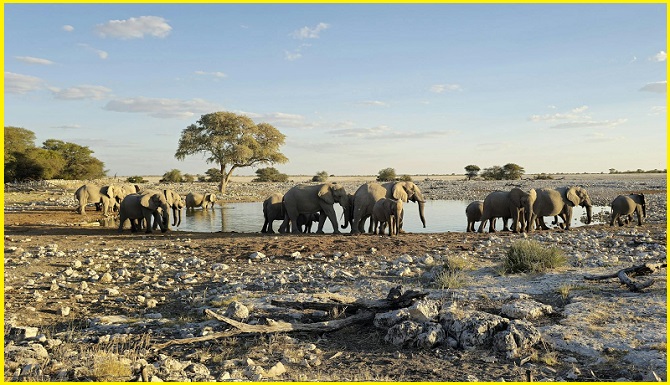
Etosha National Park
Etosha National Park, located in northwestern Namibia, is one of Africa’s largest national parks. First proclaimed a game reserve in March 1907, it was later declared a Wildschutzgebiet in 1958 and officially granted national park status in 1967. Covering 22,270 km², the park takes its name from the vast Etosha Pan, which alone spans 4,760 km² and accounts for 23% of its total area. Etosha provides habitat for hundreds of mammal, bird, and reptile species, including threatened and endangered wildlife such as the black rhinoceros. The park lies in the Kunene Region and borders the regions of Oshana, Oshikoto, and Otjozondjupa.
As the gateway to northern Namibia and Ovamboland, Etosha National Park is a must-visit stop on any Namibian journey. Above all, it stands as the country’s premier wildlife sanctuary, renowned for its diverse and dramatic landscapes that support an exceptional variety of animals. Visitors may encounter lions, elephants, leopards, giraffes, cheetahs, hyenas, springbok, two species of zebra, eland, and countless other wildlife that thrive within this unique environment.
Etosha National Park Map
Explore Etosha National Park using detailed maps that highlight key features of the reserve, including its location, main waterholes, road networks, and surrounding regions.

Geography
The salt pans are the most striking geological features of Etosha National Park. The largest depression spans about 5,000 km², stretching roughly 130 km in length and up to 50 km in width at certain points. Due to the hypersaline environment, only a limited range of species can survive within the pan itself, though extremophile microorganisms adapted to such conditions are present. For most of the year, the pan remains dry, but during the summer rains, it temporarily fills with water, attracting large flocks of pelicans and flamingos. In the dry season, strong winds sweep across the pan, lifting saline dust and dispersing it over much of Namibia and into the southern Atlantic. This salt distribution enriches soils with vital minerals that support wildlife, although it also poses challenges for agricultural activities.
Once upon a time, the Etosha pan was an ancient inland sea that over the past millennia has dried up. Although no longer an ocean, the summer rains bring forth a layer of algae across the pan’s surface, which entices flocks of flamingos and countless other birdlife. Another striking aspect of the park is the varied vegetation within its area, which nourishes countless herds of plains game such as zebra, wildebeest, and elephant while also providing refuge for the endangered Black Rhino, Black-faced Impala, and Tsessebe.
Dolomite
Along the park’s southern border near the Andersson entrance gate lie the dolomite hills known as Ondundozonananandana, a name meaning “the place where the young boy herding cattle went and never returned.” This likely refers to the area’s historically high density of predators, such as leopards, which gave rise to its English name, Leopard Hills. The Halali area also features dolomite formations, including a hill within the camp itself and the nearby Twee Koppies just outside. In western Etosha, dolomite hills dominate the landscape, and this region is notable for being the only part of the park where mountain zebras are found.
Etosha National Park Safari
With its origins in the Bantu language, Etosha translates to “great white place,” referencing the nearly 5,000 km² mirage-inducing pan that is known as Namibia’s 22,750 km² Etosha National Park home. Considered one of the largest national parks on the globe and home to over 114 mammal and 340 bird species, this wildlife haven is one of the most easily accessible and adored places to visit in southern Africa.
Etosha National Park offers a variety of safari experiences, including both camping and lodge-based options. Tours can range from single-day excursions to multi-day adventures, allowing visitors to see iconic wildlife such as elephants, giraffes, and lions, while exploring the remarkable Etosha Pan landscape. Tours can be booked through platforms like Viator and Tripadvisor, or you can opt for a self-drive adventure.
Also read- Namibia’s Damaraland: A Haven for Adventure and Wildlife
Camping Safaris: Multi-day tours that provide camping equipment and often meals, offering a rustic and immersive wildlife experience.
Lodge Safaris: Comfortable lodge accommodation is provided, often as part of longer itineraries that include other Namibian destinations such as Swakopmund and Sossusvlei.
Self-Drive Tours: Ideal for independent travelers who want to explore at their own pace, though guided tours provide valuable insights into the park’s wildlife and ecosystems.
Multi-Destination Safaris: Many tours combine Etosha with other highlights of Namibia, such as the Namib Desert, Sossusvlei, and the coastal town of Swakopmund, for a comprehensive travel experience.

Etosha National Park Accommodation
Etosha National Park offers a diverse range of accommodation options, from secluded bush chalets and family-friendly chalets to premier accommodations and well-equipped campsites. Find the ideal place to enhance your safari adventure, all conveniently situated near the park’s main routes.
Okaukuejo Camp
Namutoni Camp
Halali Camp
Dolomite Camp
Onkoshi Camp
OliFantsrus Camp
How to Reach Etosha National Park
The primary access point to Etosha National Park is from Windhoek, Namibia’s capital, which is approximately a six-hour drive along well-maintained roads. Visitors can choose to drive a rental car, join a guided tour, or take a charter flight from Hosea Kutako International Airport to a nearby airstrip within or close to the park for faster access.
The most convenient entry is through Anderson’s Gate in the south, providing direct access to Okaukuejo Camp. The park also has other entry points, including the eastern gates (Von Lindequist/Namutoni) and the northern gate (King Nehale), offering flexibility depending on your itinerary.