sutikshan
Lower Valley of the Awash
The Awash Valley hosts one of Africa’s most significant concentrations of paleontological sites. Fossil remains found here, some dating back over 4 million years, offer crucial insights into human evolution and have reshaped our understanding of humankind’s history. Among its most remarkable discoveries was in 1974, when 52 skeletal fragments were uncovered, allowing the reconstruction of the famous hominid, Lucy.
The Awash Valley, particularly the Middle Awash, is world-renowned for its exceptional concentration of hominin fossils, providing invaluable insights into the early stages of human evolution. Among its most famous discoveries is “Lucy”, a 3.2-million-year-old specimen of Australopithecus afarensis, found in the Lower Awash Valley. Owing to its outstanding paleoanthropological significance, the Lower Valley of the Awash was inscribed on the UNESCO World Heritage List in 1980.
Geography
The Awash River basin, spans 23 administrative zones and covers about 10% of Ethiopia’s land area. Partially located within the Main Ethiopian Rift, the Awash River stretches for approximately 1,200 km. Originating in Ethiopia’s central highlands at an elevation of about 3,000 m, it traverses various landscapes before ending in Lake Abbe at around 250 m. The basin is typically divided into three sections: upper, middle, and lower. The river rises south of Mount Warqe, west of Addis Ababa, in the Dendi woreda near the town of Ginchi in the West Shewa Zone, Oromia Region. After entering the base of the Great Rift Valley, the Awash flows southward, looping around Mount Zuqualla, then turns east and northeast before entering the Koka Reservoir.
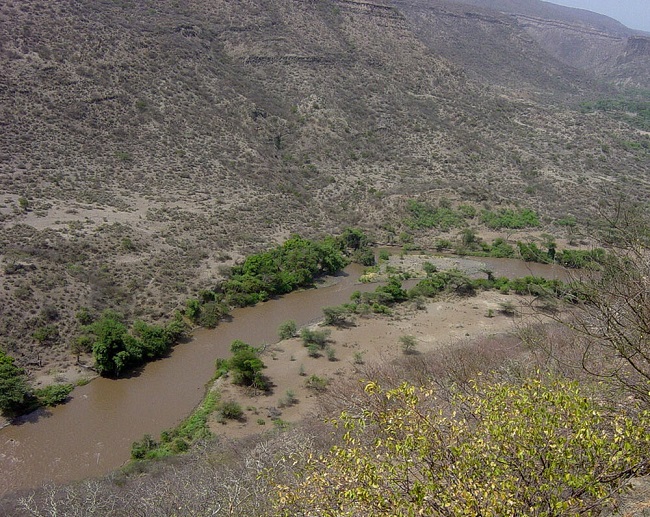
Awash Valley Fossils
The Lower Awash Valley paleo-anthropological site, situated about 300 km northeast of Addis Ababa in the western Afar Depression, spans approximately 150 km². Excavations began in 1973 by an international team of paleoanthropologists and prehistorians, continuing until 1980. During this period, numerous fossilized hominid and animal remains were unearthed in exceptional condition, some exceeding 4 million years in age. Later, another landmark discovery emerged—a female skeleton nicknamed Ardi, dated at 4.4 million years old, making it 1.2 million years older than Lucy. These findings confirm Australopithecus afarensis as a key ancestral link to both the genus Australopithecus and Homo sapiens.
Also Read- Chengjiang Fossil Site – The Oldest Record of Marine Fossil Treasures
Importance of Awash Valley
Since 1981, the Middle Awash Valley has been the subject of extensive research, and today, the entire Awash Valley is recognized as one of the world’s most important paleoanthropological and prehistoric regions. To ensure its protection, the property’s boundaries must be clearly defined to include all areas with confirmed and potential archaeological value, along with the creation of an adequate buffer zone.
Despite its remote location in the Afar Depression, the site faces threats from individual tourists seeking fossil souvenirs, making it highly vulnerable and in need of stringent protective measures.
Awash river Origin
The Awash River originates in the Ethiopian highlands at Becho, west of Addis Ababa, at elevations reaching up to 3,000 m a.s.l. After flowing through the Koka Reservoir, the river descends into the Rift Valley and ultimately terminates at Lake Abe near Ethiopia’s border, at an elevation of about 250 m a.s.l.
The Awash River is one of Ethiopia’s major rivers. Entirely contained within the country’s borders, it flows into a chain of interconnected lakes, starting with Lake Gargori and ending at Lake Abbe (Abhe Bad), near the Djibouti border, approximately 100 km from the head of the Gulf of Tadjoura.
The Awash River is the main watercourse of an endorheic drainage basin that spans parts of the Amhara, Oromia, and Somali Regions, as well as the southern half of the Afar Region. Covering 23 administrative zones, the Awash River basin accounts for about 10% of Ethiopia’s total land area.
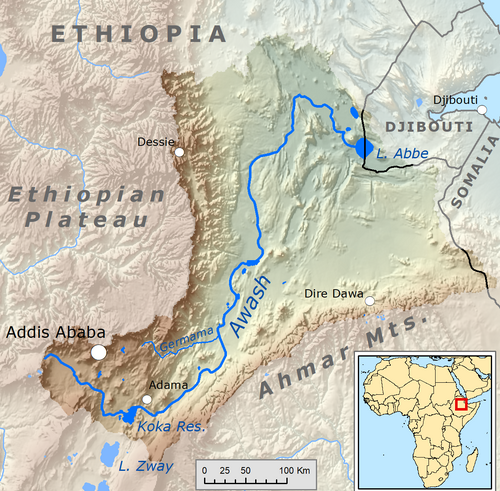
Awash river Map
Awash river map highlighting key features of the Awash River Basin, including irrigation intake points, geothermal spring discharge areas, and the extent of major aquifers.
How to Reach Lower Valley of the Awash
To visit the Lower Valley of the Awash, home to the renowned paleo-anthropological site of Hadar, travelers must first fly into Ethiopia and then continue overland from the regional capital, typically with the assistance of a local guide due to limited infrastructure. From Addis Ababa, the route follows the Addis Ababa–Kombolcha road to the town of Eli Wuha, which serves as the main access point. From Eli Wuha, you turn toward the Awash River, where navigating unpaved local roads requires the presence of both a guide and a police escort.