 sutikshan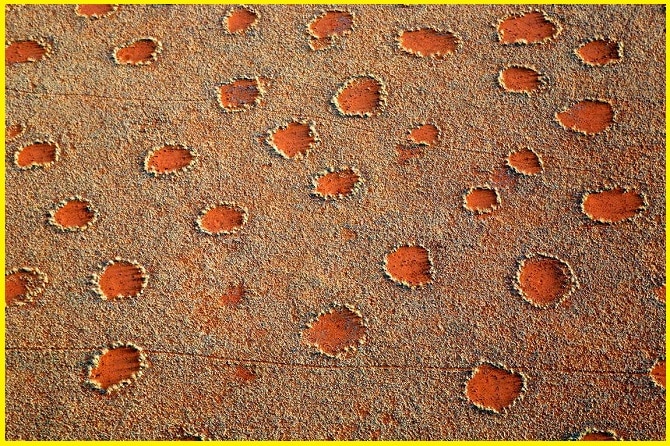
Fairy Circles
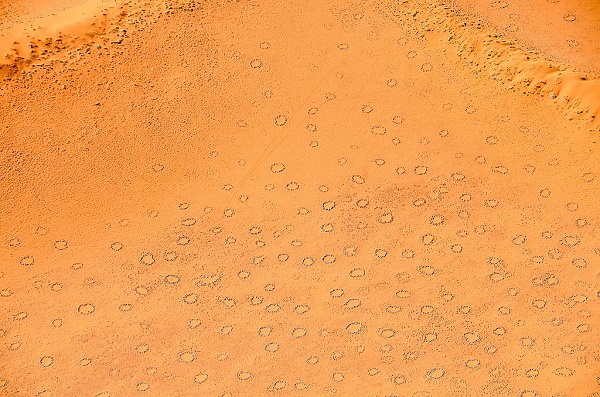
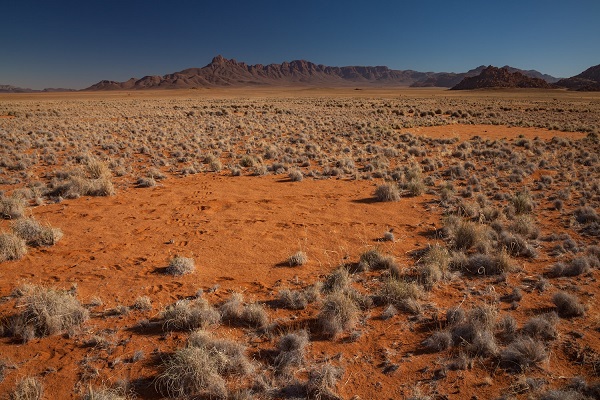
Africa’s Namib Desert, the sprawling grasslands are marked with a set of spots, known as Fields of “fairy circles.” These barren circles, edged with patches of vegetation and ranging from 3 to 20 meters in diameter, stretch for hundreds of miles. These marks resemble a vast sheet of polka dots, or, to a small observer, perhaps a bad case of chickenpox.
In Africa, the circles occur in a band lying about 160 kilometers inland and extending southward from Angola for some 2,400 kilometers down to the Northwestern Cape Province of South Africa. It is mainly a remote and inhospitable region, much of it over a hundred kilometers from the nearest village.
What are Fairy Circles
In local myths, it is said that the fairy circle was created by the gods who left behind their footprints on the red earth. But the formation of the circles has more to do with math and biology than folklore. Since “fairy circles” became the focus of scientific study, researchers have proposed a number of ways by which the bare discs of soil may form.
One study says that fairy circles are created by termites under the soil that clear vegetation in the area around their nests. By making the soil porous, the argument goes, they establish permanent reservoirs of rainwater 50 centimeters below the surface, which sustains them and the surrounding ecosystem.
An alternative idea is that the circles are explained by plants competing for water. Plants help their nearest neighbors by creating shade and maintaining water on the soil’s surface, but hinder those further away by growing long roots that extract water from the soil.
Also, read- Namibia’s Damaraland: A Haven for Adventure and Wildlife
The water competition theory hasn’t been proven by the many university studies. Meanwhile, the termite theory is backed up by observations of termite nests in the circles, but it couldn’t explain why the patterns are so regular.
Until 2014, the phenomenon was known to occur only in the arid grasslands of the Namib Desert in western Southern Africa. In that year, ecologists found similar vegetation rings outside Africa, in the Pilbara region of Western Australia.
Fairy circles Namibia typically occur in essentially monospecific grassy vegetation, where conditions are particularly arid. Associated grasses commonly are species in the genus Stipagrostis. Studies show that these circles pass through a life cycle of some 30 to 60 years.
Read- Geotourism And Modern Geotechniques
How to Reach Fairy Circles Namibia
You can reach the Fairy Circles by driving or taking a guided tour to locations in the Namib Desert, such as the Sesriem area or the Namib Rand Nature Reserve; access is typically via guided coach or private car from Windhoek or Swakopmund, followed by guided drives or walking tours offered by local lodges, or by scouting specific locations using Google Earth.