 sutikshan
The Boiling River
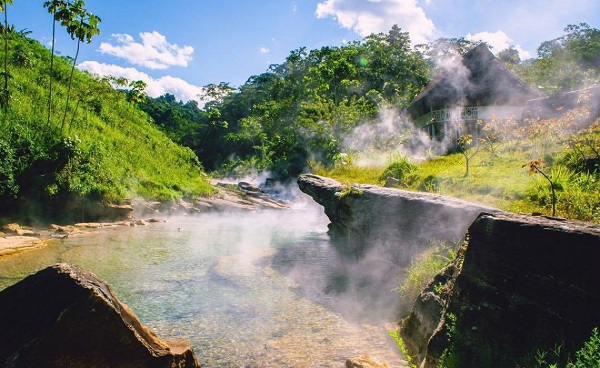
For centuries, Peruvian locals have talked about a river in the Amazon that burns so hot that anything that falls into it can kill. Hidden in the dense jungle of the Peruvian Amazon is a percolating, roiling river. The turquoise waters of the river can reach up to 200 degrees Fahrenheit. The river is guided by ivory-colored stones and guarded by 60-foot walls of lush forest and vegetation. Locals believed the river was sacred and that the hot waters held healing powers with medicinal uses.
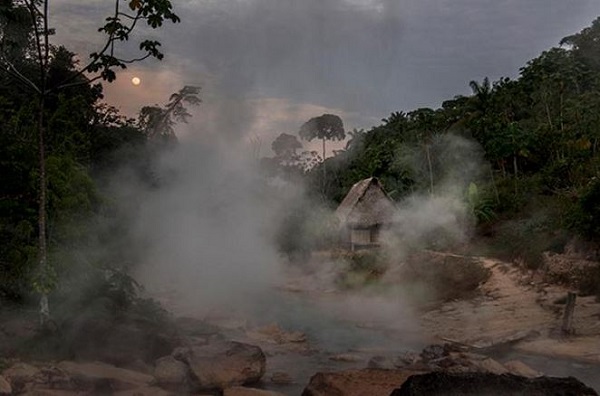
Andres Ruzo, a National Geographic Young Explorer, first heard about this river from his Peruvian grandfather. When Ruzo became a geophysicist, he decided to investigate whether this story is true or not. He travels deep into the Peruvian jungle to unravel the mystery. He has spent the last several years studying a very peculiar phenomenon in the Amazon Rainforest.
The Boiling River is in the central Peruvian Amazon, in the middle of the low jungle. From Lima, it’s about an hour’s flight to the city of Pucallpa, the largest city in the central Peruvian Amazon. From Pucallpa, it was a 2-hour drive mostly on red dirt roads to the Pachitea River, a tributary of the Amazon over 300 meters wide. From there, a 30-minute drive to the mouth of the Boiling River.
The boiling river’s local name is Shanay-timpishka, which translates to the river that is boiled with the heat of the sun. Local people believe that the boiling water is born by Yucamama, a giant serpent spirit known as the “Mother of the Waters.
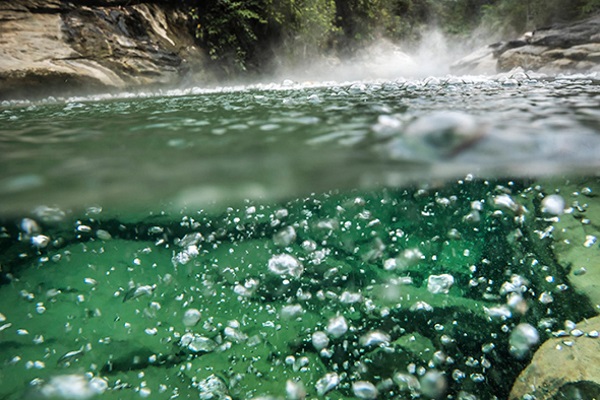
The total river system is about 9 kilometers, but it is the 6.24 kilometers on the lower part of the river that are hot. Most of that flow, particularly during the dry season, is hot enough to kill you. Small mammals, reptiles, or amphibians regularly fall in and are boiled alive.
Also read- World’s most Beautiful Natural Wonder ,‘’The Antelope Canyon, Arizona’’
Scientific hypotheses for the existence of the river
One hypothesis says that this was a volcanic feature, a magmatic system from which hot water flowed out of the earth at an anomalously high rate. According to Andres Ruzo, a body of water the size of the Boiling River requires a heat source with a lot of energy, yet the closest active volcano is more than 700 km away, and there are no known magmatic systems in the Amazon jungle. This raises a question for geoscientists as to how a vast amount of water can be heated with no nearby apparent heat source.
After some investigating and testing different hypotheses, Ruzo and the associate researchers believe that a fault-led hydrothermal feature was causing the river to reach such temperatures. The Earth heats up as you get deeper into the crust, mantle, and core. This is partly a combination of residual heating from initial planetary accretion billions of years ago, radioactive decay, and several other smaller heat sources. The water gets down deep into the earth, heats up underground, and resurfaces through faults and cracks.
Although some still believe that it could be the result of an oil and gas flow, which accidentally drills into a geothermal system. The boiling river is only 2-3 kilometers from the oldest active oil field in the Peruvian Amazon. The biggest and most frightening example of this was the Lusi mud volcano on Java. Over 40,000 people have been displaced, and the area is still erupting.
Read- Geotourism And Modern Geotechniques
How to Reach The Boiling River, Peru, Amazon
To reach the Boiling River (Shanay-Timpishka) in the Peruvian Amazon, fly to Pucallpa, then take a van/bus to Honoria, followed by a boat ride up the Pachitea River, and a final hike into the jungle to the Mayantuyacu area, often booked as a tour for convenience, involving road, river, and jungle trekking.