 sutikshan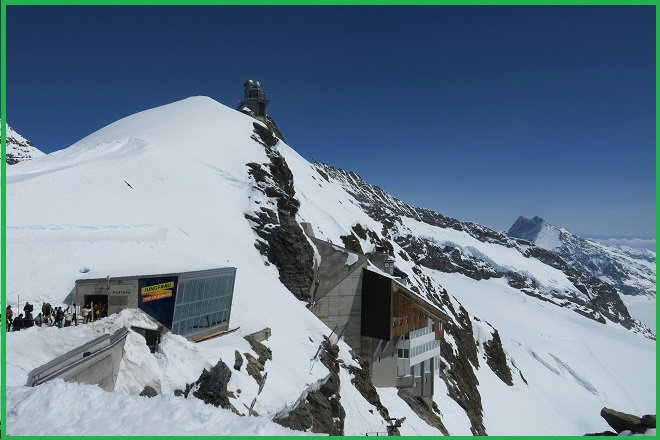
Aletsch Glacier
The Aletsch Glacier (or Great Aletsch Glacier), the largest glacier in the Alps in the Bernese Alps of Valais, Switzerland, spans about 23 km in length and covers 81.7 km. Formed by four converging glaciers at Konkordiaplatz, where it reaches a maximum thickness of 905 meters, this river of ice flows toward the Rhône valley to birth the Massa River. However, like most glaciers globally, it is retreating: by 2016, it had lost 3.2 km of its length since 1870. The entire region has been recognized as a UNESCO World Heritage Site (Jungfrau-Aletsch Protected Area) since 2001.
Formation of the Aletsch Glacier
Glaciers, like the Aletsch Glacier, form when snow and ice accumulation surpasses melting, leading to a buildup that compacts and begins to move under the pressure of gravity and its own weight. Historically, the Aletsch Glacier was vast: 18,000 years ago, it completely covered the lower ridge between Riederalp and the ice, with only the summits of the Bettmerhorn, Eggishorn, and Fusshörner rising above the surface. Following a major retreat, the glacier advanced again 11,000 years ago, reaching the Rhône valley and leaving visible moraines (glacial debris piles) that remain in the Aletsch Forest today.
The UNESCO site Swiss Alps Jungfrau-Aletsch, is a remarkable example of the formation of the High Alps. The Alps were shaped by uplift and compression that began 20 to 40 million years ago. Covering an altitude range of over 3,400 meters, the region dramatically displays 400-million-year-old crystalline rocks forced over younger carbonate rocks. It is a result of the African tectonic plate’s northward drift. In addition to this geological record, the area boasts a great diversity of geomorphological features, including classic U-shaped glacial valleys, cirques, horn peaks, and moraines. As the most heavily glaciated part of the Alps, it is home to the Aletsch Glacier, Europe’s largest and longest, which holds significant scientific value for studying glacial history and ongoing processes, especially those related to climate change.
Also read- Triassic Beds of Lake Lugano and Ticino In Switzerland
Aletsch Glacier Trail
The Aletsch Glacier Trail is an ideal 12-kilometer day-hike offering spectacular views of the Alps’ largest glacier (located in the UNESCO World Heritage site). Beginning at the Moosfluh upper cable station near Riederalp and concluding at the Fiescheralp upper cable station, this trail is suitable for all hikers. However, it is essential to note that the path skirts the glacier, not crossing the ice itself.
The Aletsch Glacier hike begins on the northern flanks of the Eiger, Mönch, and Jungfrau mountains and flows southward, passing Märjelensee lake on its way to the Aletsch Forest before it fragments. The Aletsch Glacier Trail provides a structured day-hike experience by overlapping with a segment of the Aletsch Panoramaweg 39. The trail joins the long-distance route at Moosfluh, follows it until the Gletscherstube at Märjelensee, and then branches off to finish at the cable car station above Fiescheralp.
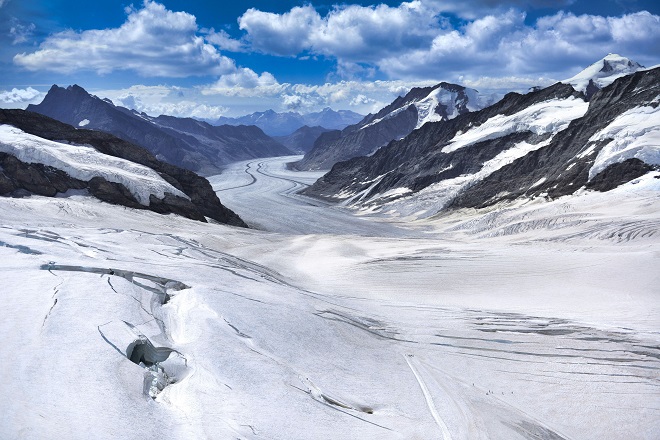
The Aletsch Arena, a core part of the Swiss Alps Jungfrau-Aletsch UNESCO World Heritage Site, offers a spectacular network of 300 kilometers of hiking trails for every skill level. Hikers are drawn by magnificent views of the Aletsch Glacier—the longest in the Alps—as well as ancient stone pine forests and a thrilling collection of five suspension bridges located in the Aletsch Goms area.
Also read- Business Leader Success story
Swiss Helicopter Aletsch Glacier Tour
A Swiss Helicopter Aletsch Glacier Tour offers a spectacular aerial view of the Alps’ longest glacier. Departing from bases like Lauterbrunnen, these scenic flights (from providers such as Flightbase or Swiss Helicopter) take you over the iconic peaks of the Eiger, Mönch, and Jungfrau. You’ll also see the Lauterbrunnen Valley and Lakes Thun and Brienz. Packages often include an optional glacier landing on sites like the Petersgrat, or a stop at a mountain restaurant for an unforgettable closer look.
Scenic flight path: The scenic flight path offers spectacular views of the Eiger, Mönch, and Jungfrau peaks, the Lauterbrunnen Valley, and the magnificent Aletsch Glacier. Glacier landing: As a popular optional feature, a glacier landing allows passengers to step onto the ice for a short time, giving them a chance to take photos and experience the glacier up close.
How to get to the Aletsch Glacier
To reach the Aletsch Glacier, drive or take public transport to a valley station like Fiesch, Betten, or Mörel. The journey continues via cable car up to the plateau, where high-altitude villages such as Bettmeralp or Fiescheralp serve as starting points. From these areas, follow the well-marked trails to hike toward the glacier’s viewpoints.