 sutikshan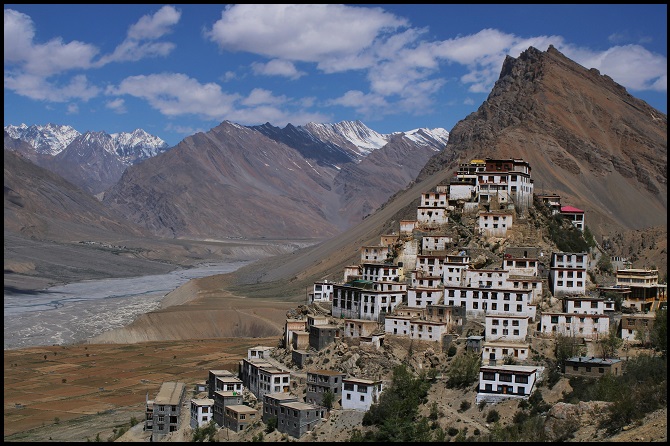
Cold Desert Landscape of India
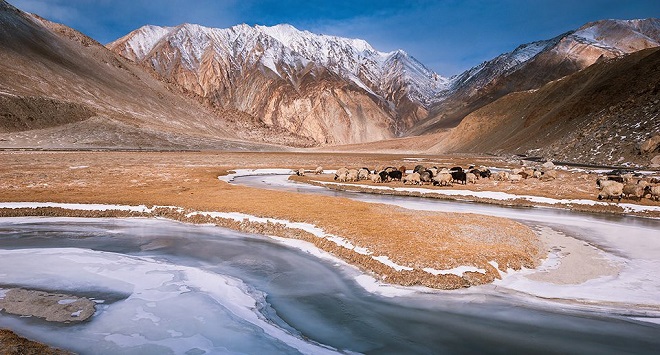
The Cold Desert Cultural Landscape of India features a striking, barren terrain located in the northwestern part of the country, beyond the Greater Himalayas. This dramatic landscape is adorned with towering mountains that touch the azure sky, crystal-clear streams flowing through deep gorges, and sparse vegetation that allows for uninterrupted panoramic views. The region receives ample sunlight and snow but very little rainfall. Spanning parts of Jammu & Kashmir and Himachal Pradesh, it supports a unique Cold Desert ecosystem that shelters rare and endangered species of flora and fauna. To protect this fragile biodiversity, several national parks and wildlife reserves have been established in the area. Human settlements here are small, scattered, and sparsely populated, with their layout reflecting the demands of the harsh terrain and climate.
The proposed property lies on a trans-Himalayan marginal plateau — a transitional zone between the Greater Himalayas and the Tibetan Plateau — making it exceptional both physically and culturally. Deeply rooted in Buddhism, the region’s culture shares strong ties with Tibet, while also integrating distinct Indian influences. This fusion is evident in its architectural styles and rich intangible traditions, both of which enjoy global recognition.
The Cold Desert has been designated as a Biosphere Reserve of India, encompassing an ecosystem of exceptional scientific and natural significance. It provides critical habitat for numerous rare and endangered species of flora and fauna, including the Snow Leopard, Tibetan Antelope, and Himalayan Wolf — all listed as Critically Endangered on the IUCN Red List. The region’s diverse plant life has traditionally been utilized by local communities for various purposes, particularly medicinal, and is recognized as possessing Outstanding Universal Value for conservation efforts.
Geography
Situated adjacent to the Himalayan Mountains, the cold deserts of India lie in the rain shadow of the Himalayas. As a result, they remain largely unaffected by the Indian monsoon, giving rise to their distinctive arid and cold climatic conditions. The Cold Desert spans an area of approximately 7,770 square kilometres. The biosphere reserve includes several important protected areas, namely the Chandratal Wildlife Sanctuary, Kibber Wildlife Sanctuary, Pin Valley National Park, and Sarchu.
Also Read- Spiti Valley: Gateway to Himalayan Serenity
Cold Desert Landscape Climate
A cold desert landscape climate is characterized by extremely dry, arid conditions with very low precipitation, often in the form of snow, and significant temperature variations, with cold winters and cool to warm summers. Common features include sub-zero temperatures for much of the year, high altitude, intense wind erosion, scarce rainfall (less than 400 mm annually), and sparse vegetation adapted to arid conditions, such as plants with needle-like leaves.
Low Temperatures: Temperatures often hover below freezing, especially during the long, harsh winters. Dry Conditions: Cold deserts are arid, receiving very little rainfall and experiencing very low humidity. Snowfall: Precipitation primarily occurs as snow during the winter months. High Altitude: Many cold deserts are located at high elevations, which contributes to their frigid temperatures. Strong Winds: The dry atmosphere and lack of substantial vegetation make cold deserts prone to wind erosion. Sparse Vegetation: Plants in these regions have adapted to survive extreme cold and drought, often with needle-like or spiky leaves to minimize water loss.
Examples of Cold Desert Landscapes
Ladakh, India: Located in the Himalayas, it experiences very low temperatures, especially at night, with harsh, freezing winters and short, cool summers. Gobi Desert: Situated in China and Mongolia, it has frigid winters and dry summers. Antarctica: A polar desert, it supports only cold-tolerant organisms, with most precipitation falling as snow. Patagonian Desert: An example of a cold desert in Argentina. Spiti Valley, India: Located in the Himalayas, it has been recognized as a cold desert biosphere reserve.
Flora and Fauna
Owing to its unique climatic conditions, the Cold Desert sustains rich biodiversity. It harbours over 500 plant species, including 118 species with medicinal properties. Notable examples of these medicinal plants include Aconitum rotundifolium, Arnebia euchroma, Ephedra gerardiana, and Ferula jaeschkeana. The region is also home to several fauna species classified as Critically Endangered on the IUCN Red List, such as the Snow Leopard, Tibetan Antelope, and Himalayan Wolf. Other notable wildlife includes woolly hare, Himalayan black bear, Himalayan brown bear, red fox, Himalayan ibex, Himalayan marmot, Himalayan blue sheep, red-billed chough, Chukar partridge, snow partridge, blue rock pigeon, snow pigeon, Himalayan snowcock, lammergeier, Himalayan griffon, golden eagle, and rosefinch.
UNESCO Designation
India now has 13 United Nations Educational, Scientific, and Cultural Organization (UNESCO) Biosphere Reserves, following the inclusion of the Cold Desert Biosphere Reserve in UNESCO’s global network on September 27, 2025. The announcement was made during the Fifth World Congress of Biosphere Reserves held in Hangzhou, China, where 26 new sites were added worldwide.
This marks India’s first high-altitude cold desert biosphere reserve, representing one of the coldest and driest ecosystems within UNESCO’s World Network of Biosphere Reserves. Covering an area of 7,770 square kilometres at elevations ranging from 3,300 to 6,600 metres, the site includes Pin Valley National Park and its surrounding areas, such as Chandratal, Sarchu, and Kibber Wildlife Sanctuary. The landscape is distinguished by windswept plateaus, glacial valleys, alpine lakes, and rugged high-altitude deserts.
Landscape
India’s cold desert landscape is a distinctive high-altitude region of the Himalayas, defined by its extreme cold, minimal precipitation, and sparse vegetation. It includes Ladakh, the Spiti region of Himachal Pradesh, and Kinnaur. The harsh climatic conditions arise from its position in the Himalayan rain-shadow zone, combined with high elevation, resulting in long, frigid winters and short, dry summers. The terrain is rugged and dramatic, supporting hardy alpine vegetation and remarkable wildlife such as the Snow Leopard and Himalayan Ibex.
The reserve integrates Pin Valley National Park, Kibber Wildlife Sanctuary, and the Chandratal Wetland. Its terrain is characterized by windswept plateaus, glacial valleys, alpine lakes, and high-altitude deserts, forming one of the coldest and driest ecosystems within the World Network of Biosphere Reserves (WNBR).
How to reach the Cold Desert Landscape of India
To explore India’s Cold Desert, head north to Ladakh or south to Spiti Valley and Kinnaur in Himachal Pradesh. These regions can be accessed via major airports such as Leh or Shimla, followed by travel by connecting flights, private vehicles, or buses. The most favorable time to visit is between April and October.
Ladakh: The northernmost part of the Cold Desert region, with Leh serving as the major hub and primary access point. Himachal Pradesh: The southern section of the Cold Desert, encompassing the Spiti region in Lahaul and Spiti district, as well as parts of Kinnaur district. Spiti Valley: A prominent area within the Cold Desert Biosphere Reserve, renowned for its ancient monasteries such as Tabo and Dhankar.
Leh Airport (Kushok Bakula Rimpochee Airport) serves the Ladakh region and offers flights from major Indian cities like Delhi and Chandigarh. Shimla Airport: Connects to the Himachal Pradesh side of the Cold Desert, though this is a smaller airport. You may need to travel to Chandigarh or Delhi first.