 sutikshan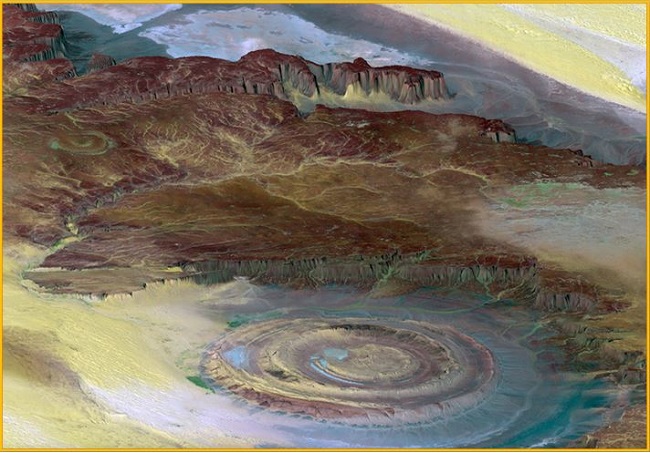
Eye of the Sahara
For millions of years, the Eye of the Sahara was hidden in the plain of the African desert because this huge and mysterious geologic formation is hard to spot from ground level, as one walks around on Earth. This prominent circular feature in the Sahara Desert of Mauretania has attracted attention because it forms a conspicuous bull’s-eye structure in the featureless Sahara Desert. It’s looking like an outsized ammonite in the desert. The structure has a diameter of almost 50 kilometers and becomes a landmark for space shuttle crews.
Eye of the Sahara From Space
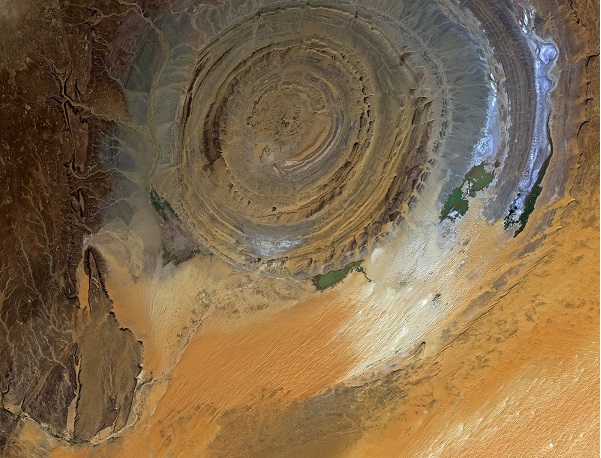
‘Eye of Sahara’ or Richat Structure is located in the vast Sahara Desert just outside of Ouadane town in Mauritania. From space, this natural curiosity forms a distinct and unmistakable bullseye that once served as a Geographical Landmark for Astronauts as they passed over the Sahara. The outermost rings are approximately 40-50 kilometers across, That the Region it is very clear from space. When viewed from space, the structure appears as a bullseye with distinct, concentric rings.
Eye of the Sahara Atlantis
The “Eye of the Sahara,” or Richat Structure, is a geological formation in Mauritania that some theorists believe to be the lost city of Atlantis, due to its concentric ring formation that resembles Plato’s description of the Atlantean capital. However, scientific and archaeological evidence does not support this claim, as the structure is a natural dome formed by volcanic activity and subsequent erosion, and has no signs of ancient habitation or a large civilization.
The theory suggests the Eye of the Sahara is a match for Plato’s account of Atlantis because of its circular shape with concentric ridges and depressions.
Proponents, like the YouTube channel Bright Insight, argue that the structure would have contained three rings of land and two rings of water, similar to the capital of Atlantis described in Plato’s dialogues, “Critias” and “Timaeus”. Some also point to a supposed 11-mile diameter match between Plato’s description and the size of the structure.
Geological Theory
Initially, this structure was interpreted as a meteorite impact structure because of its high degree of circularity, but the formation is now widely believed to have been caused by the erosion of a geological dome formed by pressure from a bulb of molten magma below.
The desert floor ‘blistered,’ and the layers of rock were pushed up and fractured. This also created fault lines circling the Eye and crossing it. The molten rock also dissolved limestone near the center of the eye, which collapsed to form a special rock type known as Breccia. Due to the years of weathering gradually the structure gradually leveled off and exposed the structures in distinctive concentric rings. Geologists classified this structure as a domed anticline. In this type of geologic structure, rocks exposed in the center of the “bull’s eye” are older than rocks forming the outer rings.
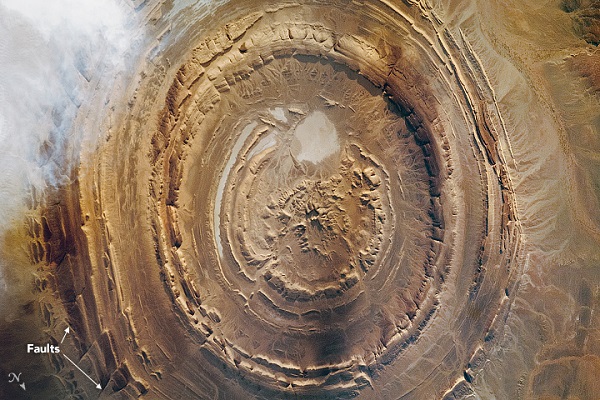
Most of Mauritania faces Dry climate conditions and periodic droughts due to its location in the Sahara Desert. Approximately 3.7 million people live in Mauritania, and much of the population lives along its Atlantic coastline, about 500 kilometers from the Richat Structure.
Also read- Mauritius: A Tropical Paradise in the Indian Ocean
Chinguetti and Ouadane towns are UNESCO World Heritage Sites because they are vestiges of the once-flourishing civilizations that existed during the era of the Trans-Saharan salt trade. This civilization is known as Ksours.
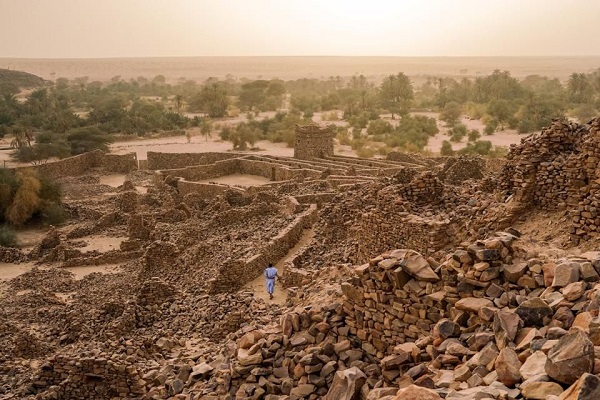
The dunes around the Richat structure are part of the Oudane. An enormous body of sand stretching hundreds of kilometers to Mali, within which still some ancient Ksours stand.
Read- Geotourism And Modern Geotechniques
How to Reach Eye of the Sahara
To reach the “Eye of the Sahara,” you must travel to Mauritania and drive from the town of Ouadane using a 4WD vehicle and a GPS. The structure is a large geological dome in the Sahara Desert, and the best way to see its full circular shape is from a high vantage point or from space.