 sutikshan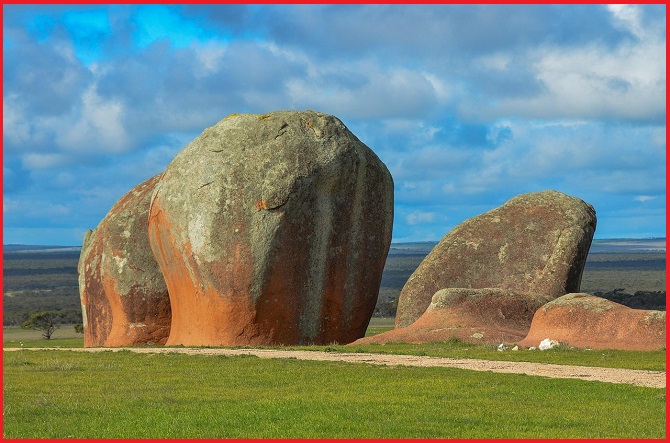
Murphy’s Haystacks
Murphy’s Haystacks, distinctive inselberg rock formations, are situated at Mortana on South Australia’s Eyre Peninsula, specifically between Streaky Bay and Port Kenny.
These formations are weathered pink Granite outcrops, specifically taking a Tumulus (mound-like) shape. The rock itself is a massive, coarsely Equigranular (equal-sized crystals) pink granite, primarily composed of the minerals quartz and orthoclase.
Their distinctive appearance is believed to be the result of a two-stage erosion process: first, by underground rainwater, and then by surface weathering after the rock was exposed to the elements. Most of the rock pillars rise directly and continuously from the underlying granite. The structural base of the formations is supported by a system of either orthogonal (right-angled) or vertically-aligned sheet jointing.
Murphy’s haystacks Eyre Peninsula
The Eyre Peninsula is a large, triangular peninsula in South Australia. It is geographically defined by the Spencer Gulf to the east, the Great Australian Bight to the west, and the Gawler Ranges marking its northern boundary.
The peninsula is named after explorer Edward John Eyre, who extensively explored parts of the area between 1839 and 1841. Earlier, the coastline was charted almost simultaneously by two major expeditions: Matthew Flinders and the French explorer Nicolas Baudin in 1801–02.

How were Murphy’s haystacks formed?
The formation of Murphy’s Haystacks began over 1.4 billion years ago when the erosion of softer overlying material exposed the massive Hiltaba Granite—a process known as inselberg formation. Over subsequent millions of years, weathering (including erosion by underground rainwater) sculpted the hard granite into the distinctive, haystack-like pillars seen today.
Exposure: Over vast geological periods, the softer overlying layers of sedimentary rocks gradually eroded. This process uncovered the much more resistant Hiltaba Granite beneath, bringing it to the surface.
Sculpting: Once exposed, the granite was intensely sculpted by ongoing erosion. Water—especially underground rainwater that seeped along existing natural fractures—eroded the rock from below, initially creating concave shapes. Subsequent surface weathering, including wind, then finalized the shape into the distinct, individual granite pillars visible today.
Resulting Inselbergs: This differential erosion left the hardest, central masses of granite standing as inselbergs (“island mountains”), starkly contrasting with the lower, surrounding areas of weathered clay and soil. Haystacks, a striking ancient rock formation, is a captivating stop for travelers exploring the Eyre Peninsula. Composed of pink granite.
Also read- The Untold Secret of ‘THE PINNACLES AUSTRALIA’
Murphy’s Haystack Facts
Murphy’s Haystacks is a unique and ancient granite rock formation located on South Australia’s Eyre Peninsula. These striking pink, weathered formations—technically classified as inselbergs and estimated to be over $1.5$ billion years old—are highly significant both geologically and culturally. The site gets its name from an early traveler who famously mistook the pillars for haystacks on the Murphy family’s land. Although the property remains privately owned, the site is accessible to the public for a donation-based entry fee, providing visitors with interpretive signage, walking paths, and picnic areas.
Murphy’s Haystacks Camping
The campground is situated right on the private property next to the unique rock formations. Entry to view the Haystacks is $2 for a single person, $5 for a family. Camping requires an additional fee, typically around $10 per rig for an overnight stay (prices are subject to change, so check the honesty box sign upon arrival).
It is a budget-friendly and unique place to camp. The location is especially popular with photographers, as the pink granite pillars glow with deep red and orange colors at sunrise and sunset.
Also read- Business Leaders’ Success Story
Photographer’s Dream
A favored spot for photographers, the rocks offer a breathtaking spectacle at sunset, radiating deep reds and oranges against the vast South Australian sky. Whether you are drawn by its ancient geological history or simply the stunning scenery, Murphy’s Haystacks is a must-see landmark on the Eyre Peninsula.
How To Reach Murphy’s Haystacks
To reach Murphy’s Haystacks, drive to the Eyre Peninsula in South Australia, between Streaky Bay and Port Kenny. The site is located on private land, so be prepared to pay a small donation fee upon entry, which helps with the property’s maintenance. There is a walking track from the car park to the rock formations.