 sutikshan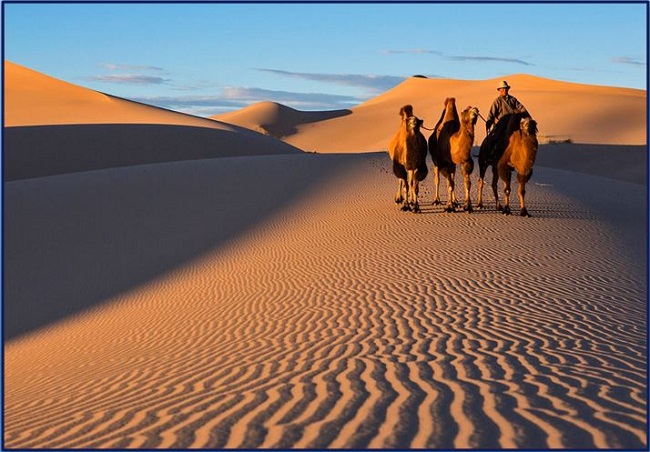
The Gobi Desert
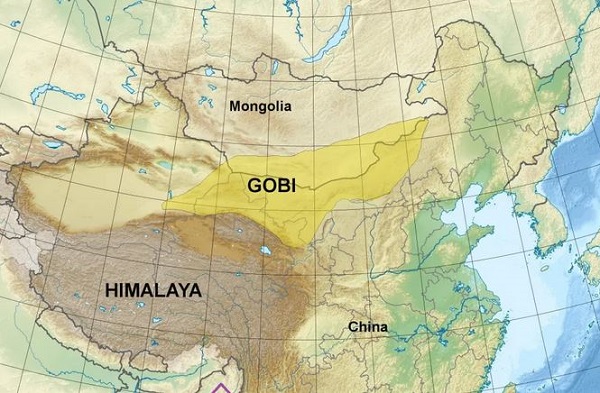
The Gobi Desert is a large desert covering the two-nation southern part of Mongolia and North and Northwest China. It is located at an altitude of 900 to 1500 m above sea level. The Gobi occupies a vast arc of land 1,600 km long and 500 to 1,000 km wide, with an estimated area of 1,300,000 square km. The Gobi Desert is bounded on the North by the chain of the Altai Mountains and the steppes of Mongolia, and the Kunlun and western Altun mountains to the south.
It is considered to be the 5th largest desert in the world and the first in Asia. A vast zone of desert and desert steppe covers almost 30 percent of the Mongolian territory.
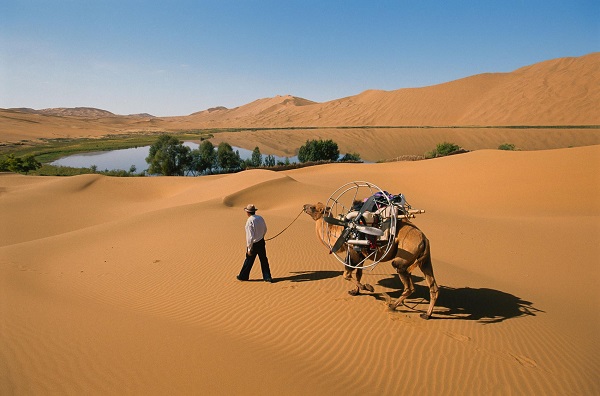
The desert is stony and nearly waterless, through salt marshes lie in the secluded depressions. The soil is grayish brown, contains gypsum and halite or rock salt. People always imagine the Gobi as a lifeless sandy desert, but in reality, only 5% of the total area is sand dunes. Most of part of the Gobi Desert is a land of steppes, sands, and mountains, and it is the home for camel breeders, rich with wildlife and vegetation.
Geological Setup
The Gobi Desert is composed of sediment from the erosion of volcanic rocks like granite, basalt, and rhyolite, as well as from ocean sediments. The ocean sediments are Chalk and other rocks chiefly of the Cenozoic Age. Volcanic isolated hills are Older.
The terrain contains small masses of shifting sands. In the central Gobi, the remains of dinosaurs from the Mesozoic Era and fossils of Cenozoic mammals have been found. The desert also contains Paleolithic and Neolithic sites occupied by ancient peoples. These Sites produced artifacts up to 35,000 years old.
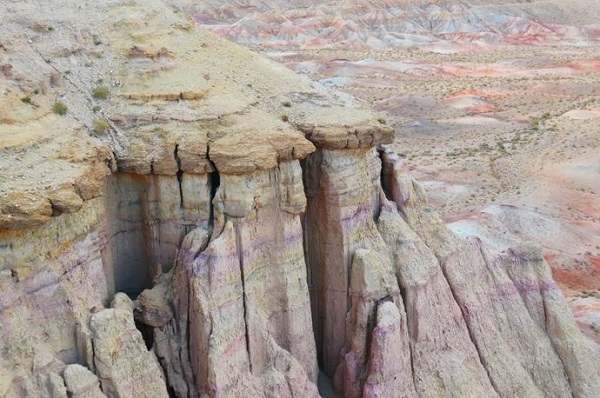
Many geoscientists believe that the Gobi was the ocean Bottom. Indeed, before Mongolia, there were many oceans, including the Tethys Ocean. This ocean is being closed during the Central Asian orogenic Belt (CAOB); many relics are visible in the Gobi Desert. Fossilized coral heads, ‘sea lilies’, and various shells were found in the Gobi Altai province.
Also read- Did You Know? Russia Covers 1/8th of Earth’s Landmass
During different geological periods, deposits of marine sediments are deposited at the bottom of the oceans. Thus, it is possible to observe on an outcrop the different strata of sedimentation. This person has a strong interest in understanding the geology and climate of the time. If you have a large thickness of sediment during a period, this means that there was strong active erosion. As suggested in the limestone strata from the Gobi.
Continental Desert
The Gobi Desert is considered to be a continental desert. That means there is a variation in temperature between the summer and winter highs. The winters are cold (-40° C), while summers are often very hot (+ 50 ° C). The reason for this climate change is that it is immune to a mountain barrier (the Himalayas), which blocks the depressions from the Indian Ocean. So the masses of humid air pour their rain on the side in direct contact with the wind.
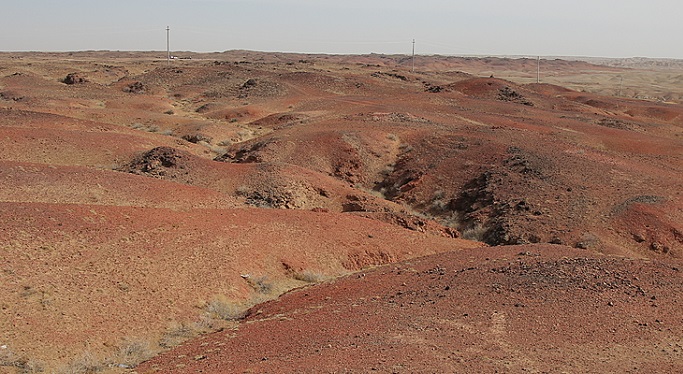
On the other side, being sheltered from the wind, water bodies there have low access, preventing the arrival of rain. We call this phenomenon ‘shadow rainfall’. The rainfall of the Gobi is 154 mm per year.
The Gobi Desert is not only famous for dinosaur species but also well known for its rich natural resources. The Gobi Desert is rich in copper, gold, Salt, and coal deposits. Oyu Tolgoi is the world’s third-largest copper and gold mine.
Read- Geotourism And Modern Geotechniques
Flaming Cliffs is a famous tourist attraction in the Gobi Desert and is famous all over the world. In the 1920s, an American researcher found dinosaur eggs, a huge rhino-like dinosaur skeleton, and a parrot-nosed dinosaur in this place.
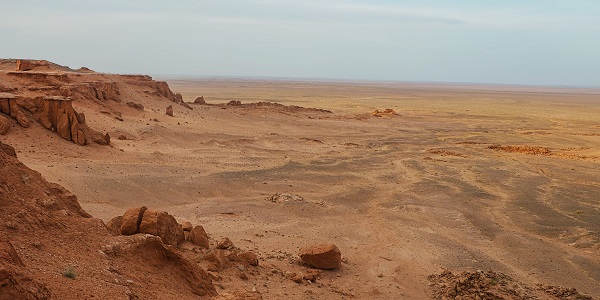
The Khongor dunes are another tourist attraction in Gobi Gurvan Saikhan National Park. The dunes are 27 km at their widest, covering 965 square km in total, reaching 200 meters in height.
How to Reach The Gobi Desert
To reach the Gobi Desert, fly into Ulaanbaatar (Mongolia) or a gateway city in China, then take a domestic flight to Dalanzadgad (Mongolia) for the South Gobi, or arrange a road trip with a local guide for the North Gobi, as it’s a vast region best explored via organized tours or 4×4 adventures from major hubs like Ulaanbaatar.