 sutikshan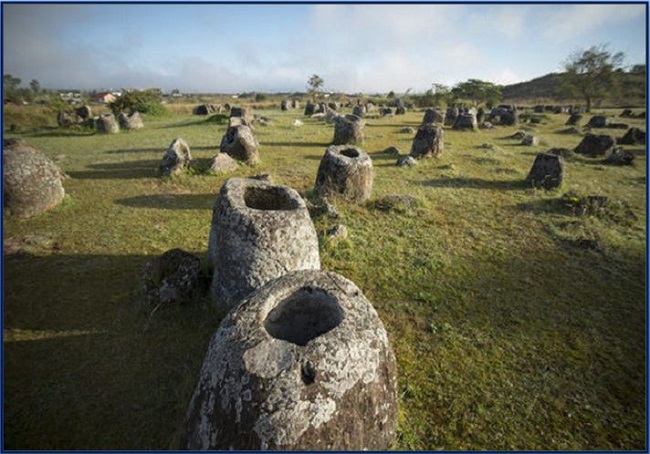
The Plain of Jars
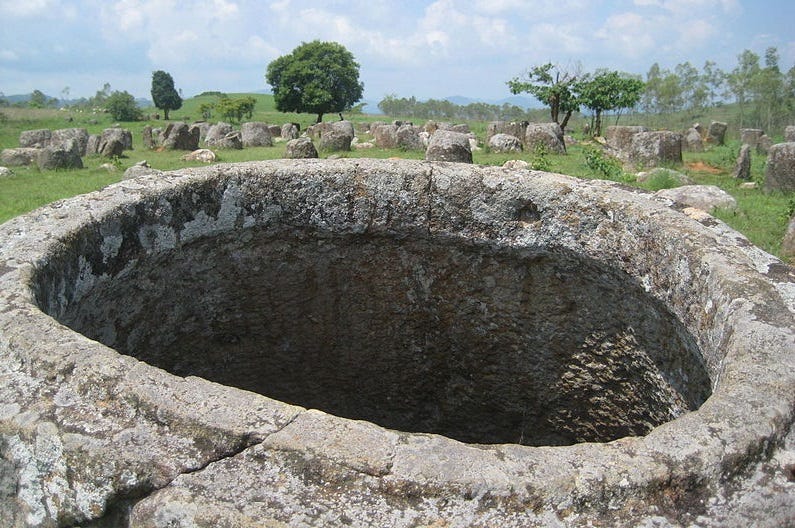
The Plain of Jars in central Laos is one of Southeast Asia’s most mysterious and misunderstood prehistoric places. Around 90 sites scattered across miles of rolling landscape contain thousands of giant stone jars, each stone weighing several tons. The stone jars are surrounded by impressive scenery and offer easy access to an abundance of cultural and historic sites.
The Stone jars are spread around the upland valleys and the lower foothills of the central plain of the Xiangkhoang Plateau. The Xieng Khouang Plateau is located at the northern end of the Annamese Cordillera, the principal mountain range of Indochina.
A mystery about the Jars
To date, the origin of the jars is unknown; it is a wonder to see how they got there and why. Many researchers have theorized that the jars may have once served as funeral urns or food storage. Some believe that the jars collected monsoon rainwater for caravan travelers to use during the dry season. Travelers would use the water and then leave behind prayer beads or offerings in the jars.
Significance
The Plain of Jars, situated on a plateau in central Laos, is named for the over 2,100 tubular megalithic stone jars used for Iron Age funerary rituals (500 BCE – 500 CE). This remarkable serial property, featuring 15 distinct components, offers the most prominent evidence of the civilization that created and utilized these structures until its decline around 500 CE. Key elements include the large carved jars, stone discs, tombstones, and associated secondary burials and funerary objects found alongside quarry sites. The Plain of Jars in Laos was officially inscribed as a UNESCO World Heritage Site on July 6, 2019, during the 43rd Session of the World Heritage Committee held in Baku, Azerbaijan.
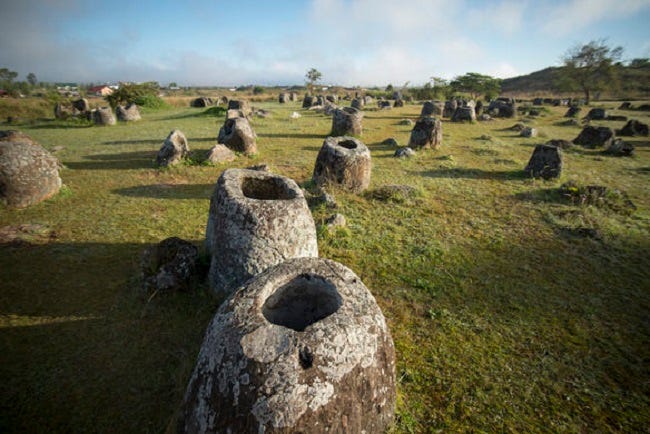
Many local Laotian legends say that the jars were created by Khun Cheung, an ancient king who lived in the highlands. It is said that Cheung, after fighting a victorious battle, created the jars in order to brew huge amounts of celebratory Lao Lao rice wine.
Also read- Sơn Đoòng Cave: Vietnam’s Hidden Underground Kingdom
The majority of the jars are sandstone and have been manufactured with a degree of knowledge of what materials and techniques were suitable. It is assumed that the Plain of Jars used iron chisels to manufacture the jars, although no conclusive evidence has been found.
Xieng Khouang Plain of Jars
The Plain of Jars received Western attention in the 1930s when French archaeologist Madeleine Colani began surveying the area. Colani discovered a nearby cave housing human remains, such as burned bones and ash, leading her to believe that the jars were funeral urns for chieftains. Colani excavated the artifacts, some of which dated to between 500 BC and 800 AD, and published her findings in The Megaliths of Upper Laos.
Though the Xieng Khouang plain remains the central site of the jars, similar clusters can be connected to form a linear path all the way to northern India. The existence of similar jar clusters in other parts of Asia also led to the belief that the jars were part of a large trade route.
Read- Geotourism And Modern Geotechniques
Till now, over 100 jar sites have been found in the province of Phonsavan. Surprisingly, A vast area of Xieng Khouang’s plain is covered with Jars (the largest jars are 2.5 x 2.57 meters).
Apart from this, the area remains one of the most dangerous archaeological sites in the world. Thousands of unexploded bombs remain from the Secret War of the 1960s, and some of these bombs still cause injuries to this day. Some Quarry is open to visitors, while several organizations work to remove explosives from the area.
How to Reach the Plain of Jars
To reach the Plain of Jars, you must first get to Phonsavan, the nearest town. From there, you can fly or take a long bus or minivan ride from major Laotian cities like Vientiane or Luang Prabang. Alternatively, you can enter Laos by bus from Vietnam, and then take a bus to Phonsavan.
Source-atlas Obscura, Lonely Planet