 sutikshan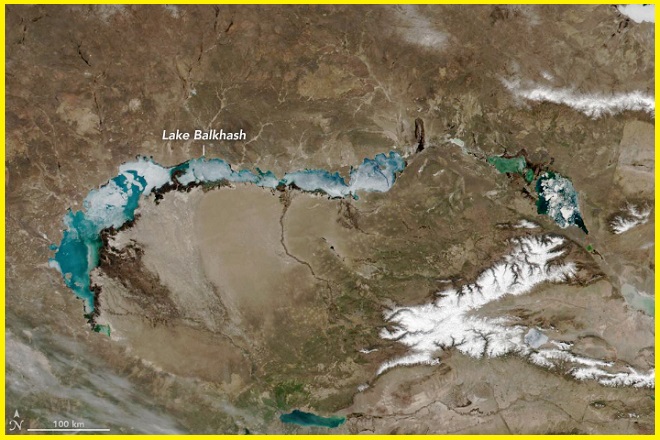
Lake Balkhash
Lake Balkhash, the world’s fifteenth-largest and the second-largest saline lake, is a crescent-shaped body of water in southeastern Kazakhstan. It forms part of the endorheic Balkhash-Alakol basin, which extends across Kazakhstan, China, and Kyrgyzstan. Alakol Basin, an endorheic (closed) basin, is fed by seven rivers—the largest being the Ili River, which originates in China’s Xinjiang region and carries most of the inflow from snowmelt. Other rivers, such as the Karatal, contribute both surface and subsurface water.
The Origin of the Lake
Balkhash lies in the deepest section of the vast Balkhash–Alakol Depression, a sloping trough formed during the Neogene and Quaternary periods between the Alpine orogenic mountains and the older Kazakhstan Block. Rapid erosion of the Tian Shan mountains caused the depression to fill quickly with sandy river sediments, a process that occurred within a relatively short geological timeframe. The basin forms part of the Dzungarian Alatau region, which also includes Lakes Sasykkol, Alakol, and Aibi. These lakes, along with Balkhash, are remnants of an ancient sea that once covered the entire depression, though it was never connected to the Aral–Caspian Depression.
Lake Balkhash Map
Lake Balkhash, the world’s fifteenth-largest lake and the second-largest saline lake, is a crescent-shaped body of water located in southeastern Kazakhstan.

Geography
All the rivers of the region that originate in the high mountains flow into Lake Balkhash, but none flow out. The main tributaries are the Ili, Aksu, and Karatal rivers. From the north, the Tokrau River also heads toward the lake, but its waters are absorbed into the sands before reaching the shore. The lake itself is split into two sections by the Saryesik Peninsula (meaning “Yellow Door” in Kazakh), with the Uzynaral Strait serving as the connection between them.
Situated in southeast Kazakhstan, Lake Balkhash is framed by two contrasting landscapes: the Kazakh Uplands, a vast peneplain to the north, and the sandy Saryesik-Atyrau Desert to the south, stretching 400 km across eastern Kazakhstan. The lake lies at an elevation of 342 m within the expansive Balkhash–Alaköl basin, itself part of the greater Dzungarian Alatau basin that also encompasses Lakes Sasykkol, Alakol, and Aibi. Scattered across Balkhash’s surface are 43 islands, covering about 66 square kilometers, with researchers predicting the emergence of new islands due to fluctuating water levels and shallow depths.
The lake’s shores reveal distinct terrain. Its western bank rises steeply, composed of limestone, tuff, and granite, averaging 24 m in elevation. By contrast, the southern shore is low and sandy—just 5 feet high—fringed with reeds and dotted with small neighboring lakes. Along its perimeter lie numerous bays, including Karakamys, Kashkanteniz, Saryshagan, Karashigan, Kukuna, and Guzkol.
Also Read- The Mountain of 14 Colors: A Geological Masterpiece of the Andes
Kazakhstan’s Lake Balkhash is shrinking due to climate change and overuse
The lake covers approximately 16,400 km², but, like the Aral Sea, it is shrinking due to water diversion and extraction. A narrow central strait divides the lake into two distinct parts: the western section contains freshwater, while the eastern section is saline and about 1.7 times deeper. The city of Balkhash, with around 66,000 residents, is the largest settlement on its shores, where mining, ore processing, and fishing form the core of local industry.
Growing concerns include declining water levels caused by industrial use, desertification of surrounding microclimates, and the added pressures of climate change, all of which threaten the lake’s ecosystems.
Lake Balkhash Islands
Lake Balkhash in Kazakhstan was formed through uneven subsidence of the Turan Plate and the subsequent flooding of the resulting depressions, likely during the later stages of the Cenozoic era. The higher portions of the plate gave rise to numerous small islands and several larger ones.
In total, the lake contains 43 islands, covering an area of about 66 km². The largest and most significant among them are Basaral, Tasaral, Ortaaral, Ozinaral, and Algazi. Few islands are found in the saline eastern part of the lake. The name Balkhash is believed to derive from the word Balkh in Tatar, Kazakh, and South Altaic languages, meaning “hummocks in a swamp.”
Lake Balkhash Tourism
Tourism at Lake Balkhash centers on its remarkable divide between freshwater and saline sections, set against a backdrop of striking natural beauty. Visitors can enjoy birdwatching, fishing, hunting, and water sports such as boating and surfing. Despite its rich potential, the region’s tourism sector remains limited by underdeveloped infrastructure. The best months for swimming and water activities are from May to September, while the lake typically freezes from November through April.
Birdwatching:
Lake Balkhash hosts around 120 bird species, including pheasants, cormorants, and golden eagles, making it a prime destination for bird enthusiasts.
Fishing:
Home to more than 20 fish species, the lake is a popular spot for anglers, with several fishing bases located along its shores. Hunting:
In autumn, the surrounding areas provide opportunities for hunting wild boars, hares, ducks, and other game.
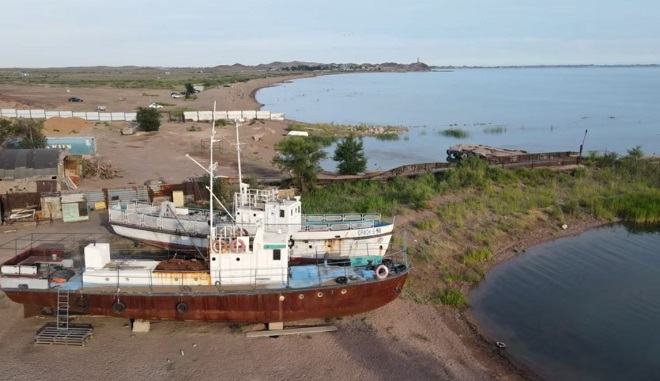
Lake Balkhash Beach, Kazakhstan
Lake Balkhash in Kazakhstan offers sandy and pebbly beaches along its shores, with warm—though sometimes slightly murky—waters that make it a popular spot for fishing and outdoor recreation. The lake is unique in that its western section contains freshwater, while the eastern section is saline, creating contrasting environments within a single body of water. Its diverse shorelines support rich ecosystems of birds, fish, and plant life, making it a haven for nature enthusiasts.
Visitors can reach the lake from multiple access points and enjoy activities such as birdwatching, kayaking, and fishing. The ideal time to visit is between April and October, when the climate is most favorable.
How to Reach Lake Balkhash
To reach Lake Balkhash in Kazakhstan, you can travel to the city of Balkhash by plane, bus, or train from major hubs such as Astana or Karaganda. From Balkhash, or from other locations along the Bishkek–Karaganda Highway, access to the lake is readily available.