 sutikshan
Grassy Mountain Nonconformity, Missouri
The Grassy Mountain Nonconformity on Highway 72, west of Fredericktown, Missouri, is a major geological site representing the “Great Unconformity.” It features the ~1.46-billion-year-old Proterozoic Grassy Mountain Ignimbrite (volcanic ash flow tuff), directly overlain by the Cambrian-age (roughly 500 million years old) Lamotte Sandstone, representing nearly a billion years of missing time.
The contact represents an ancient eroded surface (paleotopography) on which Cambrian marine sediments were deposited over deeply eroded Precambrian volcanic rocks.
Geology
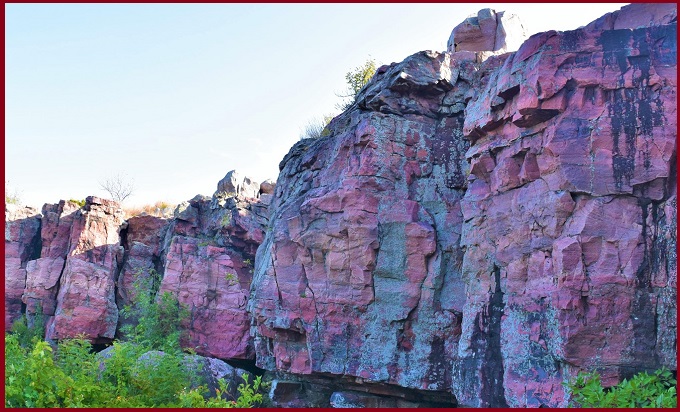
The St. Francois Mountains are the exposed core of the ancient Mesoproterozoic igneous basement, representing one of the oldest exposed rock units in North America. This Igneous basement consists of Grassy Mountain Ignimbrite, a maroon-to-black volcanic rock with smoky quartz and reddish alkali feldspar phenocrysts. Above this is a Nonconformable sedimentary formation, the Lamotte Sandstone, exposed with underlying Ignimbrite Cobbles.
Grassy Mountain Nonconformity
The site offers an excellent exposure of the Great Nonconformity, where much older Precambrian crystalline rocks lie beneath younger Cambrian sedimentary layers. The boundary between these two rock types represents a significant gap in Earth’s history—nearly a billion years missing from the geologic record.
Here, the crystalline rock can be seen at the base of the outcrop on the south side of the road and across most of the exposure on the north side. This rock is known as the Grassy Mountain Ignimbrite, part of the approximately 1.4-billion-year-old Butler Hill Group. It has a dark maroon to black groundmass and contains visible crystals, or phenocrysts, of quartz (smoky in color) and alkali feldspar (reddish at this location). This rock formed during a powerful volcanic eruption. The St. Francois Mountains are composed of similar volcanic and plutonic rocks with comparable chemistry, all formed around the same geological period.
Also read- Sioux Quartzite: A Powerful America’s Ancient Terrain
Above the crystalline rock lies the Lamotte Sandstone, which dates to the Upper Cambrian period, around 510 million years ago. This sandstone formed in a shallow sea that once covered much of North America. Its appearance varies across southern Missouri. In some areas, the lowest layers are so coarse-grained that they are better described as conglomerate.
Nonconformity
The unconformity between these two rock units marks a vast gap in time of roughly 900 million years. Similar contacts between Precambrian and Cambrian rocks are found across North America, including Powell’s Unconformity at the base of the Grand Canyon. The widespread occurrence of this type of unconformity remains a topic of scientific debate, but it may be linked to global icehouse conditions during the Cryogenian Period (about 720 to 635 million years ago).
Also read- Geotourism And Modern Geotechniques
How to Reach Grassy Mountain Nonconformity
The Grassy Mountain nonconformity, a significant geological site, is primarily located in areas like the Crowsnest Pass in Canada or near Malheur County, Oregon, where gold exploration occurs. Accessing such sites typically requires accessing regional, unpaved mining access roads.