 sutikshan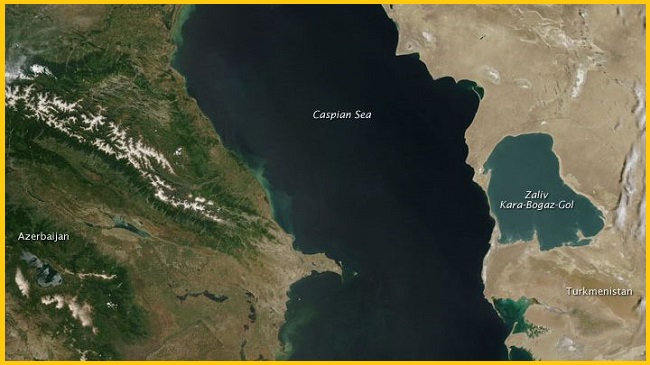
Caspian sea
The Caspian Sea, the world’s largest enclosed inland body of water, lies at the junction of Europe and Asia and is bordered by Russia, Kazakhstan, Turkmenistan, Iran, and Azerbaijan. As an endorheic basin, it has no natural outlet to the ocean. The sea is renowned for its vast oil and gas reserves as well as its sturgeon population, the source of prized caviar. In recent years, however, the Caspian Sea has faced a sharp decline in water levels, driven by climate change and rising evaporation rates.
The Caspian Sea has a salinity of about 1.2% (12 g/L), roughly one-third that of average seawater. It is bordered by Kazakhstan to the northeast, Russia to the northwest, Azerbaijan to the southwest, Iran to the south, and Turkmenistan to the southeast. Its name is derived from the ancient Iranic Caspi people.
Stretching 1,200 km from north to south with an average width of 320 km, the Caspian covers an area of 386,400 km². Its surface lies about 27 m below sea level. The sea’s main freshwater inflow comes from the Volga River, Europe’s longest, which enters at its shallow northern end. In contrast, its central and southern zones contain two deep basins that create variations in temperature, salinity, and ecology. The seabed in the southern basin reaches a depth of 1,023 m below sea level, making it the world’s third-deepest natural non-oceanic depression after Lake Baikal and Lake Tanganyika.
Formation of the Lake
The South Caspian Basin, like the Black Sea, is a remnant of the ancient Paratethys Sea. Its seafloor is composed of oceanic basalt rather than continental granite, making it geologically distinct.[20] The Caspian Sea is estimated to be around 30 million years old[21] and became landlocked during the Late Miocene, about 5.5 million years ago, as a result of tectonic uplift and falling sea levels.
During the Pliocene, the Caspian existed as a relatively small endorheic lake, but around the Pliocene–Pleistocene transition, its surface area expanded nearly fivefold.[22] Throughout history, warm and arid periods caused the sea to shrink dramatically, leaving behind evaporitic deposits such as halite. These layers were later buried by windblown sediments and sealed as evaporite sinks until wetter climatic phases replenished the basin. (Comparable evaporite formations can also be found beneath the Mediterranean.)
Today, freshwater inflows from the north give the Caspian a distinct salinity gradient—its northern waters are nearly fresh, becoming progressively more brackish toward the south. The highest salinity occurs along the Iranian coast, where rivers contribute minimal inflow.[23] On average, the Caspian’s salinity is about one-third that of the world’s oceans. The Garabogazköl lagoon, once cut off in the 1980s and dried out, has since been reconnected and restored.
Also read- Sarygamysh Lake: A Remote Oasis in Northern Turkmenistan
Geology
The geologic history of the Caspian region can be divided into two major stages. The first, during the Miocene, was shaped by tectonic activity linked to the closing of the Tethys Sea. The second, in the Pleistocene, was characterized by glaciation cycles and the full development of the modern Volga River system.
In the Miocene stage, the Tethys Sea gradually transformed into the Sarmatian Lake, which included the areas of the present Black Sea and southern Caspian. This occurred as the collision of the Arabian Peninsula with western Asia uplifted the Kopet Dag and Caucasus Mountains, forming natural southern and western boundaries of the basin. Throughout this period, ongoing orogenic activity caused the Caspian to be repeatedly isolated from the Black Sea.
During the late Pontian stage, a mountain arch rose across the southern basin, dividing it into two separate water bodies: the Khachmaz and Lankaran lakes. Later, in the Akchagylian period, this restriction ended, and the Caspian expanded to more than three times its present size, reestablishing connections with both the Black Sea and the Aral Sea. The retreat of Lake Akchagyl marked the close of the first stage.
Caspian Sea Map

Caspian Sea Shrinking
The Caspian Sea is undergoing severe shrinkage driven by rising evaporation from climate change, reduced river inflow, and growing water use for agriculture and industry. Projections indicate that by the end of the century, the sea could lose up to 34% of its surface area, with water levels dropping by as much as 18 meters. The impact is already evident in receding shorelines, newly exposed land, and infrastructure left stranded far from the water’s edge. This crisis poses serious risks to ecosystems and coastal communities, underscoring the urgent need for regional cooperation and global action to reduce greenhouse gas emissions.
Key Factors Behind the Caspian Sea’s Decline
Climate Change and Increased Evaporation
Rising global temperatures are intensifying evaporation from the sea’s surface, hastening water loss.
Reduced River Discharge
The Volga River—responsible for the majority of the Caspian’s inflow—along with other rivers, is experiencing diminished flow, reducing replenishment.
Human Water Diversion
Expanding agricultural irrigation and industrial consumption divert large volumes of water away from rivers that feed the sea.
Infrastructure Development
Projects such as dams, reservoirs, and hydroelectric stations—particularly in Russia—retain water upstream and alter natural river flows into the Caspian.
Caspian Sea Beach
Beaches and Locations – Azerbaijan
Bilgah Beach – Famous for its golden sands and calm waters, making it an excellent choice for families and casual swimmers. The beach also offers resorts and leisure facilities.
Lankaran Beaches – Notable for their therapeutic black volcanic sand and some of the clearest waters along the Azerbaijani coast. A perfect blend of relaxation, health tourism, and natural beauty.
Shikhov Beach – Located near Baku, this is a resort-style beach with modern amenities and accessibility. While convenient, it is sometimes considered less pristine compared to Bilgah or Lankaran.
Mardakan & Novkhani Beaches – Quieter and less crowded alternatives, featuring clear waters and a more relaxed atmosphere, ideal for those seeking peace away from the busier coastal spots.
Kazakhstan
Aktau City Beach – A popular urban beach along the Caspian, featuring clean sandy shores and modern amenities such as sun loungers and cafés. It’s especially famous for its stunning sunset views over the water, making it both a leisure and sightseeing spot.
How to Reach Caspian sea
You can reach the Caspian Sea by flying into major airports such as Baku in Azerbaijan, Aktau in Kazakhstan, or Astrakhan in Russia. Travelers may also opt for scenic train journeys like the Trans-Caspian Railway or drive along well-maintained highways that connect coastal cities. Once at the coast, you can explore nearby destinations by road or take a ferry across the Caspian Sea, with routes operating between countries like Kazakhstan and Azerbaijan.