 sutikshan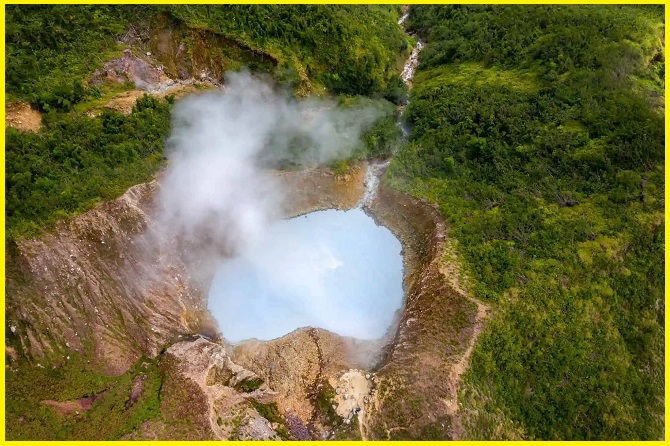
Boiling Lake Dominica
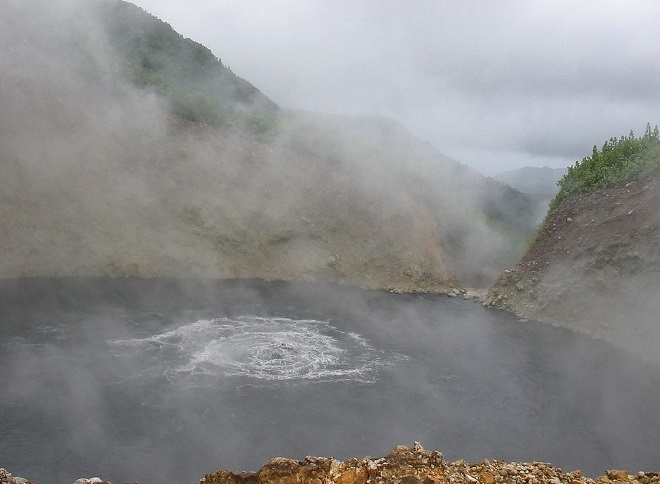
The Boiling Lake is a flooded fumarole located in Morne Trois Pitons National Park, a World Heritage Site on the island of Dominica. The lake, located 10.5 km east of Dominica’s capital, Roseau, is filled with bubbling greyish-blue water that is usually enveloped in a cloud of vapour. The Boiling Lake is approximately 60 to 75 m across and is the second-largest hot lake in the world after Frying Pan Lake, located in Waimangu Valley near Rotorua, New Zealand.
Geology
The Boiling Lake sits at the bottom of a large, sinkhole-like basin and is more accurately described as a flooded fumarole—a vent near a volcano that emits steam and gases from molten magma beneath. Today, visitors can view the lake from a broad cliff-top ledge approximately 30 meters above its shoreline, with the basin enclosed by steep rock walls.
Its grayish-blue waters are in a perpetual rolling boil, resembling a massive pot of water cooking and steaming. The lake is fed by rainfall and two small streams, which seep downward and are heated by the underlying magma to boiling temperatures. The trail to the lake passes through the Valley of Desolation, another volcanic landscape, where the air is hot, steamy, and acrid with sulfur.
The area is characterized by vapors and escaping gases, bubbling sulfur-water pools, spraying and hissing geysers, fissures, and a stream running beneath the terrain. Even tiny, invisible sprays of steam can easily scald an ankle or foot, making caution essential when exploring the site.
Boiling Lake tour, Dominica
The Boiling Lake is a volcano-hydrothermal feature situated near the Valley of Desolation in southern Dominica. Measuring roughly 60 meters in diameter and about 15 meters deep, it is the second-largest lake of its kind in the world, after Frying Pan Lake in New Zealand.
The lake is typically in a state of continuous boiling, though its water levels and temperatures occasionally fluctuate. Since 1876, there have been at least eight recorded changes in its water levels. One of the more recent fluctuations occurred between December 2004 and April 2005, during which the lake’s levels rose and fell several times, a pattern of activity that continues into the 21st century.
The Valley of Desolation and the Boiling Lake are popular sites of interest for both locals and visitors to Dominica. These remarkable natural features have been part of Morne Trois Pitons National Park, a UNESCO World Heritage Site, since 1987.
Boiling Lake Hike, Dominica
The Boiling Lake hike in Dominica is a challenging 13 km round-trip trek through Morne Trois Pitons National Park. Due to technical sections and a dangerous descent into the Valley of Desolation, the hike requires a local guide.
Along the route, hikers ascend Morne Nicholls, traverse the steaming Valley of Desolation, and reach the world’s second-largest boiling lake—a flooded fumarole with bubbling grayish-blue water. The trek typically takes 6–8 hours and demands a good fitness level, sturdy hiking boots, and guidance from an experienced local guide for safety and navigation.
The Boiling Lake hike can be divided into three sections, each taking roughly one hour-
Part I: Begins in Laudat, near Titou Gorge, and ends at Breakfast River, where hikers can refill with fresh water.
Part II: Ascends Morne Nicholls, which reaches an altitude of 3,168 feet (966 m), and concludes at the top of the Valley of Desolation.
Part III: Features a hazardous descent into the Valley of Desolation, followed by a long trek past sulfur springs and hot pools, culminating at a viewpoint overlooking the Boiling Lake.
The hike is not without risk; in 1900, two members of a three-person party—a hiker and a Dominican guide—died near the Boiling Lake after being asphyxiated by a sudden release of volcanic gases and falling to their deaths.
How to Reach Boiling Lake
To reach the Boiling Lake in Dominica, hikers must undertake a challenging, full-day trek starting from the village of Laudat. The route passes through Titou Gorge, ascends Morne Nicholls, descends into the Valley of Desolation, and concludes with a final hike to the lake itself.
Due to the difficult terrain and inherent risks, hiring a local, professional guide is mandatory. While the hike can take 3 to 6 hours, most visitors should expect a full day to complete the trail, which is rugged, potentially muddy, and features steep climbs and descents.