 sutikshan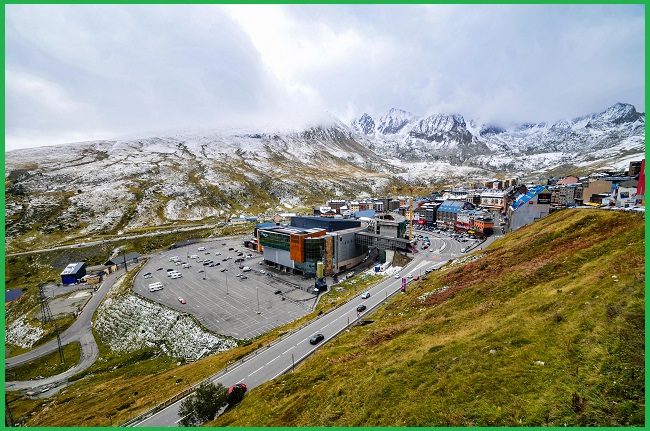
Andorra
Andorra, officially known as the Principality of Andorra, is a sovereign landlocked microstate located in the eastern Pyrenees on the Iberian Peninsula in Southwestern Europe. It shares borders with France to the north and Spain to the south. Traditionally believed to have been established by Charlemagne, Andorra was under the control of the Count of Urgell until 988, when authority was transferred to the Roman Catholic Diocese of Urgell. The current principality was formalized through a charter in 1278. Today, it is governed by two co-princes: the Bishop of Urgell in Catalonia, Spain, and the President of France. Its capital and largest city is Andorra la Vella.
Covering an area of 468 square kilometers, Andorra is the fifth-smallest state in Europe and has a population of about 87,486. Andorrans are a Romance ethnic group closely related to Catalans. Globally, Andorra ranks as the 16th-smallest country by area and 11th-smallest by population. Its capital, Andorra la Vella, holds the distinction of being the highest capital city in Europe, sitting at an elevation of 1,023 meters above sea level. The official language is Catalan, though Spanish, Portuguese, and French are widely spoken.
Geography and Geology
Located in the eastern Pyrenees, Andorra is largely mountainous, with rugged terrain dominating its landscape. The highest peak, Coma Pedrosa, rises to 2,946 meters, while the country’s average elevation is about 1,996 meters. The mountains are intersected by three narrow valleys forming a Y-shaped pattern, which merge into a single valley as the Gran Valira River flows south into Spain at Andorra’s lowest point of 840 meters. The country covers a total area of 468 square kilometers.
Andorra lies at the heart of the Central Pyrenees, a mountain range stretching 500 km well beyond its borders. The sediments that would eventually form these mountains were first deposited in coastal basins during the Paleozoic and Mesozoic eras. Around 100 to 150 million years ago, during the Lower Cretaceous Period, the landmasses of present-day France and Spain collided.
This tectonic movement generated immense pressure, uplifting the terrain and giving rise to the eastern segment of the range. Over millions of years, the remaining portions of the Pyrenees gradually rose to form the dramatic mountains seen today. During the Quaternary period, this range—including the area of modern-day Andorra—was extensively glaciated. Repeated cycles of glacial advance and retreat sculpted the terrain, creating features such as glacial cirques, basins, and deep river valleys.
Andorra Mountains
Andorra is a mountainous country boasts 175 named peaks, with Alt de Comapedrosa standing as the highest at 2,943 m and Pic de l’Estanyó as the most prominent at 2,915 m. Andorra’s elevation spans from 840 m at its lowest point to the peak of Alt de Comapedrosa at 2,943 m, with an average elevation of 1,996 m. Nestled within the Pyrenees, the country features three narrow valleys that intersect in a Y-shaped pattern.
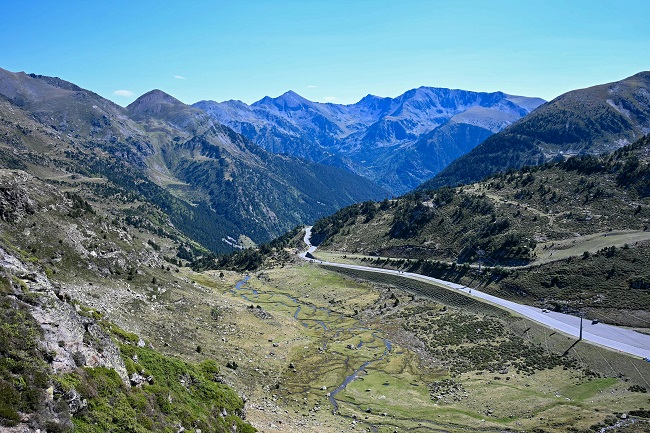
The Madriu-Perafita-Claror Valley, which accounts for about one-tenth of Andorra’s territory, showcases dramatic landscapes of steep valleys, open pastures, and traces of glacial activity. While many high peaks and ridgelines remain alpine and barren, the majority of hillsides are densely cloaked in forests.
UNESCO World Heritage Site
Andorra’s only UNESCO World Heritage Site, the Madriu-Perafita-Claror Valley, is a cultural landscape in the Pyrenees designated in 2004. Spanning more than 9% of the country, this glacial valley exemplifies the centuries-long coexistence of human activity and the high-mountain environment, showcasing traditions of pastoralism, alpine farming, and communal land management.
Andorra Tourism
Andorra attracts visitors with its breathtaking Pyrenean landscapes, offering year-round outdoor adventures. In winter, resorts like Grandvalira provide world-class skiing and snowboarding, while summer brings opportunities for hiking and mountain biking on scenic trails such as the Tristaina Lake Trail. Beyond nature, travelers can explore the capital, Andorra la Vella, known for historic landmarks like Casa de la Vall and Sant Esteve Church, indulge in tax-free shopping, and discover charming mountain villages scattered across the country.
Andorra Itinerary
Day 1: Explore Andorra la Vella & Cultural Highlights
Arrive in Andorra la Vella and stroll through the Old Quarter. Visit Casa de la Vall, the historic parliament building. Stop by Sant Esteve Church, a beautiful Romanesque landmark. Enjoy tax-free shopping on Avinguda Meritxell. Relax at Caldea Spa, Europe’s largest thermal spa. Dine at a traditional bordas (Andorran mountain restaurant).
Day 2: Outdoor Adventure in the Pyrenees
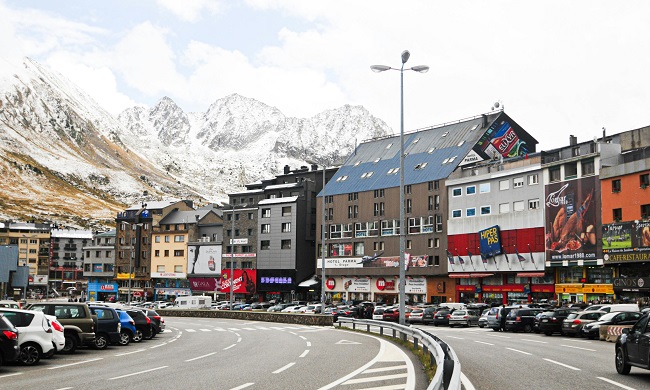
Head to Grandvalira or Pal Arinsal for skiing/snowboarding (winter) or try mountain biking & hiking (summer). Take a scenic cable car ride for panoramic views. Try snowshoeing or a guided nature walk. Enjoy après-ski activities or relax in your resort.
Day 3: Scenic Hikes & Mountain Villages
Hike the Tristaina Lakes Trail (family-friendly) or challenge yourself with Pic de Coma Pedrosa (expert). Alternative: Explore Vall de Juclar for high-altitude lakes. Visit picturesque villages like Ordino and Canillo. Stop by Sant Joan de Caselles Church, an iconic Romanesque site. Taste local dishes like trinxat or escudella before departure.
Hiking in Andorra
Andorra is a hiker’s paradise, offering routes for all skill levels—from gentle valley strolls to demanding mountain climbs. Its well-marked trails traverse diverse landscapes of alpine forests, glacial lakes, and rugged peaks such as Pic de Coma Pedrosa. Popular hikes include the family-friendly Tristaina Lakes Trail, the Vall de Juclar for stunning high-altitude lakes, and the Mirador Circuit near Andorra la Vella for panoramic city views. With an extensive trail network, the country is highly accessible to hikers, though proper preparation for unpredictable mountain weather remains essential.
Tristaina Lakes Trail (Ruta dels Estanys de Tristaina):
A scenic, family-friendly circular route that takes you past three stunning glacial lakes in the Arcalís area. This well-marked trail is suitable for all skill levels and offers breathtaking mountain views throughout.
Vall de Juclar:
A picturesque hike leading to Andorra’s largest lake, this route offers stunning high-altitude scenery, crystal-clear waters, and sweeping mountain views, making it a rewarding experience for nature lovers.
Pic de Coma Pedrosa:
Standing as Andorra’s highest peak, this challenging hike within the Parque Natural Comunal Valls de Comapedrosa is best suited for experienced hikers. The demanding routes reward adventurers with breathtaking panoramic views and a true high-mountain experience.
Andorra trekking trails
Andorra boasts a wide range of trekking options, from easy, family-friendly routes like the Circuit de les Fonts and Tristaina Lakes Trail to demanding ascents such as Pic de Coma Pedrosa and the multi-day Coronallacs Trail. For planning your hikes, resources like AllTrails, Tripadvisor, Wikiloc, and Komoot offer detailed trail information, difficulty ratings, and user reviews across popular regions such as Canillo and La Massana.
Skiing in Andorra
Grandvalira spans over 215 km of skiable terrain across seven sectors—Canillo, Soldeu, Pas de la Casa, Encamp, El Tarter, El Peretol, and Grau Roig—offering a comprehensive range of services and activities beyond skiing and snowboarding. Grandvalira caters to all skill levels and is family-friendly, featuring diverse accommodations, snow activities, and customizable ski passes such as the Andorra Pass and Mountain Pass for ski touring enthusiasts.
Pal Arinsal consists of two interconnected sectors—Pal and Arinsal—linked by a cable car. With over 63 km of slopes, it offers an ideal setting for all levels, from beginners to experienced skiers, making it a great destination for enjoying the snow in a welcoming environment.
Ordino Arcalís is renowned for its exceptional snow quality, thanks to its north-facing slopes, making it one of Andorra’s most popular ski resorts. With 30.5 km of runs, it caters to all levels—from beginners to expert freeriders—earning a reputation as an international reference for off-piste skiing.