sutikshan
Austria
Austria, officially the Republic of Austria, is a landlocked country in Central Europe, situated in the Eastern Alps. It is a federal republic composed of nine states, with Vienna—its capital and largest city—also functioning as one of the states. Austria shares borders with Germany to the northwest, the Czech Republic to the north, Slovakia to the northeast, Hungary to the east, Slovenia and Italy to the south, and Switzerland and Liechtenstein to the west.
The territory of present-day Austria has been continuously inhabited since at least the Paleolithic era. By around 400 BC, it was settled by Celtic tribes, and in the late 1st century BC, it was incorporated into the Roman Empire. The process of Christianization began during the 4th and 5th centuries in the late Roman period, after which the region saw the arrival of various Germanic tribes during the Migration Period.
Geography
Austria, located in Central Europe, is a predominantly mountainous country situated roughly between Germany, Italy, and Hungary. It covers a total area of 83,871 square kilometres. The country shares borders with Switzerland and Liechtenstein to the west; Germany (801 km), the Czech Republic (402 km), and Slovakia (105 km) to the north; Hungary to the east (331 km); and Slovenia (330 km), as well as Italy (404 km) to the south. In total, Austria’s land borders extend for 2,534 km.
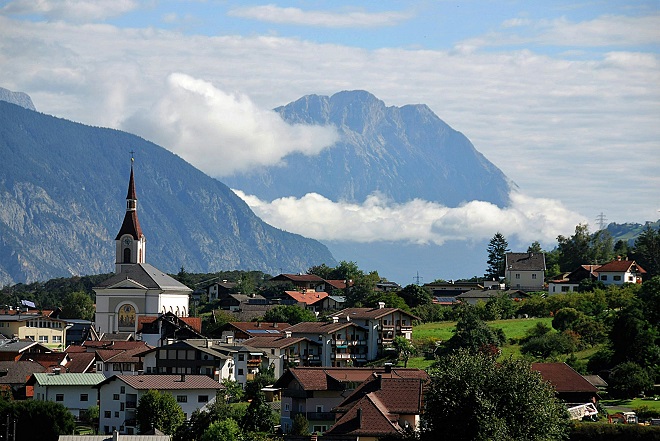
Austria is predominantly mountainous due to its location within the Alps. The Central Eastern Alps, Northern Limestone Alps, and Southern Limestone Alps all extend partly into its territory. Of Austria’s total area of 83,871 km², only about one-quarter is classified as low-lying, and just 32% lies below 500 metres. While the Alps dominate the western regions, the landscape gradually transitions into lowlands and plains toward the east.
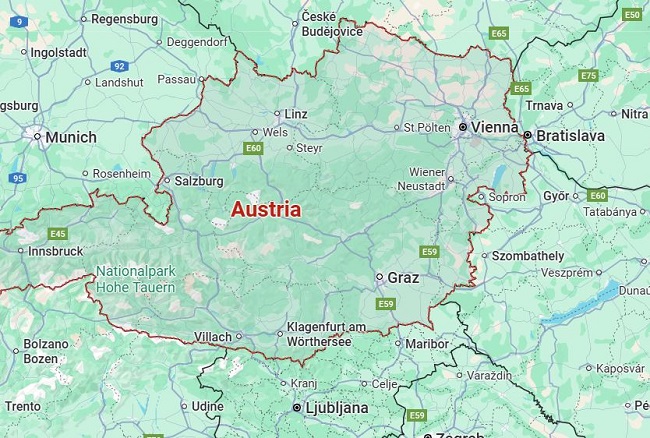
Austria Map
Austria map shows that it is a landlocked, mountainous country situated in South-Central Europe, lying within both the Northern and Eastern Hemispheres of the Earth. Located in the north-eastern part of the country, Vienna is the capital, the largest, and the most populous city of Austria.
Austria’s Best Places to Visit
Some of the most remarkable places to visit in Austria include its capital, Vienna, celebrated for its imperial heritage and landmarks such as Schönbrunn Palace; Salzburg, the birthplace of Mozart, with its iconic fortress overlooking the old town; and Innsbruck, the alpine capital, famed for its dramatic mountain scenery and outdoor adventures. The charming lakeside village of Hallstatt and the historic yet creative city of Graz also stand out as highlights. Beyond the cities, visitors are drawn to the scenic Wachau Valley, the breathtaking high alpine route of the Grossglockner Pass, and the popular mountain resort region of Zell am See.
Also read- Vienna Delights: Must-Do Activities in Austria’s Capital
Vienna
Austria’s capital city, renowned for its imperial grandeur, is home to magnificent landmarks such as Schönbrunn Palace and the Hofburg. Its elegant architecture, world-class museums, and vibrant cultural scene reflect centuries of history. Vienna is equally famous for its traditional coffee houses, which remain a cornerstone of local life and intellectual culture.
Salzburg
Famed as the birthplace of Wolfgang Amadeus Mozart and the setting of The Sound of Music, Salzburg enchants visitors with its Baroque architecture, the commanding Hohensalzburg Fortress, and its charming, narrow streets. The city’s blend of music, history, and Alpine scenery makes it one of Austria’s most picturesque destinations.
Hallstatt
One of Austria’s most picturesque villages, Hallstatt sits on the tranquil shores of a lake, framed by dramatic mountains. Part of the Salzkammergut region, it is renowned for its postcard-perfect scenery, charming alpine houses, and centuries-old salt mining history.
Graz
Austria’s second-largest city, Graz is celebrated for its beautifully preserved medieval old town, a UNESCO World Heritage Site. Blending history with modern creativity, the city boasts a vibrant art and design scene and serves as the cultural heart of the Styria region.
Austria beaches
Austria may not have ocean beaches, but it offers numerous freshwater lake shores that are perfect for swimming, relaxation, and recreation. Scenic spots can be found at Hallstatt and along the crystal-clear waters of lakes such as Achensee and Attersee. Popular bathing areas include Badestrand Hallstatt, the Obertraun lakeside area, and the inviting beaches at Strandbad Seespitz, all of which provide clean waters and breathtaking Alpine views.
Badestrand Hallstatt
Situated in the world-famous village of Hallstatt, this lakeside beach offers a lovely promenade with stunning views of both the lake and the surrounding mountains.
Obertraun Bathing Area / Lakeside Recreation Area
Just across the lake from Hallstatt, Obertraun is known for its family-friendly atmosphere, featuring clean waters, playgrounds, and ample space for relaxation.
Achensee
Often called the “Fjord of the Alps,” Achensee is one of Austria’s most popular lake destinations. Bathing spots in Pertisau and Seespitz provide crystal-clear water and dramatic Alpine scenery.
Attersee
The largest lake in the Salzkammergut region, Attersee, offers inviting bathing areas, especially around Unterach, making it a perfect place to enjoy a summer day by the water.
How to Reach Austria
Before visiting Austria, check whether you require a visa based on your nationality. Most international travelers arrive by air, with Vienna International Airport serving as the main gateway, though other airports such as Salzburg and Innsbruck also offer international connections. Austria is well integrated into Europe’s transport network, making it easily accessible by car, train, or bus from neighboring countries. Ensure your passport is valid for the required duration of your stay, and obtain a visa if necessary before traveling.