sutikshan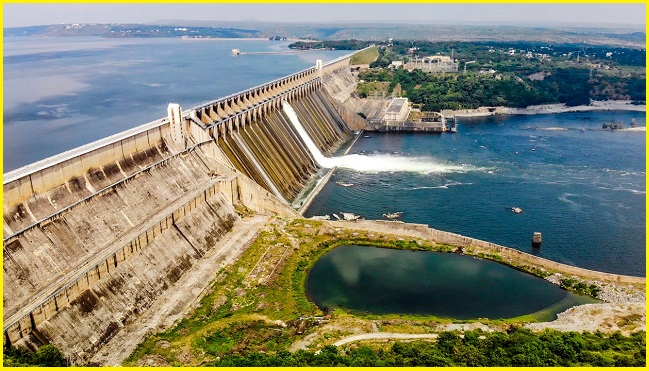
Nagarjun Sagar Dam
The Nagarjuna Sagar Dam is a masonry structure built across the Krishna River at Nagarjuna Sagar, lying on the border of Nalgonda district in Telangana and Palnadu district in Andhra Pradesh. It supplies irrigation water to the districts of Nalgonda, Suryapet, Khammam, and Bhadradri Kothagudem in Telangana, as well as Krishna, Guntur, Palnadu, Prakasam, and parts of West Godavari in Andhra Pradesh. In addition, it contributes to electricity generation for the national grid.
Constructed between 1955 and 1967, the dam formed a massive reservoir with a gross storage capacity of 11.472 billion cubic metres and an effective capacity of 6.92 cubic kilometres. Rising 124 metres from its deepest foundation and stretching 1.6 kilometres in length, the dam is equipped with 26 floodgates, each measuring 13 metres wide and 14 metres high. Its operations are managed jointly by the states of Andhra Pradesh and Telangana. As one of the earliest multi-purpose irrigation and hydroelectric projects in India, Nagarjuna Sagar Dam was among the pioneering large-scale infrastructure developments envisioned as “modern temples” to drive the Green Revolution in the country.
Nagarjun Sagar Dam on the Map
The Nagarjuna Sagar Dam is located on the Krishna River, straddling the border between the Guntur district of Andhra Pradesh and the Nalgonda district of Telangana.

History
The origins of the Nagarjuna Sagar Dam trace back to 1903, when the Nizam commissioned British engineers to begin survey work for constructing a dam across the Krishna River. The project was formally inaugurated by Prime Minister Jawaharlal Nehru on 10 December 1955, and construction continued for the next twelve years. A key figure in bringing the project to fruition was Raja Vasireddy Ramagopala Krishna Maheswara Prasad, widely known as the late Muktyala Raja, who played a crucial role through persistent political advocacy. He also made significant contributions, donating £110 million in 1952 along with 22,000 hectares of land.
Also read- An Island Dream: The Langkawi, Malaysia
At the time of its completion, Nagarjuna Sagar stood as the tallest masonry dam in the world, built entirely with indigenous expertise under the engineering leadership of Kanuri Lakshmana Rao.
Nagarjun Sagar Tour
In the heart of Telangana, the Nagarjuna Sagar Dam stands tall as a symbol of human vision and determination. Spanning the vast waters of the Krishna River, this grand structure is more than just a lifeline for agriculture and power—it is also a captivating landmark of scenic beauty. Steeped in history, admired for its engineering brilliance, and embraced by stunning natural surroundings, the Nagarjuna Sagar Dam remains both a marvel of modern infrastructure and a timeless destination for explorers.
When planning a trip to Nagarjuna Sagar Dam, it’s best to start early in the morning and carry some food, as dining options around the area are limited. If you leave by bus or cab, you can reach the Launch Point by around 9:00 AM. From there, a motorboat usually departs at 9:30 AM for Nagarjunakonda Island. The 45-minute ride offers scenic views, and once you arrive, you can spend some time exploring the ancient Buddhist excavations and the museum that preserves relics from the era.
Nearby attractions can be visited- such as Ethipothala Falls, caves, or the wildlife sanctuary. With pleasant weather, a day at Nagarjuna Sagar promises to be both refreshing and memorable.
Nagarjun Sagar Dam Boating
Boating on vast water bodies carries a charm of its own, and Telangana offers several such memorable experiences. Among them, cruising on the shimmering waters of Nagarjuna Sagar stands out as a favorite, drawing tourists from far and wide. Telangana Tourism runs regular cruise services on the reservoir, particularly when water levels rise after heavy inflows. The journey offers stunning views of the mighty Nagarjuna Sagar Dam and leads to Nagarjunakonda, a historic island in the middle of the waters, renowned for its ancient Buddhist excavations. Motorboats also operate between the reservoir and the island, with a one-way ride taking about 45 minutes. Visitors can spend ample time exploring the island and its museum, which preserves rare artifacts from the Buddhist era.
The ideal time to visit Nagarjuna Sagar Dam is between July and September, when the weather is most pleasant. A rainy day makes the experience even more spectacular, as the dam’s gates are often opened, creating a breathtaking and unforgettable sight.
How to Reach Nagarjun Sagar Dam
To reach Nagarjuna Sagar Dam, you can either drive or take a bus from nearby cities such as Hyderabad (150–163 km) or Guntur (150 km), both of which are well-connected with frequent state-run and private bus services. The nearest major railway station is at Guntur, from where taxis and buses are available to the dam. The closest airport is in Hyderabad, which serves as the main gateway for onward travel by road to Nagarjuna Sagar.