 sutikshan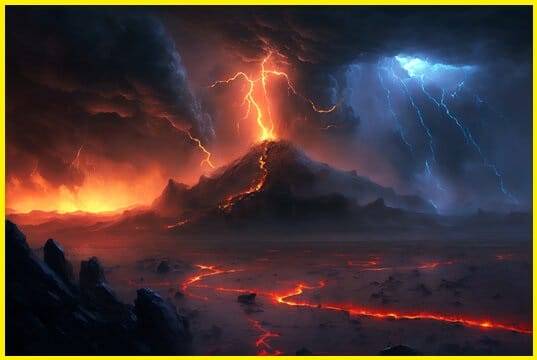
Volcanic Lightning and Fire Clouds
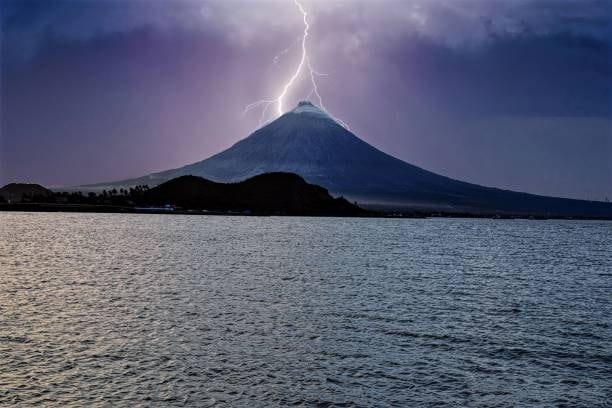
Volcanic lightning is an electrical discharge generated by volcanic eruptions rather than by conventional thunderstorms. It forms when volcanic ash—and sometimes ice particles—collide and fragment within the eruption plume, creating static electricity. This process gives rise to the phenomenon often referred to as a “dirty thunderstorm.” Moist convection currents and ice formation within the plume further influence eruption dynamics and can trigger lightning activity. Unlike ordinary thunderstorms, however, volcanic lightning can occur even in the absence of ice crystals in the ash cloud.
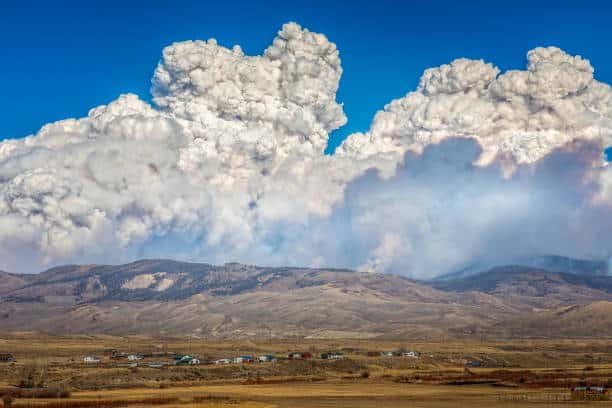
Fire Clouds (also known as pyrocumulonimbus/flammagenitus clouds) are massive, towering storm clouds formed by intense heat from fires or eruptions, containing ash, smoke, and water vapor that can produce their own lightning and strong winds, exacerbating the spread of fires. Both phenomena are visually dramatic, with lightning bolts illuminating the dark, turbulent eruption plumes, revealing the extreme energy of volcanic events.
A Fire Clouds flammagenitus cloud forms when intense surface heating strongly warms the air. This heat triggers convection, causing the air mass to rise until it reaches a stable level, typically where sufficient moisture is present. Such clouds are commonly generated by volcanic eruptions and forest fires through processes similar to those responsible for homogenitus cloud formation, and their development can be further enhanced by the presence of a low-level jet stream. Condensation occurs as ambient atmospheric moisture, along with water vapour released from burning vegetation or volcanic outgassing (a major component of eruptive gases), readily condenses onto ash particles.
Flammageniti are characterized by intense turbulence, expressed as strong surface gusts that can intensify large fires. Large flammagenitus clouds, especially those associated with volcanic eruptions, may also generate lightning.
History
The earliest recorded account of volcanic lightning comes from Pliny the Younger, who described the eruption of Mount Vesuvius in AD 79: “There was a most intense darkness rendered more appalling by the fitful gleam of torches, at intervals obscured by the transient blaze of lightning.” The first scientific investigations of volcanic lightning were later conducted by Luigi Palmieri at Mount Vesuvius. Observing eruptions in 1858, 1861, 1868, and 1872 from the Vesuvius Observatory, Palmieri documented frequent lightning activity associated with these events.
Also Read- What is Zone of Metamorphism or Metamorphic Zones
Volcanic lightning has since been observed at numerous volcanoes worldwide, including Mount Augustine in Alaska; Eyjafjallajökull and Grímsvötn in Iceland; Mount Etna in Italy; Taal Volcano in the Philippines; Mount Ruang in Indonesia; and Volcán de Fuego in Guatemala.
Factor and Process
Volcanic lightning mainly develops within the towering eruption columns produced by explosive volcanic activity. It is most frequently associated with powerful Plinian eruptions, but smaller-scale eruptions are also common in Japan’s Sakurajima, Italy’s Mount Etna, and Indonesia’s Anak Krakatau—and can also produce dramatic lightning displays.
The velocity at which volcanic material, known as tephra, is expelled plays a crucial role in this process. Rapidly rising ash clouds, driven by high gas pressure, intensify collisions among ash particles and increase electrical charging.
Mechanics behind the lighting
Unlike ordinary thunderstorms, where lightning forms through collisions between ice crystals, volcanic lightning often originates from triboelectric charging—an electrical charge produced when particles rub against one another. Close to the ground, dense clouds of volcanic ash generate static electricity in much the same way a balloon creates a static shock when rubbed against hair.
Researchers have also identified a second source of volcanic lightning occurring at much higher altitudes, near the stratosphere. At these elevations, volcanic ash can mix with water vapor to form ice crystals, whose collisions produce lightning similar to that seen in conventional thunderstorms. This dual process explains why lightning may occur both near the eruption vent and high above the ash plume, as dramatically observed during the 2015 eruption of Chile’s Calbuco volcano.
This dramatic lightning display occurs in two distinct zones: near the ground within dense ash clouds, and high above the volcano near the stratosphere within the rising eruption plume. Close to the surface, volcanic lightning is thought to result from the friction between individual ash particles, which generates static electricity powerful enough to produce lightning. Higher in the atmosphere, the process is more unexpected and closely resembles that of ordinary thunderstorms. As ash and water vapor rise and cool, ice crystals begin to form in the upper layers of the plume. Collisions between these ice particles allow electrical charges to build until they are released as lightning strikes.
Charging Mechanisms
Ice charging
Ice charging is believed to play a significant role in certain types of volcanic eruption plumes, particularly those that rise above the freezing level or involve direct interactions between magma and water. In ordinary thunderstorms, lightning is generated through ice charging as collisions between ice crystals and other hydrometeors electrify the cloud. Volcanic plumes can likewise contain substantial amounts of water, derived from the magma itself, vaporized from nearby sources such as lakes and glaciers, and entrained from the surrounding atmosphere as the plume ascends.
Frictional Charging
Triboelectric, or frictional, charging within a volcanic eruption plume is considered one of the primary mechanisms responsible for electrical activity. As rock fragments, ash, and ice particles collide within the turbulent plume, they generate static electrical charges—much like the collisions between ice particles that produce lightning in ordinary thunderstorms. Strong convective currents then lift the plume and separate regions of opposing charge, eventually leading to electrical breakdown and the discharge of lightning.
Fractoemission
Fractoemission refers to the generation of electrical charge during the fragmentation of rock particles. This process is thought to be a significant source of electrical charging near the volcanic vent during an eruption.
Radioactive Charging
Naturally occurring radioisotopes within ejected rock particles may still influence particle electrification. Studies of ash from the Eyjafjallajokull and Grímsvötn eruptions revealed that both samples exhibited natural radioactivity above background levels. However, researchers concluded that radioisotopes were unlikely to be a major source of self-charging within the Eyjafjallajökull plume.
That said, the potential for enhanced charging may exist closer to the eruption vent, where particle sizes are generally larger. Ongoing research suggests that electrification driven by radioisotopes—such as radon—could, under certain conditions, play a more significant role and may represent a relatively common charging mechanism at varying intensities.
Plume Height
The height of a volcanic ash plume appears to influence the dominant mechanism responsible for lightning generation. In taller plumes, typically reaching 7–12 km, high concentrations of water vapor can enhance lightning activity. In contrast, smaller plumes, rising about 1-4 km, tend to acquire much of their electrical charge from rock fragmentation near the volcanic vent, a process known as fractoemission. Atmospheric temperature also plays an important role: colder ambient conditions promote freezing and ice charging within the plume, leading to increased electrical activity.