 sutikshan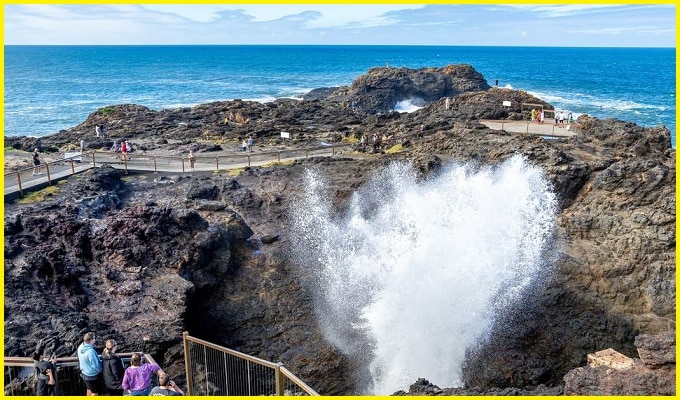
Kiama Blowhole,Australia
The Kiama Blowhole is a famous natural attraction in the town of Kiama, New South Wales, Australia, whose name translates to “where the sea makes a noise.” Drawing 900,000 tourists annually, the Big Blowhole can spray up to 50 litres of water 25 meters high under specific sea conditions. The town also features the Little Blowhole, which, while smaller, is often more reliable and equally spectacular due to its narrow shape.
The Kiama Blowhole is located at a natural sea cave that forcefully shoots water up, accompanied by a loud “whoosh” sound. It is the world’s largest blowhole and a popular attraction with viewing platforms, picnic areas, and nearby facilities, though the public is warned to stay clear of the water’s edge due to past accidents. A similar, more consistent feature is the nearby “Little Blowhole.”
Geology and Process
The blowhole originated from basalt lava flows about 260 million years ago and was initially named ‘Khanterinte’ by local Aboriginals. George Bass first recorded its existence in December 1797 during his coastal exploration trip. Water is ejected from the blowhole due to a pressure mechanism within an underground chamber. Water influx from incoming waves builds pressure in the chamber, and this stored energy is released as a geyser when the external wave force diminishes.
Read- Geotourism And Modern Geotechniques
Despite safety measures—including fences and signs—erected by the local council, the site has been associated with tragedy: a 1992 incident saw seven people drowned by a freak wave, and five years later, two more members of one of the affected families also died near the picturesque spot. Tourists are still regularly seen standing dangerously close to the edge.
Kiama Blowhole Time
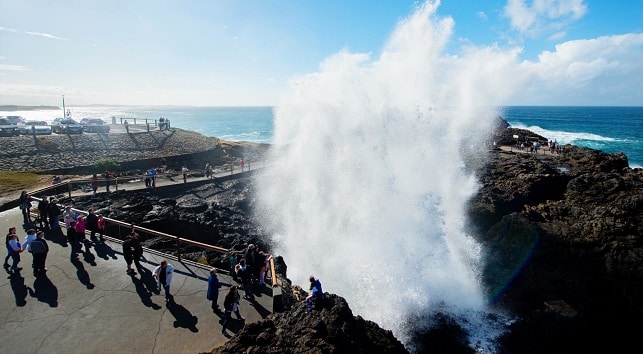
The blowhole is most active and impressive when visited during high tide, combined with a good ocean swell. While these conditions can occur at any time, scheduling your visit for sunrise or sunset will offer the best lighting and the most beautiful scenery.
Kiama Blowhole Tide
The Kiama Blowhole offers its most spectacular display, with plumes recorded over 30 meters high, when viewed during general high tide combined with a large southeast swell. To plan your visit effectively, it’s recommended that you check reliable daily tide charts for specific times and heights, as these vary based on moon phases and weather.
Also Read- Murphy’s Haystacks: A Breathtaking Granite Inselbergs of Australia
Kiama Blowhole Swimming
Swimming at the Kiama Blowhole is extremely dangerous and strictly prohibited due to powerful surges and currents, which have caused numerous fatalities and required many rescues despite warnings. For a safe swimming option, visitors should use the nearby Blowhole Point Ocean Pool. Exploring the blowhole’s underwater chamber requires free-diving expertise and extreme caution.
How to Reach Kiama Blowhole
The Kiama Blowhole is accessible by car, train, or bus. Driving from Sydney is the fastest route (about 1 hour 37 minutes), while the train from Sydney’s Central Station is a popular alternative, taking approximately 2.5 hours. Travelers coming from places like Melbourne often fly to Sydney and then proceed by train.