 sutikshan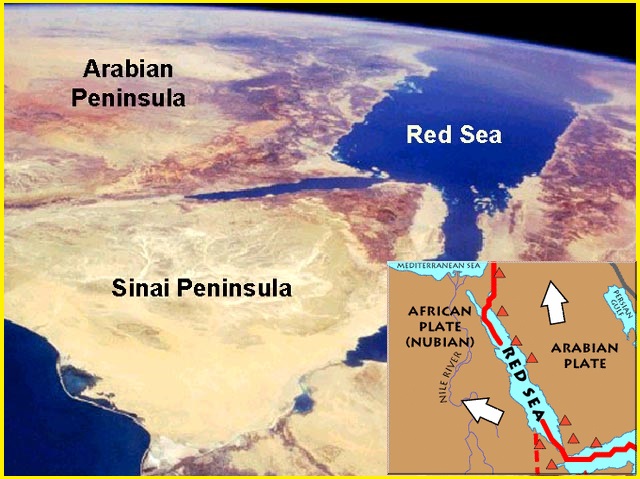
The Red Sea Rift
The Red Sea Rift is a mid-ocean ridge situated between the African and Arabian plates. This structure was formed by the divergence of these two plates, evolving from a continental to an oceanic rift. It runs from the Dead Sea Transform system and terminates at the Afar triple junction in the Afar Depression of the Horn of Africa, intersecting the Aden and East African Rifts. The plates are spreading at an approximate rate of 1 cm.
Near the Red Sea’s mouth, between Yemen and Eritrea, the rift zone contains the island of Jabal al-Tair. This landmass is actually a basaltic stratovolcano (located northwest of the Bab al-Mandab passage) that ended its 124-year dormancy with an eruption on September 30, 2007.
What type of Boundary is the Red Sea rift
The Red Sea rift is a divergent tectonic boundary where the African and Arabian plates are pulling apart. This process is creating a new oceanic basin and is currently in a transitional stage between a continental rift and a full-fledged oceanic rift. As the plates move away from each other, magma rises from the mantle, thinning and stretching the crust. The Red Sea is a “juvenile” or developing oceanic basin, and the process taking place is the very beginning of what will eventually form a new ocean.

Red Sea
The Red Sea is an Indian Ocean inlet positioned between Africa and Asia, underlain by the Red Sea Rift (part of the Great Rift Valley). It connects to the ocean in the south via the Bab-el-Mandeb Strait and the Gulf of Aden. Its northern reaches include the Gulf of Aqaba and the Gulf of Suez (leading to the Suez Canal). Extending about 2,250 km long and covering 438,000 km, the sea averages 490 m in depth but plunges to a maximum of 3,040 m in the Suakin Trough. As the world’s northernmost tropical sea, the Red Sea is surprisingly shallow, with 40% less than 100 m deep.
Also read- Know what is Afar Triple Junction-The point where the Red Sea formed!
What forces and processes formed the Red Sea rift
The tectonic evolution of this region is best explained by a two-stage spreading model. The initial major rifting began in the lower to middle Eocene, leading to significant seafloor spreading in the late Eocene and early Oligocene. This active period was followed by an extended 30-million-year (Ma) pause, during which massive evaporite deposits accumulated. Approximately five million years ago, a new and current phase of spreading commenced. This latest activity disturbed the accumulated sediments, creating an unstable environment as the crust and sediments parted and the axial trough formed. Normal faulting during earthquakes confirms that the extensional motion continues today.
While scientists agree that seafloor spreading formed the Red Sea’s axial trough (which is underlain by oceanic crust), the composition of the crust beneath the main trough and coastal plains remains highly debated. This controversy has led to several competing theories: some propose the entire Red Sea basin is oceanic crust, others suggest the main trough is only partially oceanic, and yet others claim the crust outside the axial trough is continental with basaltic intrusions, or even composed of rift meta-sediments directly contacting the upper mantle. Though geophysical data for the axial trough clearly indicate typical oceanic seismic velocities, the main trough shows extreme lateral variation, with basement velocities shifting abruptly between typical continental and oceanic signatures.
Triple Junction
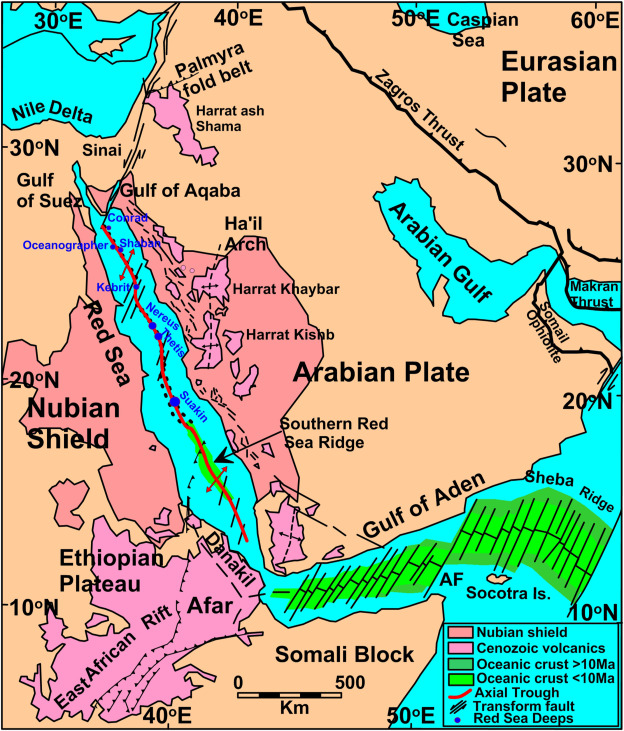
The Afar region in Northern Ethiopia is the focal point of a ‘Y’ shaped rift system where continental lithosphere is actively being stretched and split. This region hosts the Triple Junction, the meeting point of three major plate boundaries. Here, the Arabian Plate is rifting away from the African Plate along a divergent ridge to form the Red Sea and the Gulf of Aden. Simultaneously, this rifting extends southward, causing the African Plate itself to stretch and split along the East African Rift Valley, forming two new plates: the Nubian and Somalian Plates.
Also read- Business leaders success story
Interesting facts about the Red Sea Rift
The Red Sea’s inception began with Middle Tertiary rift volcanism in the Arabian-Nubian Shield, marking the first surface evidence of active mantle convection beneath the axis. Studies of Saudi Arabia’s southwestern coastal plain indicate that from 30 to 20 Ma ago, this early rift valley was filled with a diverse collection of rocks, now called the Jizan group. These deposits include the basaltic and rhyolitic Ad Darb and Damad formations, cherty tuffaceous siltstones (Baid formation), and some Nubian-type quartz sandstone (Ayyanah sandstone). Importantly, alkali-olivine basalt also erupted 100 to 200 km east of the stable craton during this same period.
The axial deep of the Red Sea rift is significant as the site of the first known hot hydrothermal brines discovered on the seafloor. Between 1949 and the 1960s, researchers confirmed the presence of these hot 60 C, saline brines and the associated metalliferous muds, determining that the hot solutions were actively emanating from a subseafloor rift. See the blue dot in the Axial trough in the Diagram.