 sutikshan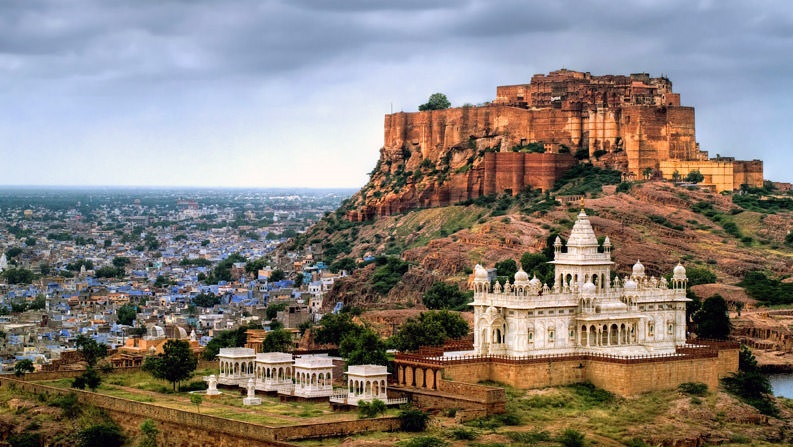
Mehrangarh Fort
Perched 122 meters above the Jodhpur plains, the Mehrangarh Fort is a majestic 15th-century fortress and one of India’s largest. Built by Rathore ruler Rao Jodha, it offers stunning views of the Blue City and houses a museum rich in Rajput relics, cementing its historical role as the former Rathore clan headquarters.
Mehrangarh Fort is known for its splendid architecture and the diverse history associated with the Rathore clan. The hot climate and its location at the edge of the desert also make Mehrangarh Fort a beautiful place. Mehrangarh fort derived its name from the Sanskrit word Mehr (Mihir), meaning ‘Sun’, and Garh means ‘Fort’ (citadel of the Sun god). Actually, the sun has been the chief deity of the Rathore dynasty, and believed that the Rathores are the descendants of the Sun. Meantime, as per the local language, Mehr-Garh came to be known as Mehrangarh.
History
Mehrangarh Fort was built by Rao Jodha of the Rathore dynasty in mid mid-15th century. Rao Jodha was the fifteenth Rathore ruler in 1458, and at the time he became king, the old ‘Mandore fort’ was slowly and gradually deteriorating. So he advised moving his capital to a safer place. This led to the foundation of Mehrangarh Fort.
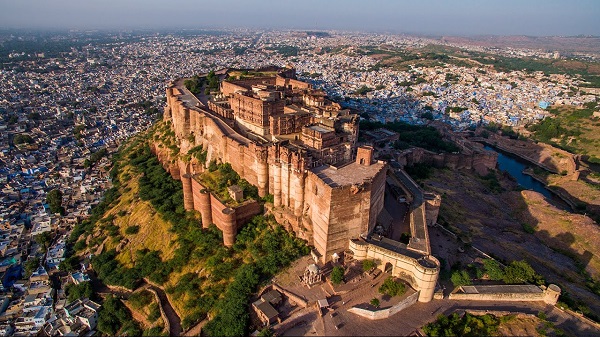
Most of the other developments in the fort were made during the time of Jaswant Singh and Maharaja Ajeet Singh between the years 1638 to 1678. The fort is perched on a vertical Cliff named ‘Bakhurcheeria’ and is ornate with the beauty of red sandstone carvings. The fort is situated 400m high above the level of Jodhpur city and is spread over 5 km. the area in the hillock.
Seven gates in the Fort can be used to enter the Fort premises. The most famous entry gate, Jaya Pol, meaning victory, was constructed by Maharaja Man Singh in 1808 following his victory over the armies of Jaipur and Bikaner. Fatteh Pol was made by Maharaja Ajit Singh to celebrate the defeat of the Mughals. Other palaces inside the fort are Moti Mahal or the Pearl Palace, which was the Royal throne of the Jodhpur king.
The fort premises have the Chamunda Mata Temple. Goddess Chamunda is the ‘family Deity’ of the Marwadi Community, and that’s the reason a large crowd of people comes to the place to worship the goddess in Navaratri every year.
Also Read- Hawamahal in Jaipur- A unique architecture made of Pink Sandstone
You are surprised that the popular 2012 film from the Batman series, ‘The Dark Knight Rises had a significant scene shot at many places in Mehrangarh. If you want to know more about the fort and its surrounding rock formation, Jodhpur is well-connected by State Highways and the Northern Railway Main Line via the Phalodi Branch railway line. Jodhpur Town is also approachable by air from the capital Delhi NCR.
Geological significance
The contact point between the Malani Igneous Suite (rhyolite) and the younger Jodhpur Group sandstones at the Mehrangarh Fort is a significant geological feature, declared a National Geological Monument by the Geological Survey of India.
The fort stands above the rhyolite rock of the Malani Igneous Suite, representing the last segment of igneous activity of the Precambrian age in the Indian Subcontinent. The Mehrangarh Fort is titled ‘National Geological Monument by the Geological Survey of India in 1976.
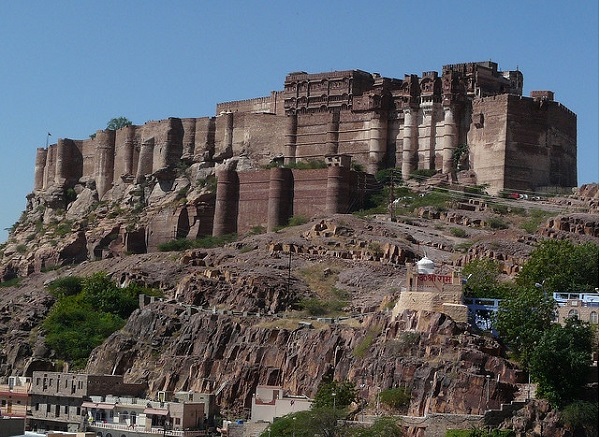
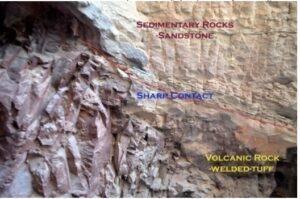
Silicic volcanic rock or rhyolite, which represents the “Malani Igneous Suite of Rock,” is overlain by a thick pile of sedimentary undeformed rocks that were deposited in a Trans-Aravalli Vindhyan or Marwar Super Group basin formed at the close of the Proterozoic and early Cambrian Period. In this hillock, welded tuff/ignimbrite (fire rain) can also be seen.
Rhyolite in the Jodhpur area can be found in various colors, including purple, red, ash, black, and green. Its strength and durability make it a valuable local mineral resource, used as aggregate, road metal, and occasionally for construction and decorative purposes. Rhyolite is a silica-rich, fine-grained, extrusive igneous rock, meaning it forms when viscous lava cools rapidly on or near the Earth’s surface during explosive volcanic eruptions. It is the extrusive equivalent of granite.
Sharp contact of volcanic base rock and overlying sedimentary rock, also known as “nonconformity”, is visible –
Best time to visit Mehrangarh Fort
The best time to visit Mehrangarh Fort is during the winter months, from October to March, when the weather is cool and pleasant. The ideal time of day is early in the morning, after the fort opens at 9 AM, or in the late afternoon to avoid the midday heat and capture good views.