 sutikshan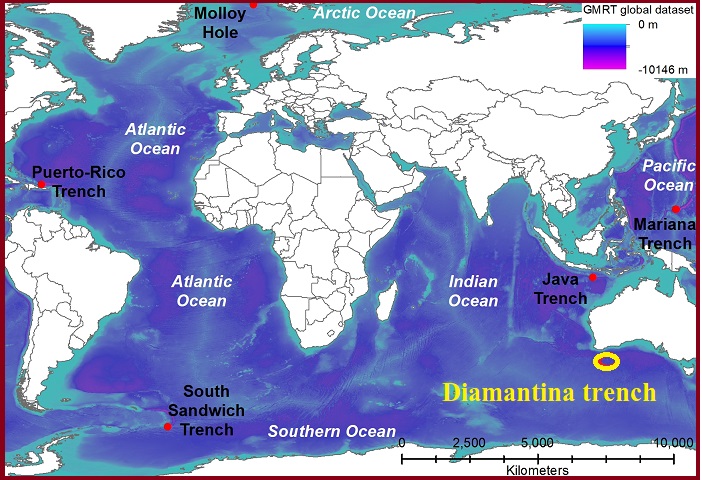
Diamantina Trench
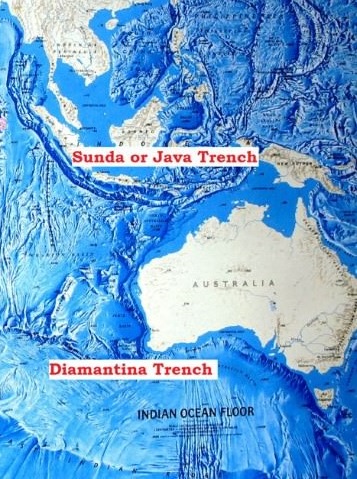
The Diamantina Trench is one of the deepest points in the Indian Ocean, with a maximum depth of about 8,047 meters. The trench is about 520 kilometers long and 70 kilometers wide, and it runs in a northeast-southwest direction. The Diamantina Fracture Zone consists of a range of ridges and trenches. It lies to the south of the mid-eastern Indian Ocean, features of the Wharton Basin, Perth Basin, and to the south-west of the Naturaliste Plateau. The Trench is located approximately 1,500 kilometers west of Perth, Australia, and is named after the Diamantina River in Australia.
The Diamantina Trench was discovered in 1953, and since then, it has been the subject of several scientific studies. The trench is considered to be an important area for marine biodiversity, as it supports a wide range of deep-sea species. In recent years, there has been growing interest in exploring the deep sea, and the Diamantina Trench is one of the areas that has attracted the attention of researchers and explorers. However, the extreme depths of the trench present significant technical challenges for exploration, and very little is known about the ecology and geology of this remote and little-studied region.
Geology and Exploration
Research says that the Diamantina Fracture Zone is not a true fracture zone in the sense used in plate tectonics, but rather an escarpment, separating two oceanic plateaus. Its extension to the west is known as the Diamantina Escarpment. It is also the southern border of the Broken Ridge Plateau. All these features are a mirrored image of the corresponding topography on the other side of the Southeast Indian Ridge.
Also read- The World’s Most Wilderness Coastline- Kimberley, Australia
Diamantina trench is situated in which ocean
The Diamantina Trench is situated in the eastern Indian Ocean, approximately 1,500 kilometers west of Perth, Australia.
Diamantina Trench on the world map
The Diamantina fracture zone is not a well-known oceanic feature, and it does not appear on most world maps. However, it is a deep underwater valley located east of the Cocos Islands and southwest of Indonesia. Diamantina trench indian ocean has a depth of approximately 8,047 meters, making it one of the deepest points in the Indian Ocean. The exact location of the Diamantina fracture zone can be found at approximately 12.2°S latitude and 97.8°E longitude.
How Diamantina Trench forms
The formation of the Diamantina fracture zone is a result of the movement of tectonic plates and the geological processes that occur in the Earth’s crust. The Indian and Australian tectonic plates are converging, and as the Indian Plate moves underneath the Australian Plate, it causes the Earth’s crust to buckle and fold. This process is known as subduction, and it creates a deep trench or valley in the ocean floor. The Diamantina Trench is located at the boundary between these two plates, and its formation is a result of the Indian Plate moving underneath the Australian Plate.
Also Read- Geotourism And Modern Geotechniques
Over millions of years, the movement of these plates has caused the Diamantina Trench to deepen and expand. The extreme depth of the trench is due to the combination of subduction and the accumulation of sediment on the ocean floor. Sediment from the surrounding areas is constantly deposited into the trench, filling it up and making it deeper over time. The extreme pressure and darkness of the deep ocean trenches have created unique and diverse ecosystems that are still being explored and studied by scientists today.