 sutikshan
The Sonorous Stones of Ringing Rock
The “sonorous stones,” or lithophonic rocks, of Pennsylvania are a mysterious geological feature found in Ringing Rocks Park in Upper Black Eddy, Bucks County. When struck, these boulders produce clear, bell-like tones. While the exact geological reason for this resonant quality remains a mystery, the natural “musical” boulders make the park a popular destination for visitors.
Examples of these unique formations can be found globally, including at Ringing Rocks County Park in Pennsylvania, as well as in Telangana, India, and Kiandra, Australia.
The Stony Garden, the largest of Pennsylvania’s three public ringing rock boulder fields, is located on the northwest slope of Haycock Mountain in Bucksville. This site is actually a series of disconnected boulder fields extending nearly half a mile, formed where the olivine diabase rock unit surfaces along the mountain’s base. It is undeveloped and accessible via a hiking trail leading from a PA Game Lands parking area on Stony Garden Road.
The Sonorous Stones of Ringing Rock Parks
Ringing Hill Park, located three miles northeast of Pottstown in Montgomery County, Pennsylvania, was established on a boulder field first identified in 1742. Its modern history began in 1894 when the Ringing Rocks Electric Railway Company bought the remote hill to create an amusement park and provide trolley service, operating until 1932. Walter J. Wolf purchased the park that same year, maintaining it as an amusement park and skating rink until September 1, 1957, when it was sold to the Ringing Hill Fire Company.
Geology of the Ringing Rocks Sound Phenomenon
The ringing rock boulder fields in southeastern Pennsylvania and central New Jersey were formed in two main stages:
Stage 1 (Early Jurassic, 200 Million Years Ago): Mafic magma from the upper mantle was injected into the Newark Basin, forming diabase sills. Olivine and pyroxene phenocrysts settled at the base, creating a distinct, crystal-rich rock layer 10–15 ft thick.
Stage 2 (Pleistocene Epoch): After the crustal uplift exposed this rock layer, it was subjected to intense periglacial (freezing) conditions. These severe freeze-thaw cycles shattered the rock, resulting in the extensive boulder fields we see today.
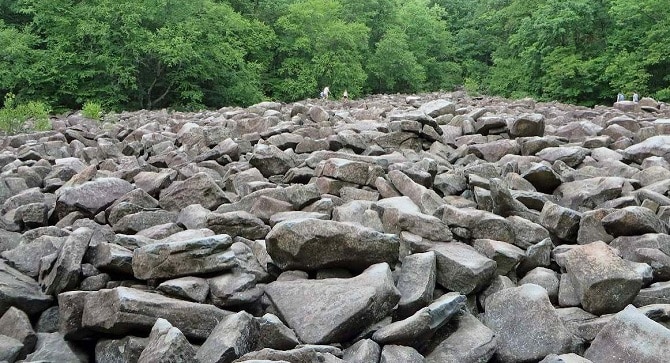
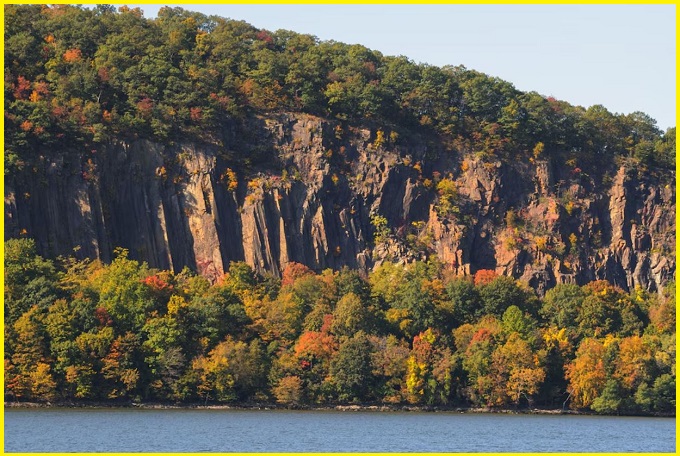
The Olivine diabase unit—the rock that forms the ringing boulder fields—is notably Harder, denser, and more resistant to weathering than the “normal” diabase found in the upper sections of the sills (similar to the Palisades Sill). A common point of confusion is that both rock types are dark grey to black, making microscopic examination often necessary to distinguish the ringing olivine unit from the more common normal diabase.
While the diabase sills stretch throughout the Appalachian Mountains, only the outcrops in a narrow band of southeastern Pennsylvania and New Jersey form a ring of rock fields. This is likely because these areas, located at the southern edge of the Pleistocene glaciers, experienced the extreme periglacial (freezing) conditions necessary to shatter these highly resistant rocks into boulder fields.
Also Read- Diana’s Punchbowl: Geothermal Wonder in USA
Scientific explanation for Sonorous Stones in Pennsylvania
The ringing ability of these boulders is highly controversial. Chemical analysis of the Coffman Hill diabase indicates an iron content (as ferric oxide) ranging between 9% and 12%. This level is often assumed to cause the ringing. However, despite being comparatively high for an average igneous rock, this iron concentration is normal for basalt. Therefore, the iron content is unlikely to be the main contributor to the unique lithophonic properties of the boulders.
However, the most widely accepted theory is that the rocks’ stored internal stress—built up from geological processes like uplift and slow weathering—is released as sound waves when the rocks are struck.
Some other factors that play an important role are: The rocks are often made of dense diabase, which allows sound to travel with minimal energy loss. They are sometimes called “fonolite,” which means “sound rock”.
The arrangement of rocks in the boulder field is also a factor: the “live rocks” that sound when struck are typically located toward the center, where they possess greater internal stress than those on the periphery.
Also Read- Geotourism And Modern Geotechniques
Why are the Sonorous Stones of Ringing Rocks Percussive?
Sonorous stones, known as “lithophones,” are percussive because their dense, homogeneous composition and internal compressive stresses (built up over millions of years) allow them to efficiently transmit sound waves when struck, producing a ringing sound. This phenomenon is often influenced by the stones’ high iron content and their arrangement in the boulder field.
Ringing Rocks Park, Pennsylvania, Directions and hours
Ringing Rocks Park is located at 2060 Ringing Rocks Rd, Upper Black Eddy, PA 18972. Admission is free, and the park is open daily from sunrise to sunset. Directions can be found using the address with GPS.
Best Hammer to use on Sonorous stones
The best tool to use on sonorous stones (lithophones) for demonstrating their ringing quality is typically a simple hammer or a rock pick/geologist’s hammer.
Simple Hammer: A standard claw hammer, brick hammer, or even a small sledgehammer is often sufficient. The key is using a tool with a hard, dense head (metal) to transfer energy efficiently.
Geologist’s Hammer/Rock Pick: This is an ideal tool as it is designed for breaking and splitting rocks, but its flat striking face is also perfect for producing the clearest sound on a ringing rock.