 sutikshan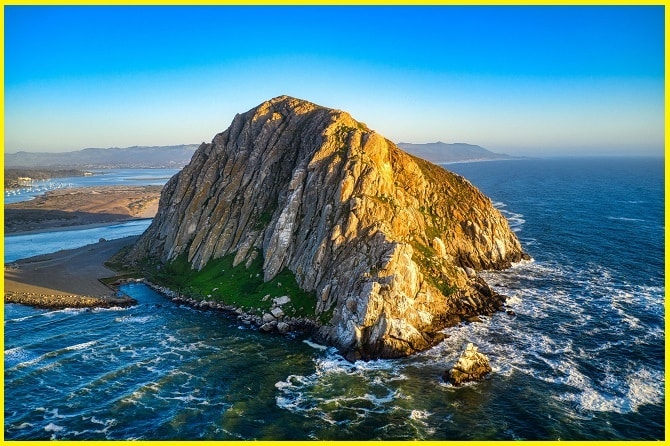
Morro Rock
A prominent volcanic plug on the Pacific Coast, Morro Rock sits at the entrance to Morro Bay harbor in California. Historically known by names including Le’samo and Lisamu’, it is connected to the shore by a causeway, classifying it as a tied island. The site is designated and protected as the Morro Rock State Preserve.
Morro Bay is a large estuary along the bay’s northern shores. This estuary is situated within the broader Estero Bay, which also includes the neighboring communities of Los Osos and Cayucos. The city of Morro Bay lies 20 km northwest of San Luis Obispo on Highway 1, and Los Osos Creek flows into the bay. The city features an all-weather, small-craft, commercial, and recreational harbor.
Geology
The 177 m. Morro Rock is part of a cluster of 13 geological features—including volcanic plugs and lava domes—that stretch across San Luis Obispo County from Morro Bay in the north to Islay Hill in the south.
Composed primarily of dacite, an igneous volcanic rock, the structure’s mineral composition includes a fine-grained groundmass of plagioclase, amphibole (hornblende), biotite, pyroxene (augite), quartz, and glass, alongside larger phenocrysts of plagioclase, resulting in a high silicon dioxide SiO2 content of 63 to 69 percent.
The cluster of dacite and felsitic rhyolite-dacite formations between Morro Rock and Islay Hill—including volcanic plugs, lava domes, and intrusive sheets—form the Morro Rock-Islay Hill Complex. This complex dates back to the Oligocene epoch (27 to 23 million years ago) and is situated east of the San Gregorio-San Simeon-Hosgri fault (SG-SS-H fault).
It is considered one of three likely origins for the volcanic rock fragments (clasts) found in the sandstone and conglomerate of the Pismo Formation (specifically the Miguelito and Edna members) located 145–160 km away in the Point Sur area, which lies west of the SG-SS-H fault. Furthermore, paleomagnetic data suggest the entire Morro Rock-Islay Hill Complex was rotated 40 to 50 degrees during the late Miocene or early Pliocene.
Also Read- Begg Rock: A Natural Wonder off California’s Coast
Morro Rock Beach
Morro Rock Beach is the scenic shoreline encircling the iconic 581-foot volcanic plug in Morro Bay, California. The site, which is part of the “Nine Sisters” chain, is a major attraction known for its natural beauty, relaxed coastal vibe, wildlife viewing, and activities like tide pooling and hiking at Morro Strand State Beach.
Morro Rock Sunset
A designated bird sanctuary and 576-foot volcanic plug, Morro Rock in Morro Bay, California, offers a dramatic setting for sunsets, frequently illuminating the Pacific Ocean with vibrant reflections of orange, pink, and red from the sky.

Settle onto the sand at Morro Rock Beach or Morro Strand State Beach for an expansive view of the sun setting over the ocean, with Morro Rock in the foreground. Firepits are often available for a cozy experience. Walk along the waterfront street, stopping at different piers or parks like Tidelands Park, to get varied perspectives of the sunset over the water and the rock. Many waterfront restaurants in the area also offer dinner with a view.
How was Morro Rock Formed?
About 23 million years ago, Morro Rock formed as a volcanic plug—the resistant, hardened core of an ancient volcano composed of tough dacite rock that cooled slowly beneath the surface. Eons of erosion by wind and sea removed the surrounding softer rock and lava, revealing the igneous core as the iconic monolith.
Magma Intrusion: Magma pushed up from beneath the Earth’s surface, filling the conduit (vent) of a volcano. Slow Cooling: This magma, rich in silica and forming dacite, cooled very slowly deep within the vent, creating a dense, hard rock.
Erosion: Millions of years of wind, waves, and weathering stripped away the softer, less resistant outer layers of the original volcano and surrounding land. Exposure: The harder, more durable dacite plug remained, standing as a prominent feature against the softer landscape.
Can you climb Morro Rock?
Climbing Morro Rock in Morro Bay, California, is strictly prohibited and illegal, primarily because the rock is a sacred site for local Native Americans (Chumash/Salinan) and a designated preserve for the endangered peregrine falcon. Violators face fines, potential arrest, and dangerous rescue operations; however, visitors are permitted to walk around its base, and the similar-sounding Moro Rock in Sequoia National Park can be legally climbed using a staircase.
Read- Geotourism And Modern Geotechniques
Is Morro Rock a volcano
Yes, Morro Rock is a volcanic plug, the remnant of an extinct volcano, formed about 23 million years ago as part of a chain of volcanic peaks. Magma rose through softer rock, solidified, and the softer material eroded, leaving the hard, plug-like structure of the rock visible today.
How To Reach Morro Rock
To visit Morro Rock in Morro Bay, California, drive along Embarcadero Road; you can view the rock from the beach, explore the surrounding area (like Morro Rock Beach), and observe wildlife such as otters and falcons, but remember that climbing the rock is prohibited by law. To visit the similar-sounding Moro Rock in Sequoia National Park, you would drive the Generals Highway to Moro Rock Road and climb its iconic 350-step staircase for panoramic views.